13 march 2026, Yves Joris
Billie J. Kanter & Faryda Moumouh at Shoobil: How many leaves does basil have?
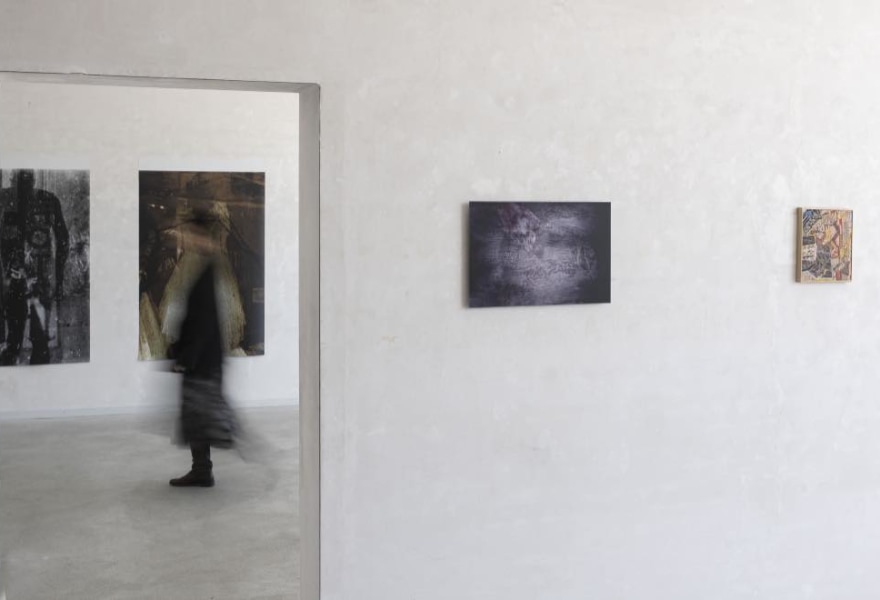
No one knows how many leaves a basil plant has
There is a basil plant on my kitchen counter. Not as a still life or as a statement, but because someone once brought it along after a dinner and it has been there ever since. During the day, it catches the sparse winter light and in the evening, it seems to forget itself. Sometimes, I pluck a leaf, sometimes I forget to water it, and yet it keeps growing with a stubbornness I recognise only from human stories.
When I read the title of the exhibition at Shoobil — How many leaves does basil have? — I thought it was a joke at first. A light, homey title, almost offhand, as if someone had scribbled it down between two shopping lists. But the longer I thought about it, the less light it became. Because it is a question that cannot be answered without undermining itself.
There are questions that look like questions, but are in fact something else. Like a snare or an opening, an invitation to get lost. The plant grows while you count. Leaves emerge, wither, are plucked and return. No number exists. Or more precisely, the number never exists twice in the same way.
That is also the philosophical core of the exhibition that brings together Billie J. Kanter and Faryda Moumouh in the gallery space at Shoobil. Counting as an illusion of control. Cataloguing as a comfort that never quite works. The basil plant here is not merely a botanical entity, but a methodological manifesto: a surface that is never finished, built from units that multiply and withdraw from any definitive inventory. Stories work like this. Images work like this. Memories even more so.
Kanter and Moumouh work from very different points of departure. One body of work is rooted in the logic of painting, the other in the wound of the photographic image. Yet their practices converge in a shared obsession: the material condition of the uncountable.

Billie J Kanter, The whale vomited out Jonah upon the dry land, 2025, Shoobil
When a whale spits you out
Kanter's works bear titles that stir the imagination. I limit myself here to The whale vomited out Jonah upon the dry land (2025), a quotation that carries its weight like a stone in your pocket. Everyone knows the biblical story or thinks they do: Jonah, the prophet who is swallowed, survives the impossible and is eventually cast back out onto dry land.
Kanter does not use this story as subject, but as structure — one of the many narrative architectures she dismantles and recomposes in the studio, where fragments of images accumulate in cycles of rearrangement and quiet revision. Notebooks, chronicles, dogmas and pamphlets do not appear as sacred objects, but as raw materials that can be unravelled and woven into new constellations.
On the surface, her work behaves like grammar. The fragments do not function as illustrations, but as sentences. Patterns contradict one another, colours correct each other, lines interrupt what they themselves have initiated. An arm becomes ornament, a face becomes pattern, a surface becomes skin. The body here is not a stable form, but a temporary image that keeps starting without ever ending.
What ultimately remains is a work that presents itself with the internal coherence of a painting, yet is created from meticulously assembled layers whose origins have almost entirely been erased. The whale has disappeared. Jonah has disappeared. What remains is the structure of the spitting-out itself: the moment when something long held inside is thrown back into the outside world: altered, stained, alive.
Strange as it may sound, there is something consoling in that image. The story of Jonah is not a story about destruction, but about enduring something far greater than ourselves and eventually being released from it. Not unscathed perhaps, but intact. Kanter's method does something similar with her source material. The story disappears into her artistic practice as Jonah disappeared into the whale and is expelled as something else: a surface full of undercurrents that can no longer be named, but are very much present.
Perhaps that is also the sharper edge of the exhibition title. How many leaves does basil have? How many forms can a body take? How many layers can an image bear before it dissolves into itself? As with basil, the moment you start counting, everything changes.

Faryda Moumouh, Scars somewhere, 2025, Shoobil
Scars in an unknown place
Where Kanter accumulates, Faryda Moumouh reduces. At first, her work seems quieter, more austere, almost documentary. But that silence is misleading. What she shows are not objects but traces.
Scars somewhere (2025): the title says it with the precision of someone who knows that exact coordinates do not exist. Scars somewhere. Not here, not there, but somewhere indeterminate. On the body, in the landscape, in the city, in the memory of the city.
Moumouh combines digital manipulation with manual intervention: acrylic, ink, tracing paper. As if she wants to redefine the photographic image, modify it and enclose it within something that is more than reproduction. She constructs layered image fields in which observed reality, remembered space and inner projection merge into mental topographies where identity and geography do not settle, but shift.
The scars in her work are not decorative; they are archaeological. Moumouh treats her images as excavation sites: you can see that something once existed, you can trace the contours, but a full reconstruction is not possible. That is not failure; it is the condition. Her images refuse to be read as documents. They do not show what was, but how what was withdraws. Like a scent that lingers after the plant is gone.
Her work has a sensitivity that could be described as an attention to the invisible frame, the foundation that carries a story rather than the story itself. And in the tension between the photographic surface and the handmade intervention resides what her work refuses to relinquish — the experience of people who were elsewhere and are here, or who were here and have ended up somewhere else. Her landscapes are not places you can visit. They are places you carry within you, places that slowly begin to change you.
The grammar beneath the surface
There is a risk in exhibitions that bring two artists together: the risk of false symbiosis, where curatorial logic suggests more coherence than the works themselves produce. That risk is absent here — but not because Kanter and Moumouh mirror each other. Quite the opposite. Kanter's abundance might become decorative without Moumouh's reduction; Moumouh's silence might become too closed without Kanter's tension.
They work from fundamentally different materials and points of departure and what connects them is subtler and therefore more genuine: a shared refusal to treat source material as authority.

Faryda Moumouh, Scars somewhere, 2025, Shoobil
Neither artist plunders. They dismantle. There is a significant difference. Plundering implies taking something and placing it elsewhere. Dismantling implies taking something apart to understand how it works and then reassembling it in a way that transforms its components. Texts and photographic images function in their hands as cultural sediment, materials whose usefulness reveals itself precisely when it is displaced.
The contemporary art world has developed a peculiar fascination with counting: numbers of exhibitions, visitors, sales, followers. The oeuvre becomes a spreadsheet; the career a graph. But as with basil, the more precise the counting, the clearer its impossibility becomes.
What remains with me after this exhibition is not a single image, but a condition. A slight disorientation. A feeling that looking itself changes while you are looking.
How many leaves does basil have? is not a question about basil. It is a question about the impossibility of the definitive — and about the beauty that resides precisely in that impossibility. Kanter and Moumouh offer no answer. They build a space in which the question can live longer than it could outside.
They whisper, both of them. And precisely because of that they become subversive in an art world that often speaks too loudly.
Meanwhile, the plant on my kitchen counter keeps growing. I have yet to count the leaves.
