23 october 2026, Flor Linckens
A still life on both sides of the camera: Chiara Bettazzi in Spazio Nuovo
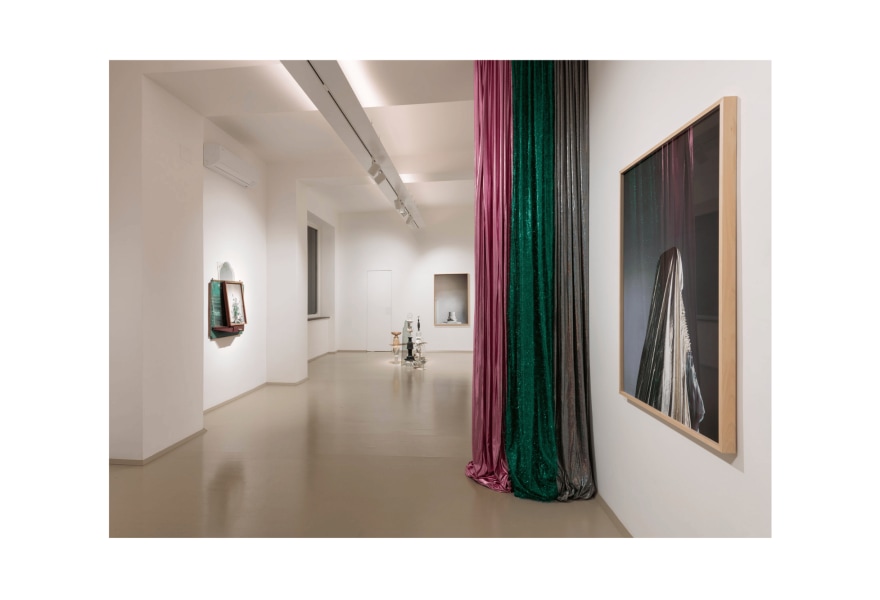
Until 18 November, Spazio Nuovo in Rome is presenting ‘Fuori Quadro’, an exhibition by Chiara Bettazzi. The show explores the boundaries of the photographic image and the interplay between photography and installation art. Literally translated as ‘Outside the Frame’, the title of the show reflects a central idea within the exhibition: the shifting relationship between the photographic image and physical reality. Some of the objects that are depicted in Bettazzi's photographs also have a physical presence in the gallery, allowing them to exist in different spaces, forms and at different moments in time. Furthermore, Bettazzi is interested in how everyday objects can acquire different meanings when they are removed from their familiar contexts. Her multidisciplinary practice encompasses photography, installation, video and site-specific projects.
The artist's studio is filled with found objects: everyday items such as vases, bottles, ceramics and artificial flowers, as well as old photographs, glass, discarded materials, furniture fragments and charred remains. Bettazzi is intrigued by our relationship with consumption, the carelessness with which we discard objects and the almost compulsive urge to accumulate new things. Rather than focusing on the original purpose of her found objects, Bettazzi is drawn to their artistic potential: their shapes, colours, textures and the relationships between them. An object will also never be entirely defined by the meaning we assign to it. Bettazzi sources her materials from a wide range of places, from flea markets to abandoned factories and former industrial sites. What others dismiss as rubbish can provide the spark for an entirely new composition. In 2005, Bettazzi established her studio SC17 in a former textile factory in Prato. Ten years later, she founded Tuscan Art Industry, an initiative dedicated to preserving and repurposing Tuscany's industrial heritage. She regularly collaborates with fellow artists, architectural historians, environmental biologists and specialists from other disciplines.

Bettazzi transforms her found objects into mysterious, three-dimensional and occasionally surreal installations, always looking for exciting tensions between different materials, the spaces in between, transparency and reflection and the way that light falls on these surfaces. Within such a sculptural setting, a vase is no longer simply a functional object but becomes an abstract form, part of a larger composition. These still lifes are often temporary: they are assembled, photographed and subsequently dismantled, only for some of their elements to reappear in entirely new arrangements.
Benedetta Casini, curator of the exhibition, says: “The objects definitively move ‘beyond the frame’, in a temporal and spatial doubling: they exist simultaneously in the past and the present, on either side of the frame, as reality and as representation.”
Initially, Bettazzi used photography primarily to document her installations and follow the process of their creation. Over time, however, the medium assumed an increasingly important and independent role within her practice. Photography becomes a kind of witness, capturing a moment that no longer exists in its original form and allowing it to endure in another.

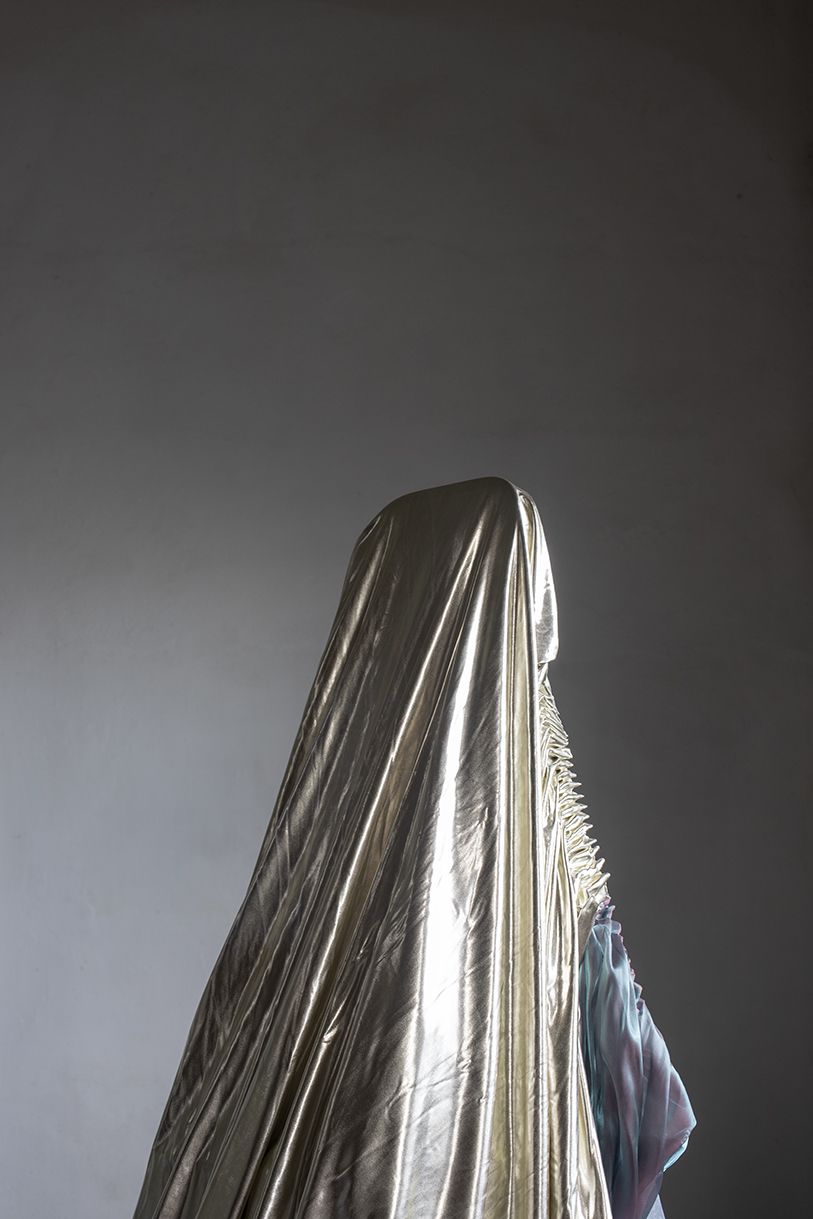
In ‘Fuori Quadro’, Bettazzi plays with this very notion. Some of the objects depicted in her photographs also appear in the exhibition space, but in slightly different arrangements that alter the relationships between them. These physical elements reveal something else as well: the artist's hand. In the photographs, the draped fabrics take on an almost human quality through the way they are arranged and illuminated, evoking the visual language of religious painting. In the gallery, this theatrical illusion disappears, revealing the material itself: three lengths of fabric, suspended from the ceiling like curtains.
Bettazzi's work also draws on the long art-historical tradition of the still life. For centuries, artists have used everyday objects to reflect on transience, ownership and the significance of material possessions. Through her still lifes, Bettazzi seeks to establish a connection between the world depicted in the image and the physical space beyond it.
Chiara Bettazzi was born in Prato in 1977, where she continues to live and work. After attending the Liceo Artistico Leon Battista Alberti in Florence, she studied arts, music and performing arts (Discipline delle Arti, della Musica e dello Spettacolo) in Bologna. Bettazzi previously exhibited her work at the Galleria Nazionale d'Arte Moderna e Contemporanea in Rome, the Fondazione Querini Stampalia in Venice, the Centro per l'Arte Contemporanea Luigi Pecci in Prato and the Museo di Santa Maria della Scala in Siena. Her work is held in the collections of the Galleria Nazionale d'Arte Moderna e Contemporanea in Rome, Casa Masaccio Centro per l'Arte Contemporanea, the Collezione Farnesina, Castello di Ama and the Museo di Santa Maria della Scala in Siena.
