25 september 2026, Wouter van den Eijkel
Alex de Vries: Seeing What You Don’t Know
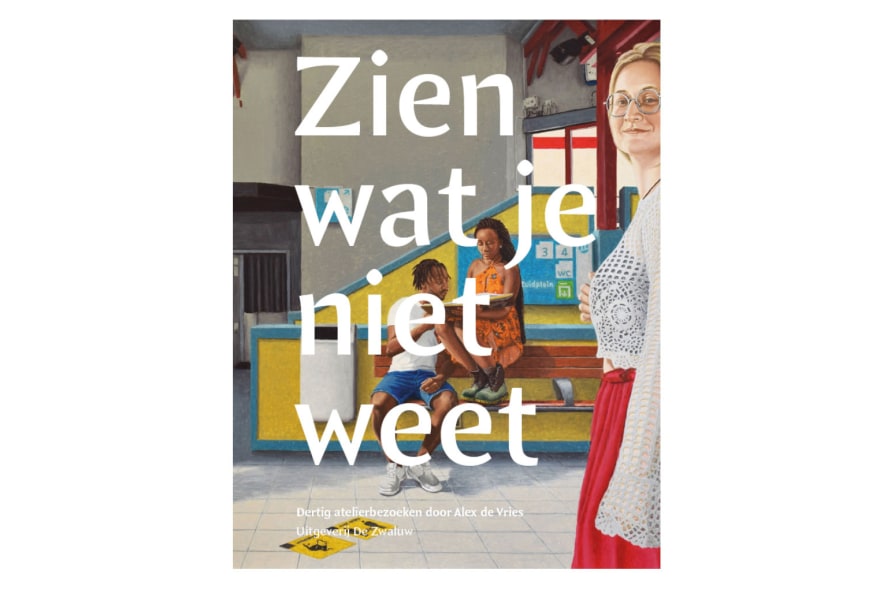
Since 2015, Alex de Vries has been interviewing artists in their studios. He has visited more than 200 artists in the Netherlands and occasionally abroad. Thirty of those conversations have now been brought together under the title Seeing What You Don’t Know.
We talked to Alex de Vries about Seeing What You Don’t Know, his approach and his view of the role of artists in society. ‘An artist is just a regular person. They also have to take their kids to school, bring their car to the garage and go grocery shopping.’
Seeing What You Don’t Know is published by Uitgeverij De Zwaluw. The book will be launched on 2 October at project space BMB in Amsterdam alongside Lisa Couwenbergh’s solo exhibition.
A trained eye should be able to recognise a piece by Alex de Vries (Erica, 1957) without having to read his name at the top. While another writer might ask about the height of the ceilings, quality of lighting and provide an extensive description of the work, De Vries will, by the second or third paragraph, almost invariably have turned to the artist’s family and childhood.
‘An article like this has become a system for me. The question I’m actually asking is: at what point did visual art become the means to achieve your dream? Often, that has to do with where you grew up.’ Broadly speaking, De Vries explains, there are two types of artists. ‘Either they had to fight for it and went to art school against their parents’ wishes or they were strongly encouraged by their parents because they had always had that desire personally, but never did anything with it, so their child has to pursue that dream.’
De Vries’ own interest in contemporary art was sparked on starting the fifth year of secondary school and making friends who were interested in art and culture. ‘I had friends who were writers. There was a school newspaper, but that didn’t interest me much. One of my friends came up with the idea to create our own magazine and that led me to visual poetry, which combines language, image and sound. I went to an evening at the Poëziehuis with the artist Robert Joseph and heard Body Music (1973) by Marten Hendriks, who had punched the contours of his body into a pianola roll. I was deeply moved by it. It was also very intriguing musically.’
Not long afterwards, De Vries decided to study art history. ‘I wanted to study Dutch, but the focus was highly linguistic and the curriculum also included statistics, which I wasn’t interested in, so I decided to study art history without really knowing what that involved.’
During his studies, which he abandoned prematurely, De Vries founded the art magazine Metropolis M in 1979 with Arjen Kok and Rob Smolders. In the 1980s, he worked at Shaffy Theatre, followed by positions at the University of the Arts Arnhem and later as director of the Academy of Art and Design in ’s-Hertogenbosch. Since 2004, he has written for Mister Motley and has also published several books, including a biography of Marten Hendriks (2018) and Knowing What You See (2022).
Unlike its successful predecessor, Knowing What You See, Seeing What You Don’t Know was compiled by De Vries personally, together with his colleague Jan Willem den Hartog. He selected conversations that demonstrate the diversity of artistic practice. Interestingly, around two-thirds of the artists in the book are women – more on that later – and many of those interviewed were born in the 1960s.
‘When I began doing this work almost 50 years ago, the artists I interviewed were generally fifteen years older than me and already had an established practice. Later, they were people ten to fifteen years younger than me. Through the editorial team at Mister Motley, I also come across younger artists. I’m particularly interested in artists with around thirty years of experience, whose practice has evolved and who have become seasoned artists.’
De Vries describes that process of being ‘seasoned’ primarily in social terms. ‘How do you actually earn your money? That’s a question I’m interested in. Many artists cannot make a living from their work alone, but do all sorts of things alongside their art: teaching, consultancy, courses. Some work as plasterers and there are even a few taxi drivers.’
Just a regular person
De Vries’ social approach runs counter to the Romantic ideas about artistic life that are still widespread. To De Vries, artists are not wounded souls searching for the sublime on the margins of society, but flesh-and-blood people with children, bills to pay and the need to replace the washing machine when it breaks down.
‘That idea of being an outsider is something I challenge. An artist is just a regular person. They also have to take their kids to school, bring their car to the garage and go grocery shopping. You have to do everything everyone else does, only you make your living by making art and alongside that have to follow different alternative paths, which in turn provide inspiration for your art.’
In the 1990s, De Vries found his inspiration with the artist Servaas, known for his Int. Fish-handel SERVAAS. Servaas (full name: Servaas Schoone, 1950–2001) taught in the Fine Art Department at the academy in Arnhem, where De Vries was head of communications in the 1990s. ‘Servaas noticed that students in the applied arts department did internships in their third year, but art students did not. So, he started the Business Art Internship Scheme, the BAS plan, and had students gain social experience related to their work. Dieuwke Spaans, for example, whose work focuses heavily on life and death, did an internship with a funeral director. She turned out to be very good at it. Someone whose work deals with consumer society did an internship at McDonald’s. Students got a lot out of it.’
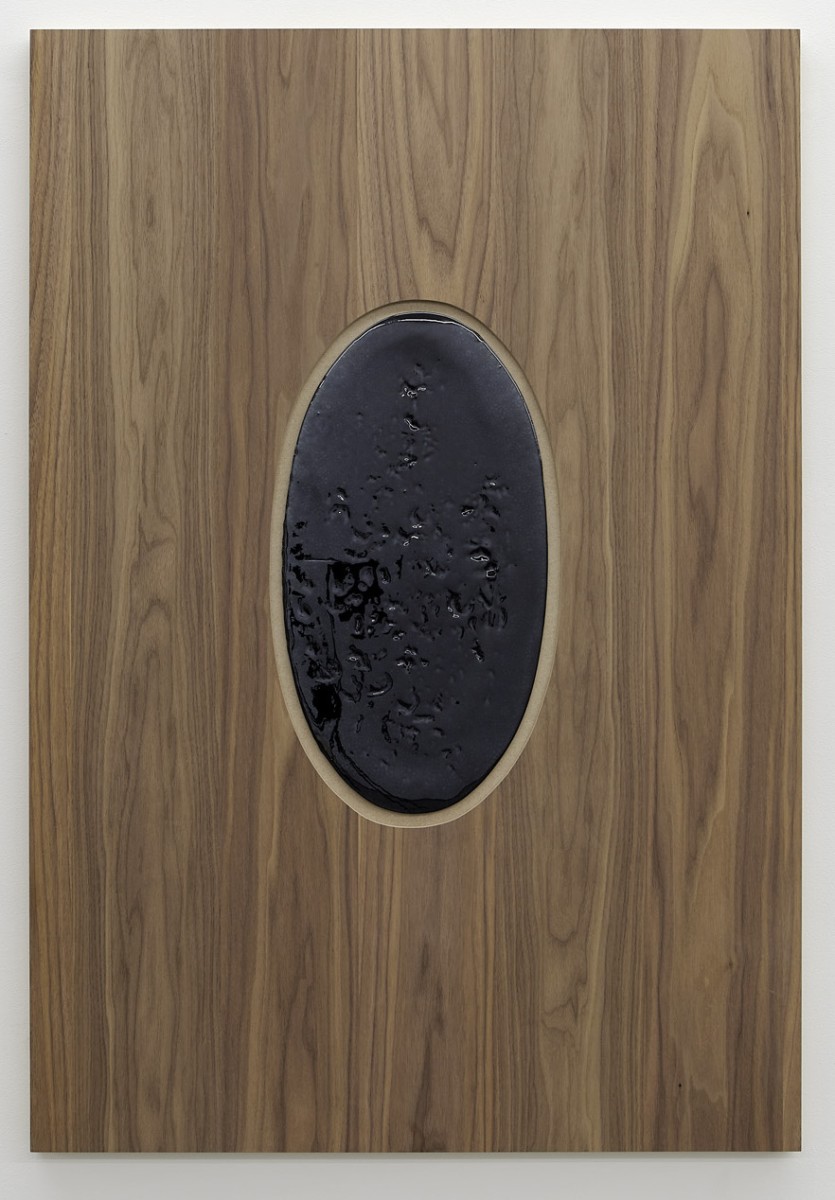 Dieuwke Spaans, Portal 6, tegenboschvanvreden
 De Vries explains the fact that the majority of interviews included in the book are with female artists by saying that more women than men approach him for studio visits. ‘I actually have to ask men and they often enjoy it and find it very valuable, but it is mainly women who approach me for a studio visit.’
De Vries also points to another trend: more women are starting to work as artists after graduating. ‘Thirty years ago, there were also lots of women at the academies, but that didn’t translate into a career afterwards. It was mainly male artists who got exhibitions and whose work was acquired. Those proportions have changed now and most artists are women. The museum workforce is also 70 per cent female.’
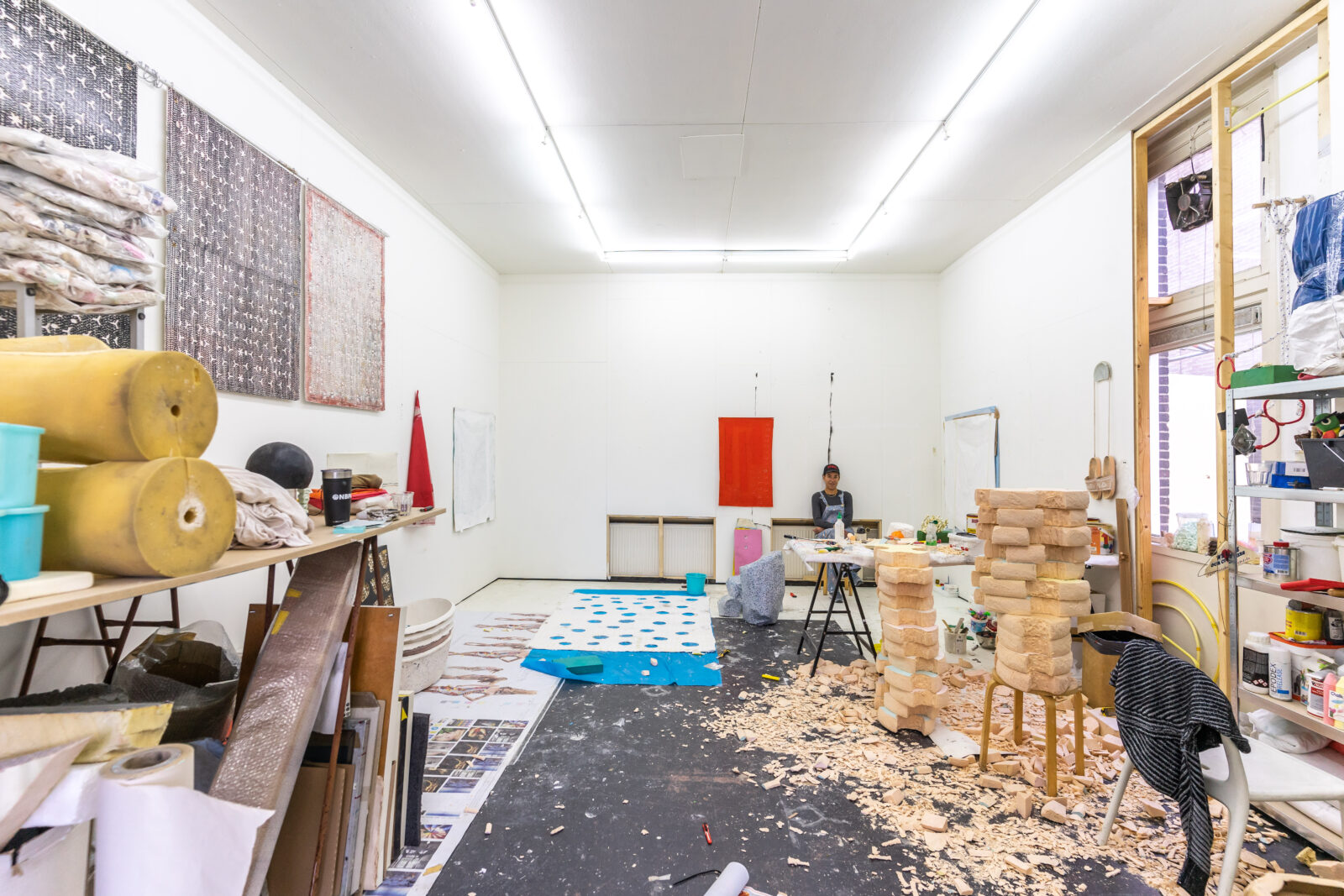 Alexandra Phillips in her studio. Photo: Steven Maybury 2024
The added value of a studio visit
Every month, De Vries visits one or two studios. They are often found in the usual places: former school buildings, factories, squats or back gardens. Once there, De Vries gets down to business fairly quickly, he says.
To De Vries, the added value of a studio visit lies in the insight it offers into an artist’s practice. ‘In a gallery or museum, you see something that has been neutralised. In a studio, you see work in its purest form, as it comes into being. You see sketches, failures, a row of paintings standing with their backs to you, an inspiration wall, books on the bookcase.’ All of this can contribute to a better understanding of the work itself. ‘You always discover something about the background to the work or an artist’s motivation.’
Sometimes, it takes a while to realise the significance of what you are seeing. In 2011, for example, De Vries interviewed Eindhoven-based artist Vincent Dams, who was 29 at the time. De Vries did not know Dams. In the studio, he saw a bookcase filled with the entire canon of world literature. ‘At first, I thought it was a gimmick, but it turned out he had read everything. You could see that in his work, too; it was steeped in that reading experience.’
