21 may 2026, Martine Bontjes
The studio of... Atousa Bandeh Ghiasabadi
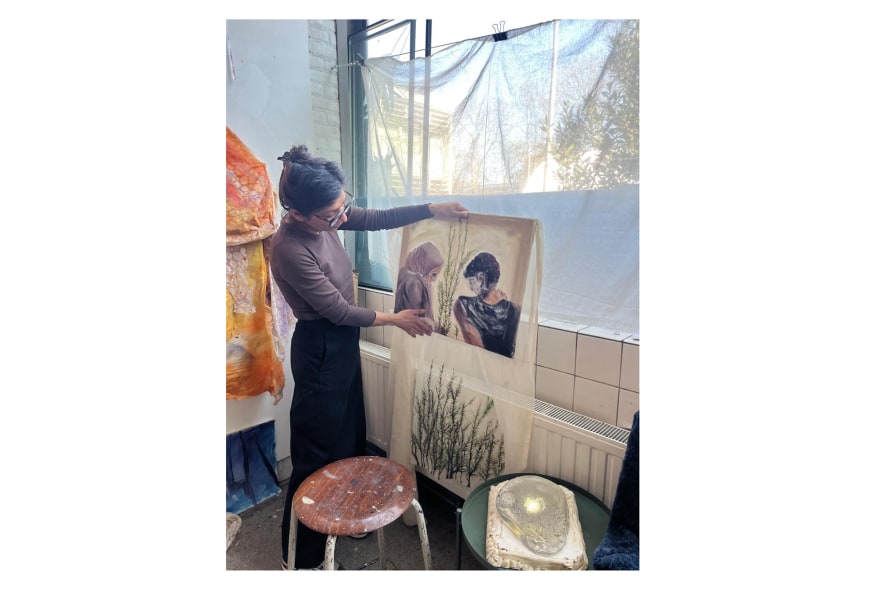
From her studio in Amsterdam West, Atousa Bandeh Ghiasabadi overlooks a nearby centre for young asylum seekers. Every day she sees young people waiting on picnic benches, their eyes fixed on their phones or on the sky. That view became the starting point for her new paintings and installations. In the exhibition 'The Boy with Blue T-shirt' at Lumen Travo Gallery the Iranian artist explores how perception is coloured by our own gaze and projection: "Not who they are, but what I see in them and what they reveal without realising it themselves." Her paintings are wrapped in textiles, a poetic metaphor for the lens through which she observes the world. They reflect the dual reality of immigrants: finding stability and peace in one place, while remaining deeply connected to a homeland shaped by tension and instability.
Attention to exchange and encounters shapes not only her work but also her studio practice. "A studio must be alive," Bandeh Ghiasabadi explains. She regularly invites other artists for shared dinners, conversations and film screenings. Alongside silence and concentration, her studio must above all be a place where ideas can develop through contact with others.
The exhibition 'The Boy with Blue T-shirt' remains on view at Lumen Travo Gallery in Amsterdam until 30 May.
What do you like most about your studio in Amsterdam-West?
My studio is inside creative incubator Bouw, a former technical college where the space still breathes the atmosphere of a different time. High ceilings, large windows overlooking a shared courtyard. I've been here for several years and also serve on the board. It's a place where things come into being that aren't predetermined.
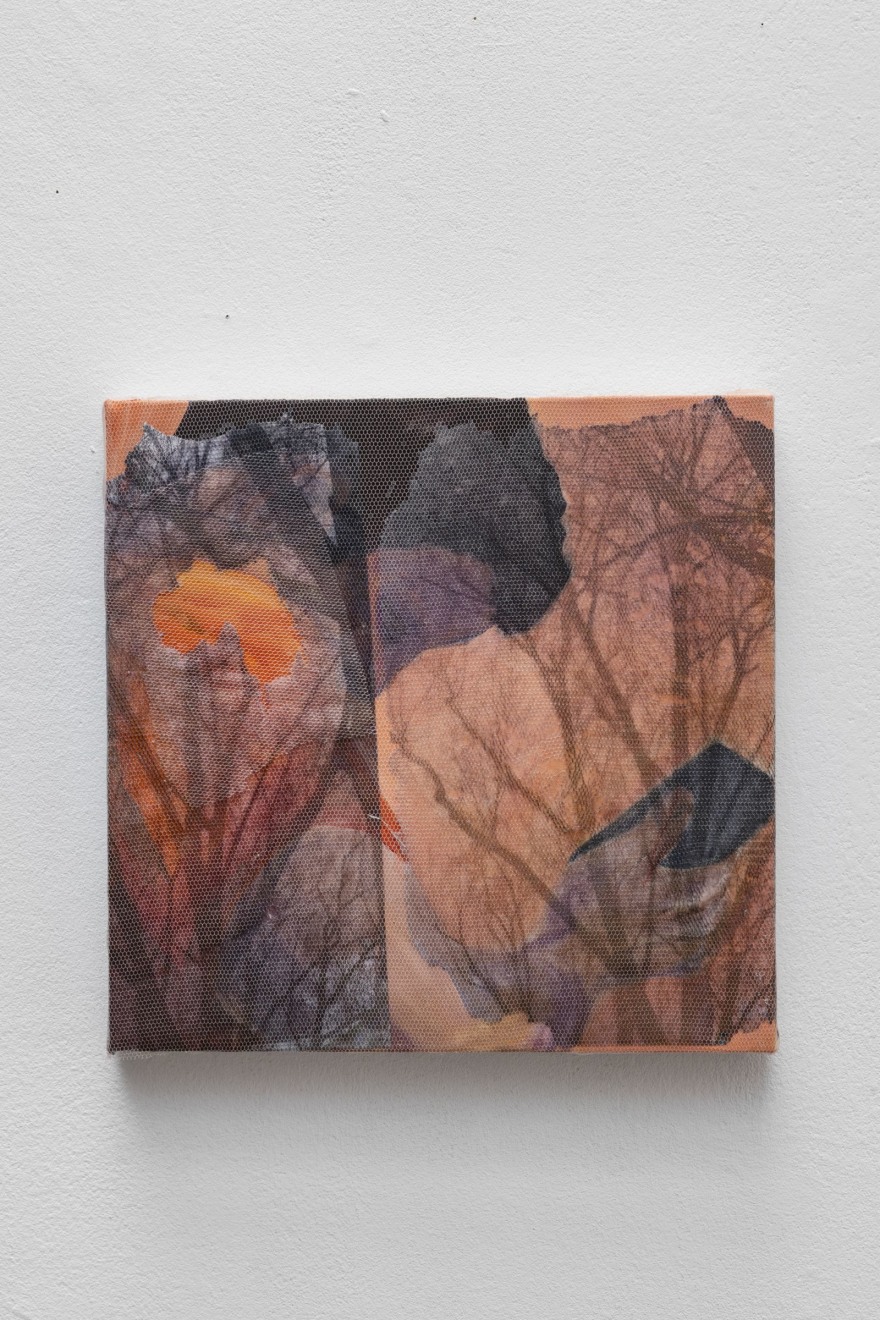
Atousa Bandeh Ghiasabadi, Boy with the Orange t-shirt, 2026, Lumen Travo Galerie
How many days a week do you go to your studio? Do you have particular routines? Do you receive visitors there or does your studio remain private?
I'm here every day, but the ritual varies. In the initial phase of a project, thinking dominates: research, sketching, paper, silence. Once the idea takes shape and the execution begins, the day changes. The studio becomes a machine of making, with its own laws. But it's also a place for encounters. Studio space is scarce in Amsterdam, so I try to get the most out of mine. I invite artists, organize dinner parties, film screenings, and discuss work. Alongside my moments of solitude, it must be a space for collectivity, exchange, and development. A studio must be alive.
When you moved from Iran to the Netherlands you continued your studies in physics and astronomy. Does that way of thinking about scale, time and distance still shape your work or have you distanced yourself from it?
When I moved from Iran to the Netherlands, I first studied physics and astronomy. It's tempting to see this as the explanation for my fascination with scale, time, and distance – but I would formulate it differently. That scientific way of thinking hasn't disappeared. Rather, I discovered what it lacked: intuition, emotion, spirituality. Those were the counterparts that interested me in art. Not a physicist who lost her way, but someone consciously exploring a different kind of precision.
As an immigrant you move between different worlds. What does it mean to navigate between multiple realities and identities?
Despite the many years here, I've never broken my connection with Iran. I travel back at least once a year, but in my work, a different identity is central: that of an immigrant. Not specifically Iranian, not specifically Dutch. It's a curved identity – someone who moves through reality with a double gaze. Part of me lives in a peaceful society, but inside I'm connected to a country where tension and instability are never far away. You can't see it from the outside. The question is: how much of me do you truly see?

Atousa Bandeh Ghiasabadi, Girl in Pink Sweater, 2026, Lumen Travo Galerie
Do you find it difficult to experience that reality from a distance at times?
Of course, I often experience the reality in Iran from a distance and filtered. But isn't that always the case? War and the propaganda war have taught me how each of us is trapped in our own literal and figurative algorithm of prejudices, culture, habits and news sources. The question isn't whether we filter, but whether we are aware of our filters. It's precisely the anonymity of something or someone that stimulates the imagination. It gives space to recognize yourself in it, without judging too quickly.
You work with different materials and techniques. How do you decide which medium can carry an image in the best way?
The question of my medium is not a technical one for me, but a conceptual one. Often, it's the idea that demands a certain material. My research is about the layers of observation: from which standpoint do we see something – physical, emotional, mental? What we see is always a collage of layers. This can be the encounter between two materials, or between image and material. Depending on the idea, I choose whether it becomes a moving image, a painting, or an object. The form doesn't follow from habit, but from the necessity of meaning.

Atousa Bandeh Ghiasabadi, Two Boys, 2026, Lumen Travo Galerie
For your new exhibition 'The Boy with Blue T-shirt' you started with observations from your studio window in Amsterdam. What did you see from your window?
This fascination with looking has taken a particular turn in recent years. From my studio window, I look out at a building that was converted into a reception center for newcomers five years ago. A studio window is a frame that isolates the view and gives you the option to look, to observe – almost what a painting tries to do. From that window, I observe them without knowing their names, their stories, or their traumas. It's not about who they are. It's about what I see. The anonymity of the figures allows me to create characters that may have nothing to do with the reality of the observed, but everything to do with my background, my projections, my own history of migration.
What ideas or stories do you project onto them?
On the picnic benches in the courtyard sit young asylum seekers, often under eighteen, waiting for their hearing. They scroll on their phones, hang around, wait. I don't want to tell a universal story about migration and displacement, although that is inevitably present. What drives me is more precise: the posture of a body. You can learn a lot about a person's state of mind from their posture. Not who they are, but what they reveal without knowing it.
This approach is not a form of voyeurism, but a conscious exercise in perception. There is no pure or unmediated seeing. Seeing is always conditioned by state – hāl – and state is formed by experience. Every experience adds a new layer to things. These layers are not obstacles to be removed; they are inevitable. But becoming aware of those layers – that is seeing more clearly. The real veil is not the layer itself, but confusing the layer with the thing itself.
To rethink perception, a few steps are useful: acknowledge extreme subjectivity; acknowledge tunnel vision; name the veils – prejudices, habits, automatisms; and redefine perception not as passive registration, but as an active, interpretative act. Practical methods follow from this. Slowing down the speed of perception breaks automatic filtering. Freezing a moment creates space for awareness. Staring at the sky provides a non-utilitarian foundation. Observing a sunset reveals the repetitive as always new.
Who is the woman in the red shirt? Why did you make her almost invisible?
In the composition, she appears almost invisible. That is deliberate. It's not a direct reference to the women's rights protests in Iran, although that association is obvious. I would rather emphasize something else: anonymity is not emptiness, but space.

Atousa Bandeh Ghiasabadi, Woman in Red Shirt, 2026, Lumen Travo Galerie
Why did you choose to wrap your works in textile?
My paintings are wrapped in textile, as if they need a skin to protect themselves – it specifically deals with this tension. As I look through my studio window at the courtyard, observe the sky, and see the young asylum seekers waiting, I keep coming back to one thing. When I look at them, I'm not sure what I'm supposed to see. Do I see their waiting? Their boredom? Their fear? Or do I just see what I want to see – something softer, simpler, less broken? For years I have photographed the sky at sunset. The gradation of colour is different every day. The large installation Thousand Sunsets is composed of modules, each one capturing a sunset colour preserved behind a curtain, frozen in time forever.
What are you working on at the moment?
This project could continue for a long time. The material still holds much to be discovered. Alongside there are several video and film projects that I would like to develop further in the coming time.

Atousa Bandeh Ghiasabadi, A Thousand Sunsets, 2026, Lumen Travo Galerie
