24 march 2026, GalleryViewer
Interview with Artist James Aldridge on his show Miraculous Visions
During the art fair Art Rotterdam, the city of Rotterdam also hosts several exciting exhibitions. One of these is Miraculous Visions at Christian Ouwens Gallery, which presents works by James Aldridge (1971). Aldridge is a British artist who has lived and worked in Sweden for several years, and this environment clearly translates seamlessly into his artistic practice.
He paints vivid and colourful constellations that pulse with elements from the animal kingdom such as beetles, owls, and moths. He renders them in all their diversity and exuberance. In his often nocturnal scenes, characterised by dark, intimate tones and a mysterious, veiled atmosphere, the night comes vividly to life.
An additional dimension appears when the paintings are viewed in darkness. Ultraviolet light reveals subtle details in the brushwork and introduces an almost otherworldly glow. This recalls the methods of biologists who use UV light during night fieldwork to study insects, to detect patterns on plants and animals that remain invisible in daylight, and to observe species that only reveal themselves under specific conditions.
Aldridge draws on seemingly divergent influences. On the one hand, Renaissance landscape painting and nineteenth-century French scenic wallpaper; on the other, a broad range of experimental music genres. His paintings show seductive landscapes in which crows exhale smoke, owls spread their majestic wings, and beetles crawl across fallen leaves. These scenes are bathing in lush flowers, yet tinged with an underlying uneasiness. Throughout the many layers in his work, the symbiotic interconnectedness of nature is apparently felt.
Aldridge has already reached several notable milestones in his career, including an impressive panoramic painting commissioned for Tate Modern. In a short interview with Gallery Viewer, the artist offers insight into the most recent works in his exhibition at Christian Ouwens Gallery. The exhibition runs until Saturday 2 May.

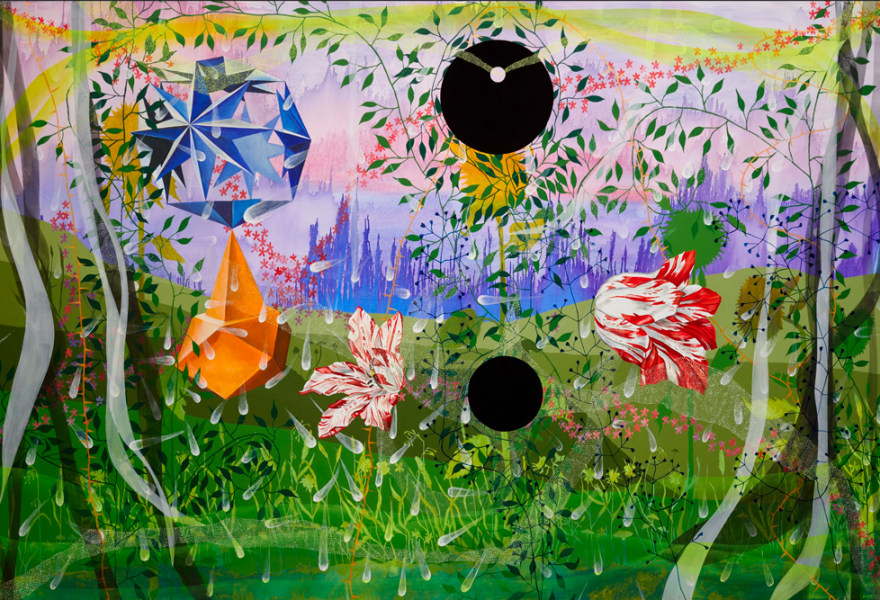
James Aldridge, Eye and Claw, 2023, Christian Ouwens Gallery
How did you develop the visual language of the works in this exhibition?
"I prefer to think of it as something that evolves through process. I am influenced by both looking at art and by representations that I see on a daily basis. This means seeing a contemporary wallpaper print or the graphics on a record cover will have as much importance as looking at a Dutch Still Life or a Renaissance painting. There is no hierarchy. These different visual languages come together in my work and they need to feel surprising. This is a balancing act and a constant shifting.
Each element is placed as a reaction to the previous one so the images build up in an intuitive way. It's like a painting starts having a conversation with itself in my mind. It directs me rather than I direct it. I always listen to music when I work as I find it sets a kind of mood and pace in the studio. I used to listen to a lot of heavy metal but for the last few years that has changed. Now I listen to music depending how I feel, ranging from free jazz, dub reggae to experimental music. For many of the recent works I was listening to a lot of Current 93 and Coil.
I also learnt to draw by copying bird watching field guides as a kid. They were around as my Dad was a keen bird watcher. It instilled knowledge and an interest in nature in me. I consider looking at nature as a way to interpret the world around me which is quite similar to how one can identify aspects of painting when looking at artworks. You decode and reference certain aspects of nature as a way to understand what you are looking at. I'm also interested in how one decodes an image not solely on identifying it, but based on other influences. For instance a magpie which crops up in my work often can be seen as a bad omen, but two can be a good omen. I think these common folkloric references may have a big impact on how we feel about images of nature on a subconscious level."

James Aldridge, Vision, 2026, Christian Ouwens Gallery
Do you see this exhibition as an extension of your existing practice, or do the recent works introduce new styles, approaches or themes?
"I see my practice like a very long conversation that slowly grows so new works are always an extension of my practice. It's like getting more fluent in a language that is constantly growing and becoming richer. Finding a way to break away from something I become too familiar with is really hard, but I know this is where something exciting can happen and the work leaps forward. This happens once in a while and it happened specifically in the works Float and Gate in this show.
Something I used in my work about 30 years ago and has resurfaced recently are phosphorescent mediums. I remember the original idea came from stars kids put on the bedroom ceiling as a way of representing the night sky. It relates to my thoughts about how we represent the world around us. At the same time I also like the idea of the works putting on a show without viewers, when the lights are turned off and no one is present. It really makes me think about how one looks at and where one is positioned as a viewer of artworks."
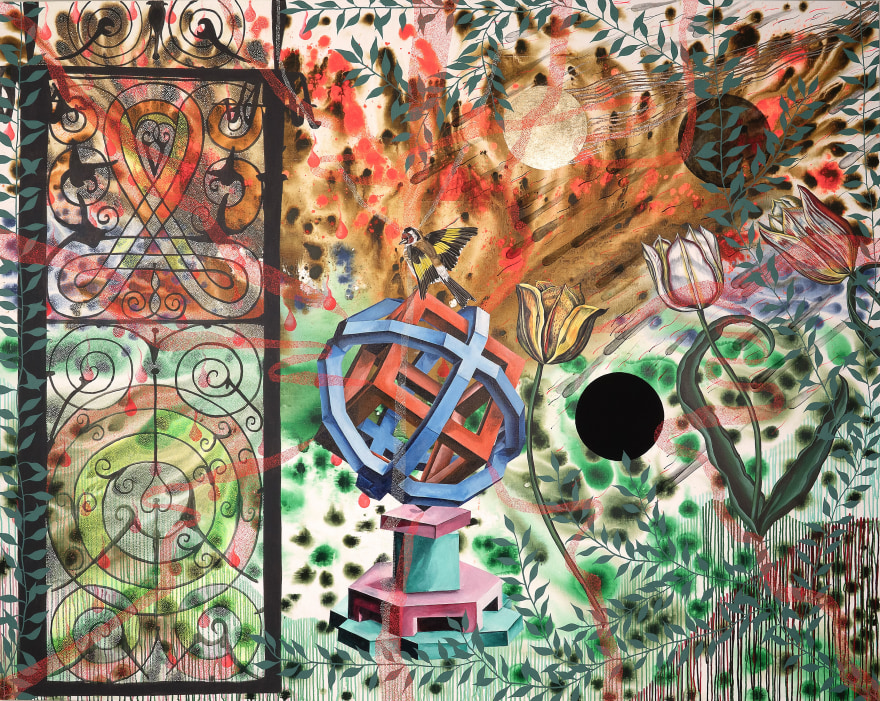
James Aldridge, Gate, 2026, Christian Ouwens Gallery
How does the title Miraculous Visions link to the works you are presenting?
"Miraculous Visions comes from looking at the 16th century manuscript The Book of Miracles while making these works. It's a really fascinating series of images of weather events and meteor storms. Of course, these things were not understood at the time, so the events took on apocalyptic connotations and are embodied as images. I really like to look at things where image making was used as a way of understanding things in the real world where the meanings of things are shaped by other influences such as belief and superstition."
