17 february 2026, Yves Joris
Thinking with your hands: a studio conversation with Luk Van Soom in the run-up to the exhibition À l’ombre des étoiles at Sofie Van den Bussche
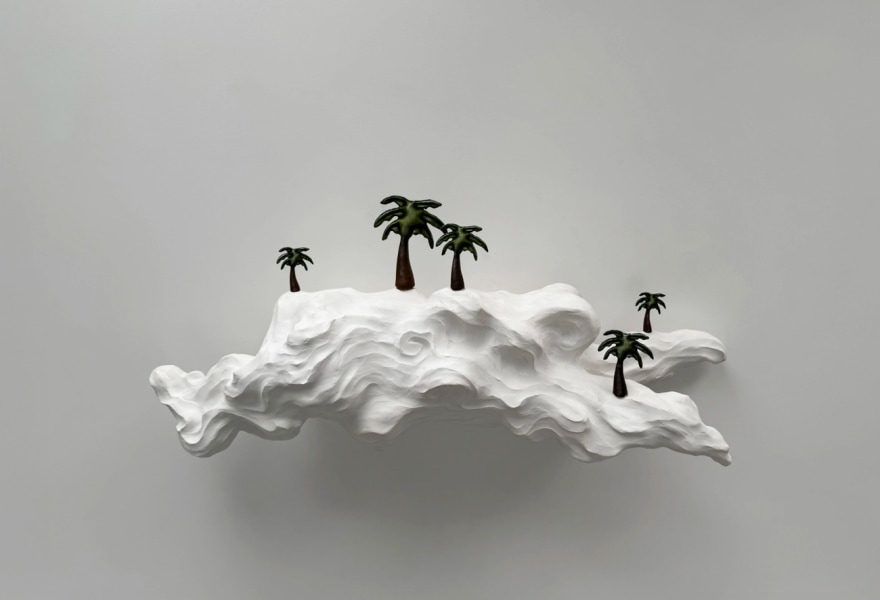
The studio is warm, not only thanks to the large industrial stove glowing red and reflecting the warmth of the conversation, but also the approach used here and how we’re welcomed by Luk Van Soom. The light is irregular and anything but clinical. Shadows fall across forms that have not yet decided what they want to become. Clay sits in large barrels, moulds waiting to be used. Parts of sculptures seem about to shift at any moment. This is not a place where you work toward an endpoint, but a place where thinking happens … with the hands.
“To me, everything starts here,” says Luk Van Soom. “Not with a well-conceived plan, but with the material. As soon as you start modelling, the clay defines its properties. This applies to all materials and the material starts to talk back. It forces you to make decisions you could not have imagined beforehand. They are invisible forces within me that I have to respond to intuitively.”
It is a working method that runs counter to the notion of preconceived artwork. Instead, form emerges from touch, from resistance, from correction, from craftsmanship. Thinking is not an abstract process that precedes creation, but something that unfolds during the act of creation itself.
A constellation, not an overview
This ‘thinking with the hands’ forms the core of Van Soom’s practice and also of À l’ombre des étoiles. He does not call the exhibition a retrospective or an overview, but a constellation: new sculptures alongside work that has existed longer, not because it is representative, but because it could be combined here.
“Some sculptures have been waiting for this place,” he says. “Not everything is new, but everything has been placed in relation to each other once again.”
The exhibition is not chronological, but spatial. Works speak to one another, respond, enable. The entirety does not feel like a selection made after the fact, but like the logical consequence of a thought process that has spanned years and now temporarily converges here.
Those who know Van Soom primarily for his monumental sculptures in public spaces will immediately notice that the scale is different here. And deliberately so.
“I didn’t want to bring outdoor sculptures inside,” he says. “The monumental way of thinking is still there, but in condensed form. This work demands proximity. You need to be able to move around everything, to almost read everything physically.”
Clay as freedom
That intimacy is not a stylistic choice, but a consequence of how the works of art come into being. Almost everything starts with clay.
“Clay gives you freedom,” he explains. “You can keep searching and adjusting, like a painter with a canvas. You can’t do that with stone. What’s gone is gone. That’s why I model almost everything first. Only later are those forms translated into other materials.”
Here, clay is not a preliminary stage, but a necessary phase of thought. It allows doubt, return, slowing down. In À l’ombre des étoiles, those traces remain visible, even when the work is executed in metal or aluminium. You can sense where something once began in softness. The materials brought together in this exhibition — clay, metal, aluminium, bronze, assemblages — each has its own resistance and history.
“The field of tension interests me,” says Van Soom. “A sculpture has to astonish, possess a mystery, take the viewer along on a journey. Heavy and light, solid and open, defying gravity: those oppositions keep the work evolving.”
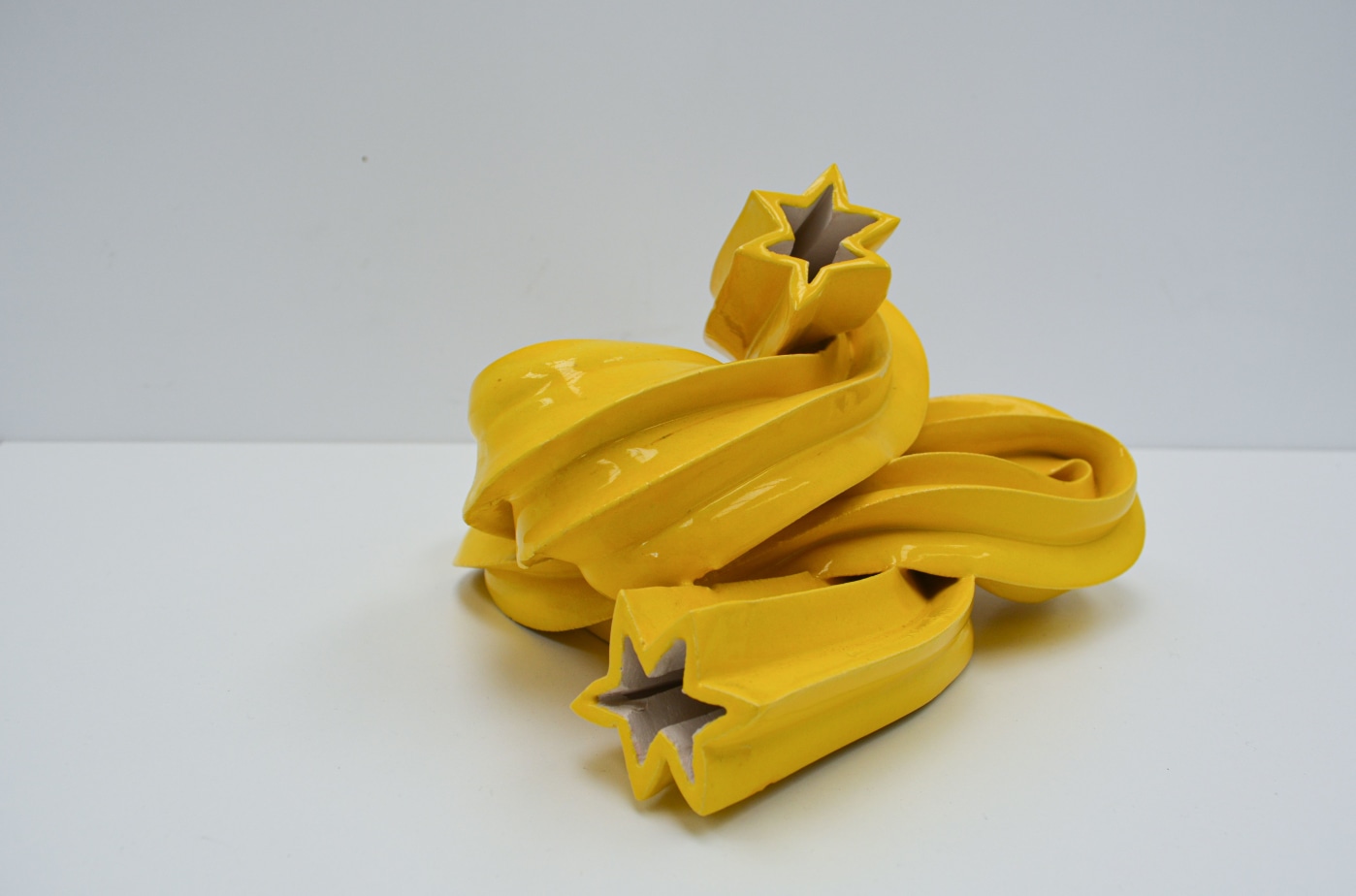
Luk Van Soom, Creampuff Amarillo Neon, 2011, Gallery Sofie Van den Bussche
Centres of gravity
The selection of work was not made afterward. It grew alongside the making. Certain forms return repeatedly: clouds, figures, tensions between weight and levitation.
“At a certain point, you get the sense that these works all belong together. Only then does it become an exhibition.”
There are sculptures that function as centres of gravity, key works that provide direction without imposing themselves. They define the field without dominating it. Other work responds, seeking distance or proximity. Like stars in the firmament, the bowl of the night sky: not hierarchy, but coherence.
This way of thinking reveals a sculptural logic focused on composition and orientation. Bound to the earth, it asks itself: Where am I standing? What am I moving toward? I surrender to the bewitchment of my memory.
Clouds as a model for thought
This cosmic imagery has run through Van Soom’s work for years. The universe, our planet, gravity, time and the four elements form an undercurrent that is never explicit, yet always present. Water and fire, air and earth: opposites that need each other.
“That’s broad enough never to be exhausted,” he says. “And it remains relevant without becoming too literal.”
Clouds play a central role, not as a romantic motif, but as a model for thought. “Clouds sculpt themselves,” he says. “You can’t grasp them. They constantly change, but are visible and you can get lost in them. I find that fascinating.” For Van Soom, clouds are closely related to thinking itself. That, too, exists without a fixed form.
“To me, a cloud is like a large brain.”
By fixing those clouds sculpturally, anchoring them, they become something essential. They are heavy yet light. Open, free and present. Visitors often see something else in them: a figure, a body, a landscape. That difference is not a problem, but an invitation.
“I don’t want to pin everything down,” he says. “The viewer has to dive in, to think along with the work.”
A thinking space
That physical experience is essential. Photographs do not do justice to the work. “Everything becomes flatter on a screen,” he says. “You lose the scale, weight, how a work relates to the body. You don’t have to understand these sculptures, you have to experience them.”
The space of the Galerie Sofie Van den Bussche plays an active role in this. The work was not simply placed, but has claimed its place.
“The space contributed to this,” he says. “Some sculptures ended up differently here than I initially thought. That’s not a concession — that’s listening.” This collaboration arose precisely from that trust.
“She understands my practice and allows space. Without that trust, you cannot make an exhibition like this.”
À l’ombre des étoiles has turned out to be a dialogue between the items themselves, but also between the working method and vision of the gallery.
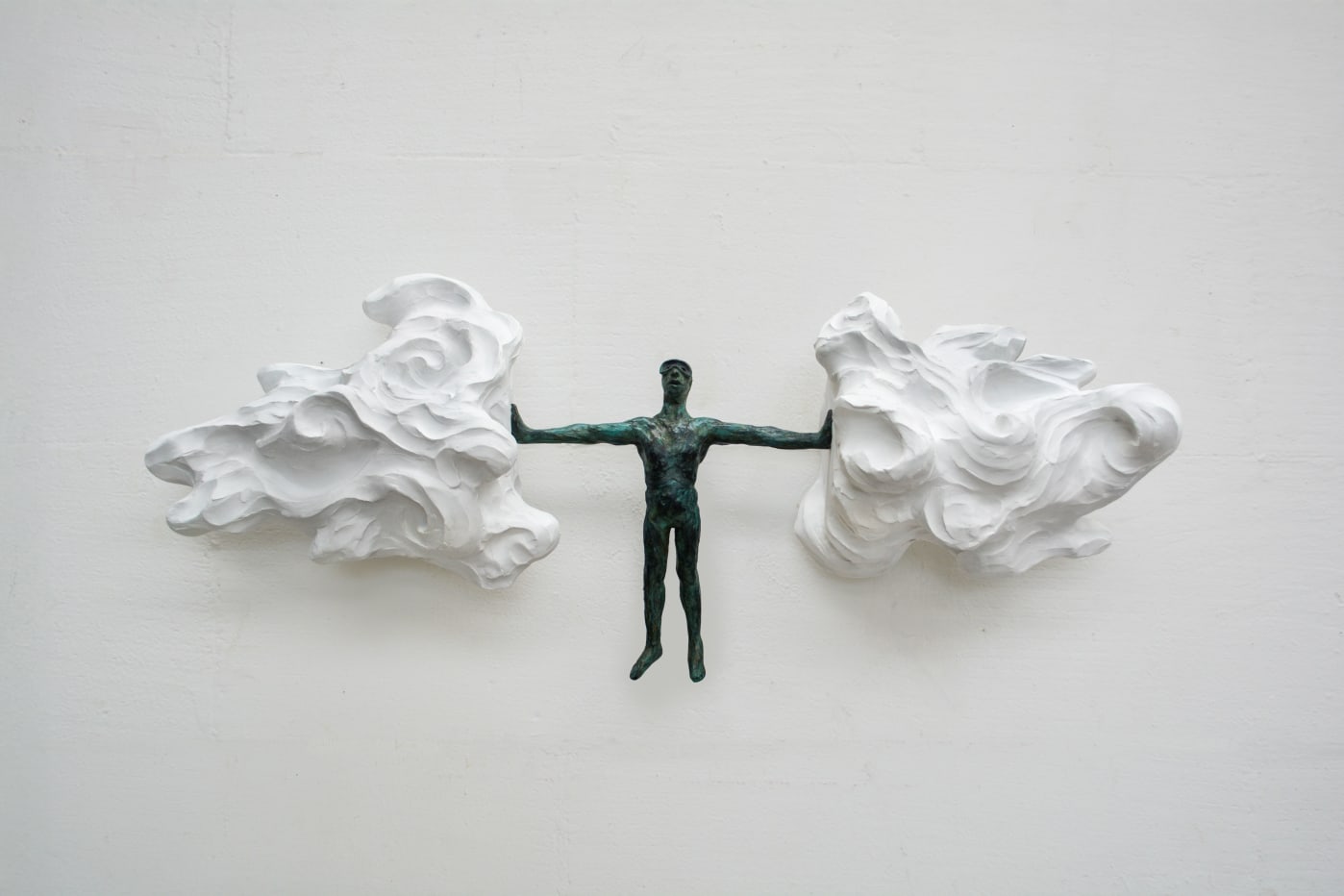
Luk Van Soom, Jerom for ever II, 2012, Gallery Sofie Van den Bussche
Humour and seriousness
Alongside the cosmic, religious imagery also slips in. Inevitably, according to Van Soom.
“My generation grew up with churches full of sculptures. I can’t pass a church in Italy or southern Germany. They contain the most reproduced imagery we know.” The Baroque in particular fascinates him deeply. In those buildings, you are embraced by a single idea, forged into a whole by architects, craftsmen, decorators, painters and sculptors. They transformed text into image. “I always find it a magical experience when I step inside.”
His fascination with this imagery is not nostalgia, but transformation. A Christ figure appears with a Superman cape.
“As a child, I actually thought Jesus was a superhero,” he says. “He could walk on water, turn water into wine, calm storms and raise the dead. That captured the imagination. There are thousands of versions of him, many by famous artists. I wanted my own version. I removed the suffering and kept the strength.” Humour is not relativisation here, but an entry point.
“Without humour, art becomes heavy. A smile makes something more approachable. Seriousness and humour go hand in hand.”
What remains
Van Soom also speaks very openly about the reality of being an artist. He documents everything about his oeuvre: photographs, dimensions, materials, locations. Not as control, but as care.
“For later. For conveyance.”
His relationship with galleries is clear-eyed yet critical.
“A good gallery is fantastic, but rare. You can’t live on one six-week exhibition every two years. You have to remain realistic.”
What he hopes visitors take with them when they leave À l’ombre des étoiles is not a conclusion.
“Not necessarily a single image,” he says, as the fire flares up briefly. “Rather a feeling. Something physical. That you step out of your daily life for a moment and begin to think about it differently — aware that you live on planet Earth, that you are standing on a sphere.”
Thinking does not always have to happen in words. Sometimes it simply starts here.
He raises his hands.
I thrust my head beyond the atmosphere, where the mass of the universe can no longer be distinguished from that of the earth — a darkness from the beginning of time.
