03 february 2026, Flor Linckens
The invisible vanishing point in the work of Reinoud Oudshoorn
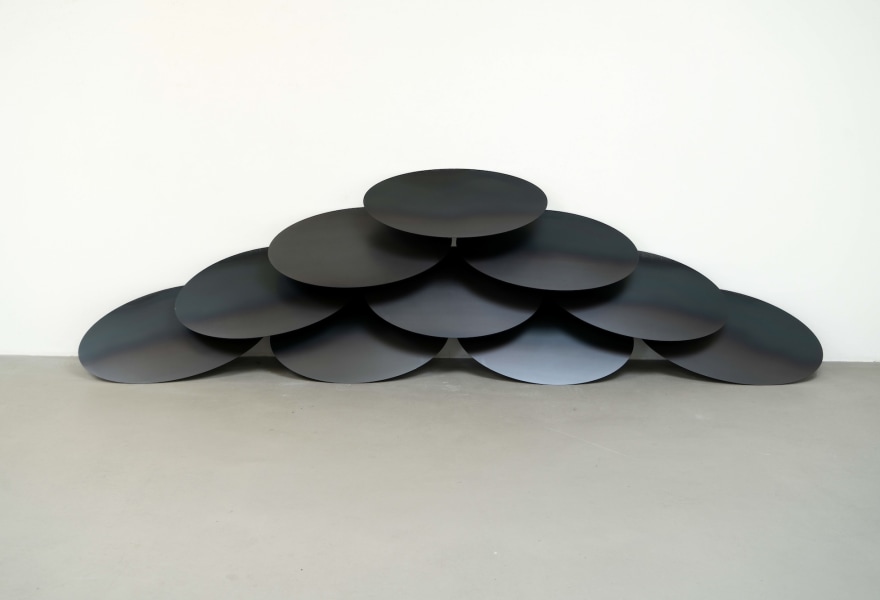
Until 1 March, Galerie Ramakers in The Hague presents a solo exhibition by Reinoud Oudshoorn. The artist titled the exhibition ‘Limit everything to the essential, but do not remove the poetry’, a quote by Dieter Rams. This renowned designer is known for his radical simplicity, functional clarity and timeless sense of aesthetics. These values are also central to Oudshoorn’s practice.
Reinoud Oudshoorn was born in Ommen, the Netherlands, in 1953. He studied at what is now the AKI ArtEZ Academy of Art & Design and completed a residency programme at Ateliers 63 in Haarlem, the predecessor of De Ateliers. From 1986 onwards, he was active at the Royal Academy of Art in The Hague as a lecturer for many years.
Oudshoorn began his artistic practice as a painter but eventually ran up against the limitations of the flat surface. He decided to shift his focus to the third dimension, without fully abandoning the language and logic of painting. The artist works from the idea that a sculpture should generate more space than it occupies. Perspective forms the foundation, as a conceptual model that connects perception and space. Not as a tool to construct an image, but as a fixed given from which each work originates. This choice determines not only the form of the sculptures, but also their internal coherence and the way they relate to the surrounding space.

This approach becomes tangible as soon as you experience the exhibition as a visitor. Your perspective on the three-dimensional works changes as you move through the space, and an implicit and explicit tension exists between the works themselves. The sculptures in the exhibition are composed of geometric forms and made from a limited range of materials: black steel, shaped wood and diffuse frosted glass. Almost all of them are placed on the wall or on the floor, which count as elements within the visual experience of the works. Visually, the sculptures refer architecture as well as organic patterns found in nature. In addition, several works on paper are also included in the exhibition.
A recurring principle within Oudshoorn’s practice is a fixed vanishing point at a height of 1.65 metres, roughly corresponding to average eye level. When viewing the works and imagining a vanishing point at 1.65 metres, the principle comes to life: invisible lines seem to converge from all directions towards a single shared point. In the exhibition, the 1.65 line functions as a shared horizon that connects the individual sculptures. In doing so, the artist plays with our perception. The result is a subtle, almost tangible ordering of the space.
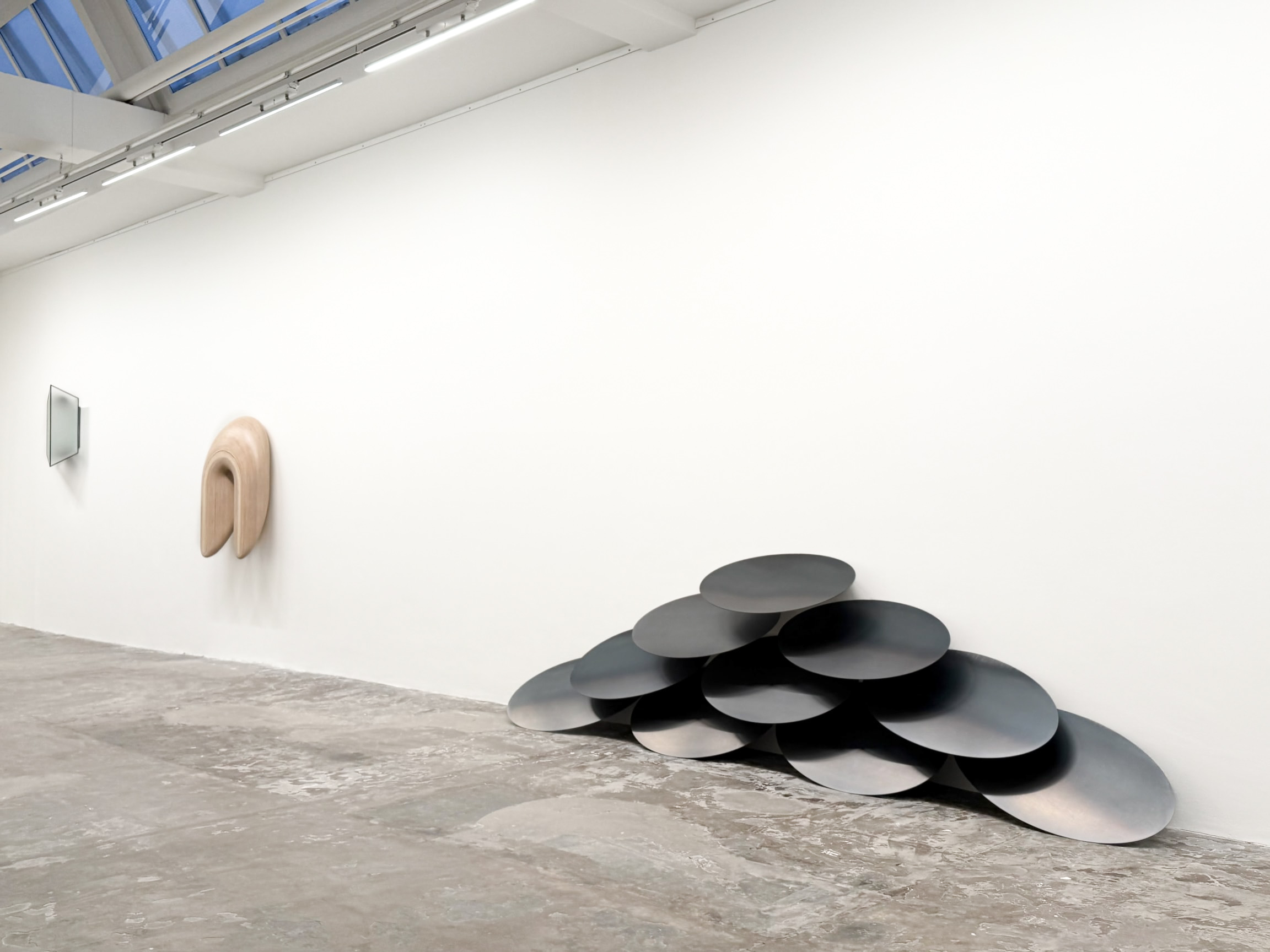
Oudshoorn works in a traditional manner: his models do not originate from digital modelling, but from sketches, mathematical calculations and drawings. The resulting works are shaped by intuition, scale, balance, harmony and tension.
Oudshoorn’s work has been collected by institutions including the Stedelijk Museum, the Jewish Historical Museum, the AkzoNobel Art Foundation, UMC Utrecht, ABN AMRO and Collection Sammlung Schroth. He has exhibited his work at venues such as the Stedelijk Museum, De Vishal, Arti & Amicitiae, Rijksmuseum Twenthe and in galleries in China, South Korea and the United Kingdom.

