02 december 2025, Flor Linckens
Daan den Houter: a work that moves between wood and surface
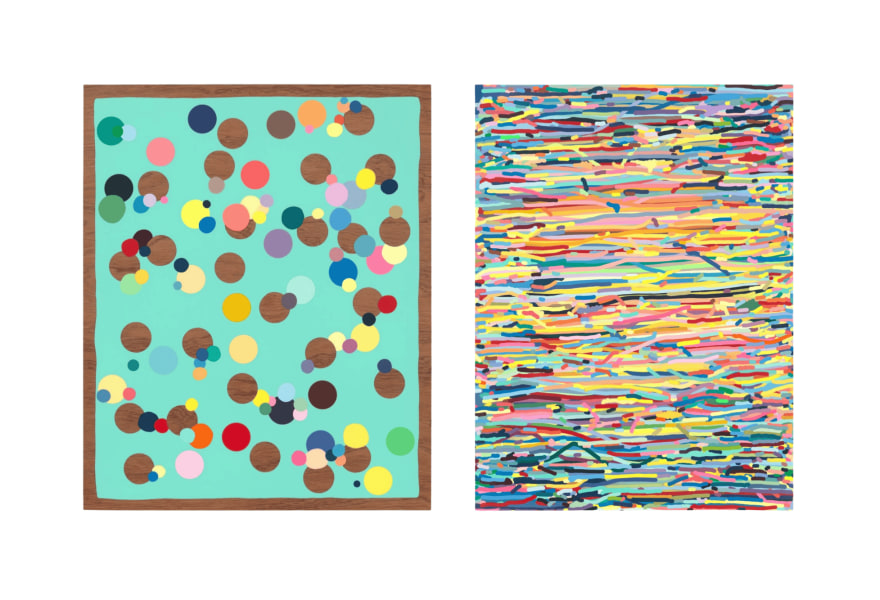
Until 20 December, Frank Taal Galerie in Rotterdam presents the exhibition ‘OOK MOOI!/ALSO NICE!’ by Daan den Houter, an artist who refuses to be contained by a single medium. His conceptual practice moves easily between painting, performance, sculpture, video and interventions. He examines the ways in which we construct ideas of value, art, money and identity. Humour, cynicism and a touch of friction are materials in their own right, ways of nudging the viewer just off balance to prompt a different perspective. In the gallery, he presents the latest step in his long-running investigation into what a painting can be, how an image takes shape and how chance, repetition and choice play a part in that.
Before enrolling at the Royal Academy of Art in The Hague, Den Houter studied Artificial Intelligence for two years. The underlying questions of that field stayed with him: how do we interpret the world, which assumptions sneak into our perception unnoticed and how do you momentarily disrupt that structure? This philosophical curiosity still underpins his artistic practice.
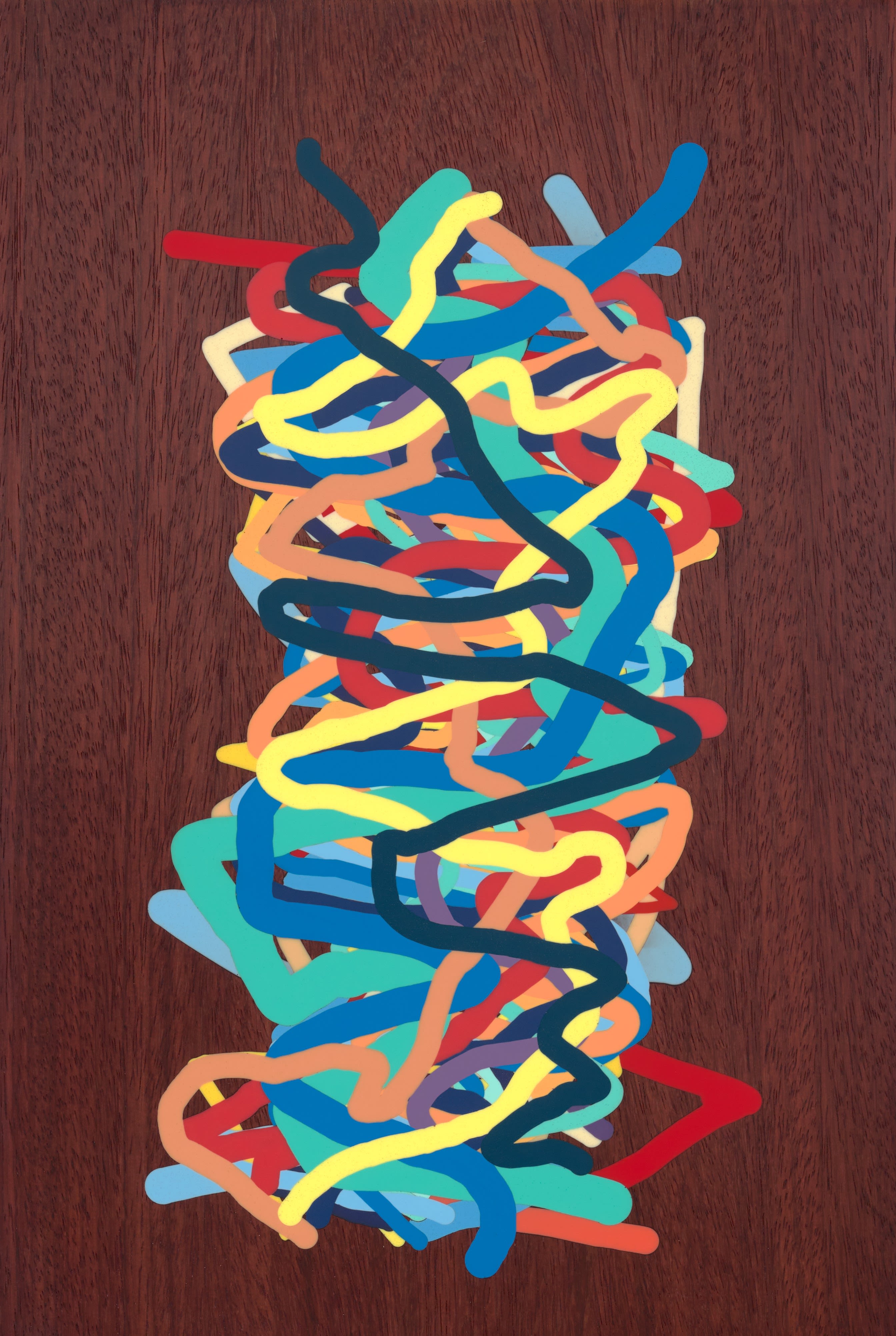
At Frank Taal Galerie he now presents the newest works from his "STRIPES" series, which he started in 2018. The panels appear almost as if they were digitally drawn in the Paint pc programme: lines that look as if they were made by an unsteady cursor, cheerful squiggles that narrowly miss each other, patterns that are reminiscent of a nineties interface. Beneath that light and playful appearance lies a slow and labour-intensive process that remains invisible to the viewer. For each colour, Den Houter carves a fresh groove into the wood, fills it with pigmented epoxy resin, allows it to harden and sands the surface completely flat and matte before starting again. He repeats this action dozens of times. By hiding this labour so thoroughly, the works acquire an almost industrial presence, despite being entirely handmade. The resulting compositions feel both playful and precise, yet carry a near-meditative intensity. It also means that the image no longer sits on the surface but is partly embedded within it. These energetic works show no brushstroke, signature or hierarchy. The smooth epoxy skin erases any trace of the human hand. Beginning and end overlap and time seems to dissolve into the image. In doing so, the works quietly unsettle the very premise of a traditional painting as a frozen gesture, without abandoning the medium itself.
What stands out in these new works is that the underlying mahogany wood, long a wilful sparring partner, has in some cases almost completely disappeared beneath the epoxy. The wood grain once dictated rhythm, direction and constraint, but in this series, Den Houter has gradually phased that out. He carves, fills, sands and polishes until the image offers no foothold and every minor irregularity has vanished. As if persuading the material to finally yield. The human mind also tends to complete missing information in subjective ways and these new "STRIPES" works leave ample room for that mechanism to unfold.

In his practice, Den Houter likes to play with situations that seem absurd at first glance. Long before a certain shredding artist made headlines, Den Houter built a paper shredder and encouraged children to feed their freshly made drawings into it. He created wigs and moustaches from his own hair, a self-portrait carrying the artist’s literal DNA. He also enjoys dissecting the financial logic of the art world. For one project he bricked a one-thousand-euro banknote into the wall of Frank Taal Galerie: the money is present but inaccessible. That tension returned in the series "Keep on Dreaming" (2018), that consists of seventeen concrete blocks, one of which contains ten thousand euros. The work may not be opened, or the owner faces legal repercussions. So in effect, you are not buying the money but rather the possibility of it, shared with sixteen co-owners who can hold each other financially accountable if one of them breaks the pact. Conceptually sharp and quietly provocative.

Another striking strand within his practice is his series of ice paintings. These are created in the freezer: layers of water and pigment are combined into compact blocks that only start ‘working’ once they leave the cold. Once hung, they begin to drip, shift in colour and eventually disappear towards the floor. The work is in constant transformation until only a trace on the wall and a small pool of colour remain. As a viewer, you also hear the process, the soft ticking and dripping, rendering it almost a performance. Although the melting appears in an autonomous way, Den Houter subtly steers it through using different paint viscosities, shapes and colour sequences. The temporary nature of these works and the fact that they literally dissolve, sit intriguingly at odds with an art market that relies on permanence and ownership.
What links all these projects is a curiosity about what art becomes when you loosen or invert the rules. Den Houter explores the boundaries of perception and conviction by creating situations that invite the viewer to piece things together. His works are clear and immediate but never unambiguous and that is precisely what makes them so engaging.
Daan den Houter was born in 1977. His work has been shown at Museum Boijmans Van Beuningen, Kunsthal Rotterdam, GEM, Heden, TENT, De Nederlandse Bank, Torrence Art Museum and 18th Street Art Center in Los Angeles, the Watou arts festival, MAC Birmingham, Richmond Art Gallery in Canada, a group exhibition in La Storta (Venezia Contemporanea) during the Venice Biennale and at the Dutch embassy in Berlin. His work is represented in the corporate collection of UMC Utrecht, the collection of the Dutch embassy in Berlin, Museum Ferropolis and the MAL Collection. He was nominated for the Royal Award for Modern Painting in 2012 and was longlisted for the Prix de Rome in 2015. Together with Alex Jacobs, he founded the Bcademie, which supports young artists in navigating the gap between art school and professional practice.
