03 october 2025, Flor Linckens
Memories as a universe in Galerie Fleur & Wouter

As a child you accept the world as it is presented to you, the story others tell you. Later you discover nuance, the shades of grey, and learn to unravel the experiences of your youth and later life, the layers that shaped you. Artists have the ability to show us how their lives, too, have been marked by such stories. By inviting us into their personal journeys, sometimes far removed from our own, they nevertheless manage to touch on something universal. Galerie Fleur & Wouter recently reopened its renovated space at Van Ostadestraat 43b with a group exhibition of Fiona Lutjenhuis, Mai van Oers and Alexxx. This presentation, on view until 26 October, explores themes of identity, ideology, loss and hope, as well as the ways in which memories take form.
Fiona Lutjenhuis grew up in a Brabant village, where her parents joined a religious community. The artist left at the age of sixteen. The Malva sect drew on an eclectic mix of theosophy, esoteric cosmology, secret societies and convictions about the supernatural and extraterrestrial life. In her practice, Lutjenhuis translates this ideological legacy and her personal memories into a hybrid visual language, supported by archival research. Her work is not a literal reconstruction but rather a symbolic and poetic retelling, often laced with humour, as a way to gain hold over her past. The result is work that balances playfulness with something darker. For Lutjenhuis, her practice is a way to reinterpret an exceptional childhood without placing a system of value on it. She approaches it from a rational and agnostic perspective, but also with a spiritual curiosity about what might exist.
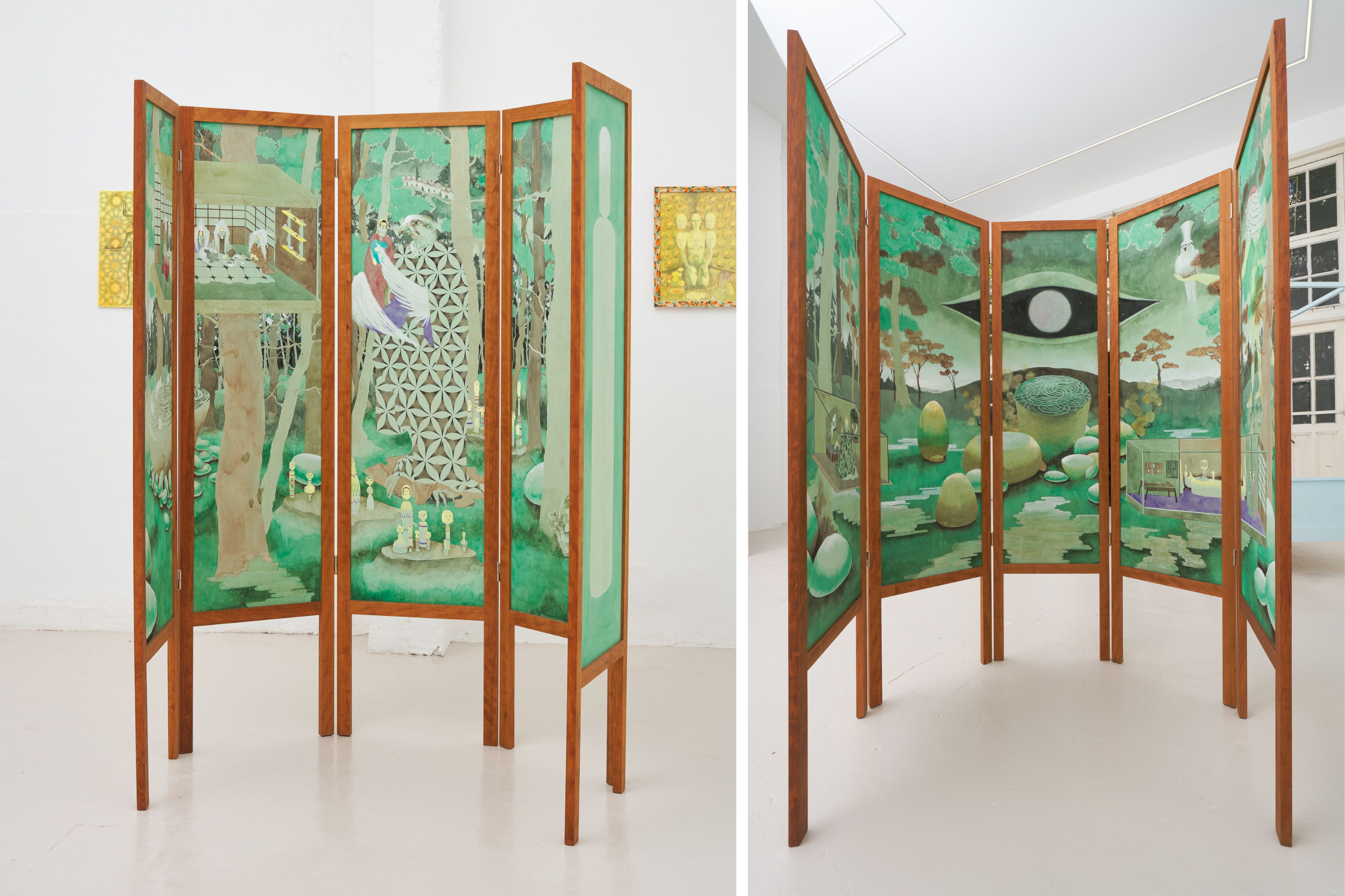
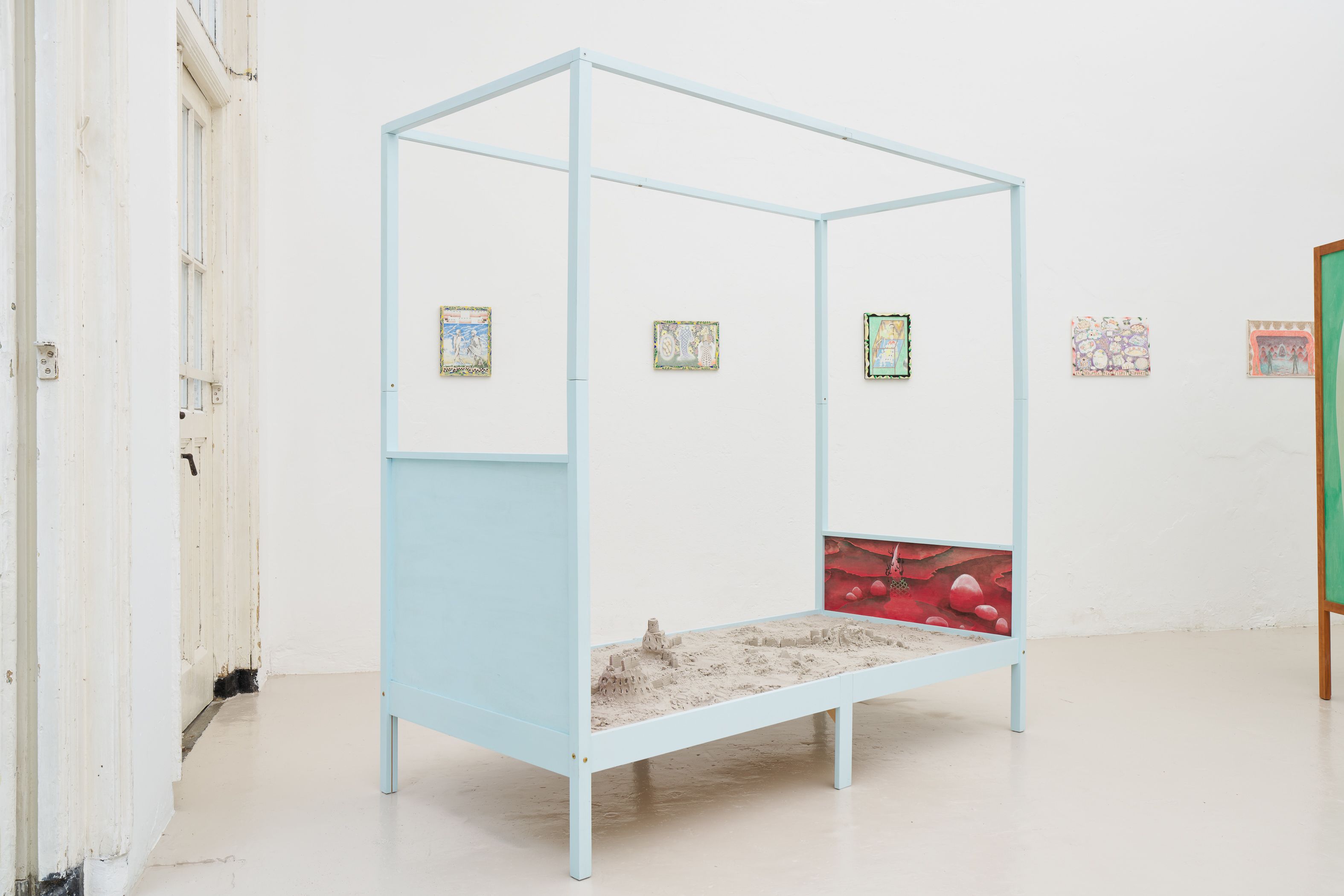
At Galerie Fleur & Wouter she presents two large room dividers with the title "I Flourish Into Chaos" (2024). Here, the leaders of the sect appear as birds of prey: owls and a hawk. Floating architectural structures with open walls depict scenes from her family history, where figures are rendered as static Japanese Kokeshi dolls, stripped of any form of agency. The Malva sect borrowed heavily from the imagery of various religious and cultural traditions, a layering that also resonates here. The all-seeing eye in the composition refers to Geza-4, the planet that was to offer salvation. Elsewhere in the exhibition, we encounter a birdhouse and a painted light-blue bed titled "Family Trip". Its frame holds a sandbox filled with sand castles, stripping the bed of its domestic function and turning it into a charged landscape. Works on cotton paper line the walls, showing human and alien figures interwoven with religious symbolism. Together, the works reflect on themes of power, submission and belief.
This exhibition marks an exciting moment in Lutjenhuis’ career. Parallel to this presentation, her first museum solo exhibition ‘Seasoned Sins’ is on view at Het Noordbrabants Museum, in which she adds a fifth season to the familiar four. Her work can also be seen in ‘Refresh Amsterdam #3’ at the Amsterdam Museum (until 30 November). The artist was recently nominated for the Prix de Rome 2025, which means her work will also be presented at the Stedelijk Museum in Amsterdam from late November onwards.
Fiona Lutjenhuis was born in 1991 in Zevenaar. She studied at ArtEZ University of the Arts in Arnhem and was a resident at the Rijksakademie van Beeldende Kunsten in Amsterdam. Her work has been shown at 1646, the Dordrechts Museum, Schiphol, the H3H Biennale and Drawing Centre Diepenheim, and is held in the collections of the AkzoNobel Art Foundation, Museum Helmond and Schunck Glaspaleis.

Mai van Oers is known for her drawings and paintings in which carefully constructed worlds take shape, populated by architecture, fairytale figures, animals and religious motifs that follow their own logic. At Galerie Fleur & Wouter, she presents a series of new pencil drawings. Van Oers usually begins without a fixed plan, allowing memories and cultural capital to find their own way onto the paper: her youth among the Catholic Ursuline nuns, long walking pilgrimages to Santiago in 1983 and Rome in 1993, as well as art-historical echoes of medieval miniatures and the literary imagery of Dante Alighieri. On the paper, cathedrals and threathening nun figures appear, as well as tombs, animals and fairytale motifs in landscapes that play with perspective and light. Here, she works in black and white with accents of muted purple or bright yellow.
The drawings are presented against a wallpaper designed by Van Oers and Alexxx, originally created for No Limits! Art Castle at the Centraal Museum in Utrecht. This pattern, composed of fragments of both artists’ work, makes the drawings appear as islands within a larger universe. In the gallery, the original works are mounted directly on the wallpaper.
Mai van Oers was born in Uden in 1953 and studied at the Gerrit Rietveld Academie in Amsterdam. Her work has been shown at the Fries Museum, the Centraal Museum, the Teylers Museum, Garage Rotterdam, Drawing Centre Diepenheim, Museum Boijmans Van Beuningen and De Vishal. In 2000, she received the Jeanne Oosting Prize for painting. Her work has been included in the collections of Museum Boijmans Van Beuningen, the Teylers Museum, the Centraal Museum, Museum Jan Cunen and the Chabot Museum. Her work is also currently on view in the exhibition ‘Missing as a circular form. The art of living through loss’ at the Stedelijk Museum Schiedam, until 1 March 2026.

The enigmatic Alexxx was born in Belarus and developed a drawing practice in which the ballpoint pen became his main instrument. With endless lines and hatchings, he creates intense, detailed works that weave together personal and social themes, including his experiences with the Immigration and Naturalisation Service (IND), shifting attitudes towards migrants in the Netherlands and a personal past in which addiction played a role.
