26 september 2025, Martine Bontjes
The studio of... Eva-Fiore Kovacovsky
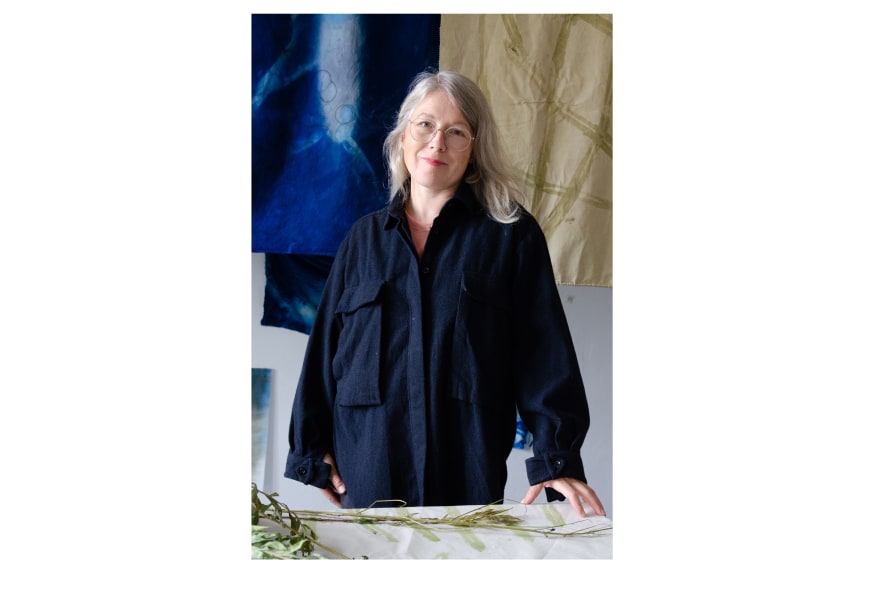
Eva-Fiore Kovacovsky’s studio is a place of experimentation, where photography, plants and food intersect. She photographs leaves and twigs in the darkroom and under direct sunlight, while the kitchen becomes a second laboratory. There she transforms clover, millet and camelina into sorbets and uses plant juices as a photographic medium. Kovacovsky invites viewers to experience plants with all their senses by seeing, tasting and imagining.
Her work is on view in Inspiration – Expiration, a duo exhibition with Ewerdt Hilgemann at Bradwolff & Partners, Amsterdam, until 25 October. The show explores breath as force and rhythm: Hilgemann’s imploded steel sculptures reveal air’s invisible power, while Kovacovsky’s nature-based photographs trace growth, decay and seasonal cycles. Together their works create a dialogue between stillness and movement, implosion and expansion: a conversation between inspiration and expiration.

Inspiration – Expiration, Ewerdt Hilgemann & Eva-Fiore Kovacovsky, Bradwolff & Partners. Photography: Gert Jan van Rooij
For your research you spend time in nature, and I noticed you also bring the plants back to your studio. Could you tell us more about how you use your studio?
My practice often takes place outdoors. The sun and the many organisms that live around us—what we call “nature”—are my main sources of inspiration, working partners, and material. I have a photographic background and work with various analogue photographic techniques, using both sunlight and the photographic enlarger in the darkroom. To create another way of engaging with the plants I work with, I began making sorbets from different wild-harvested plants. In this way, the kitchen became another part of my studio practice.
I am showing my new work ‘The Taste of Photosynthesis - Wild Ice Cream Shop’ within the exhibition Expanded Fields ERDE/N at Froh Ussicht in Switzerland. I created different sorbet from plants like clover, millet, camelina, and plantain that grow on the farm where the exhibition takes place. In this work I explore how I can introduce the particular flavours of these plants to visitors. To me the sorbet is a way of abstraction that at the same time creates relation - a connection between plants and humans. I had such interesting conversations and encountered so much curiosity by the visitors when serving the sorbet. I also used plant juice for a series of works on fabric which are somewhere between painting and anthotypes. A photographic technique in which plant juice is used as photosensitive image carriers.
Could you explain what you mean when you say that plants are your collaborators?
I like to think of plants as collaborative partners in my work. Our relationship with the other organisms that inhabit this planet—especially plants, on which we are utterly dependent—will determine the future of our species and of the planet. Through my work, I try to explore this relationship and highlight the necessity of knowing and respecting all the organisms we live alongside. I find indigenous cosmologies very helpful in regaining an understanding that, unfortunately, we have largely lost.
When did you start observing nature so closely?
One of my earliest childhood memories is seeing a wild arum in the forest, and my parents introducing me to the plant and telling me about its poisonous berries. Since I was small I was like a sponge, absorbing all knowledge about plants I could find. My parents were deeply connected to plants and had a lot of knowledge about herbs and mushrooms, which shaped my upbringing. My father was running one of the first vegetarian restaurants in Switzerland. Wild foraging plants, food and cooking were important activities in our household. This interest has stayed a central part of my life and work.
You run reading groups in Berlin. Could you tell us a bit more about that, who participates, and why did you initiate them?
I started the reading group Between Us and Nature together with Sina Ribak eight years ago in Berlin. We had met at a reading session organized by researcher Yasmine Ostendorf. Sina has a background in land use, conservation and agriculture policy. After this initial meeting we both realized that we would like to start a reading group on ecology as a format of collective learning. At that time, we also met Lorena Carràs and Jean-Marie Dhur, who run Zabriskie, an independent bookshop on nature and culture. We began to collaborate with them, and over the years we have organized and hosted more than 50 sessions in various places.
Running this reading group and working closely with Sina has had a big impact on how I think about art and ecology. As an artist, I used to work a lot on my own. The experience of being in such close dialogue with someone, researching topics together, and preparing the sessions has been absolutely wonderful. Around us, a whole community has grown. There is a lot of flux in who attends, but some participants have been with us for many years.
What makes the group special is that people are not obliged to read texts in advance, we always read together, out loud. Each session is two hours, with about half spent reading aloud while sitting in a circle. Whoever feels like it begins reading a passage, and when they stop, someone else continues. In this process, everyone becomes part of a collective organism, and listening becomes central. What continues to fascinate me after all this time is that the group is about sharing and collective learning, and that you never know exactly how the evening will unfold—what conversations will arise in the second half of the session.

Eva-Fiore Kovacovsky, Jackotype, 2017, Bradwolff & Partners. Photography: Gert Jan van Rooij
In your work "Jackotype" we see an image of the jackfruit tree. Where did you create this cyanotype work, and why the jackfruit tree?
The origin of this work is a story about my parents. Just weeks after they fell in love, my dad was caught growing weed. As a refugee from former Czechoslovakia, he feared it would affect his residence permit in Switzerland. To avoid prosecution, he decided to flee with a friend to the Seychelles in the Indian Ocean. He returned to Switzerland about a year later. When he visited the islands again in the 1990s, he brought back a jackfruit in his suitcase—an enormous fruit, along with a wild story about plucking it from a tree and thus introducing this fruit and its very particular taste to me.
Jackfruits are the largest fruits that grow on trees - they can weigh up to 50kg. Later, when I read an article describing how climate-resistant the plant is, and how it can also be turned into flour, I was struck. Because of its drought resistance, the jackfruit has the potential to replace less resilient crops in the future. This inspired me to create a work dedicated to the plant, which is native to southern India and Sri Lanka. I made a photogram of a jackfruit tree, captured on fabric coated with cyanotype chemicals, in Sri Lanka. At the back space of Bradwolff & pPrtners, in the exhibition Between Sign and Soil there is a work by herman de vries installed with soil collected from the Seychelles. I like how these works connect.
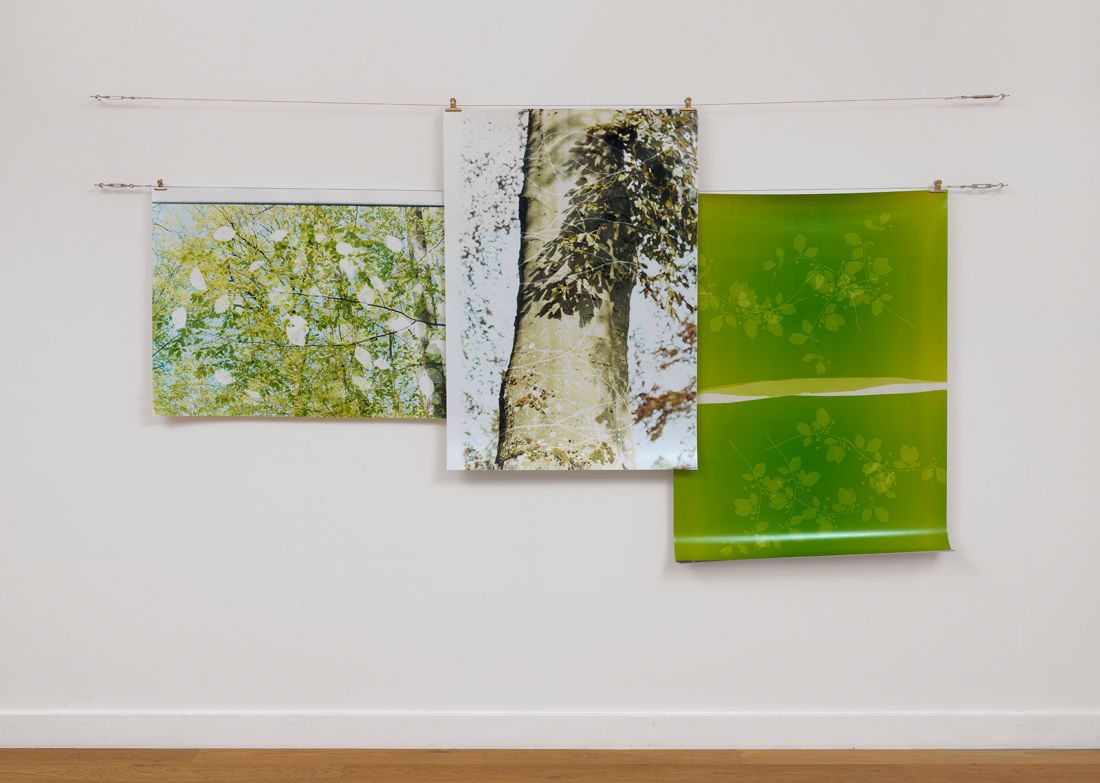
Eva-Fiore Kovacovsky, Vernal Unfolding, 2023, Bradwolff & Partners. Photography: Gert Jan van Rooij
For printing your photograms you work in the darkroom. Do you know exactly what the outcome will be on forehand, or is there also an element of surprise?
There are many unforeseeable factors in my work. I like to think of coincidence as a collaborator. This element of surprise helps bring dynamism into my practice. The work Vernal Unfolding is inspired by the enfolding of leaves in spring. I worked with twigs, branches, leaves and color negatives of beech trees in the darkroom to try to reconstruct this very particular feeling of these trees. I exposed photographic negatives on paper while placing the branches and twigs on the paper creating images that are between chance and control and have many layers. For me, the paper becomes alive as a latent, photosensitive image carrier. I worked with the layering also in the exhibition space when installing the work.
The work Feeding on Light, which I published as an artist’s book with Roma Publications, contains a total of 700 leaf negative prints. I worked with leaves that were partly eaten by caterpillars, bugs and other organisms, and placed them in the negative holder of a color enlarger. I zoomed in on the elaborate shapes—the negative spaces that had been consumed—and thus the sugar that had been passed on in the ecosystem.
Are there any projects you would like to realize in the future?
My current project, Photosynthetic Cookbook, is a two-year research project at the Royal Academy of Fine Arts Antwerp. In it, I experiment with ways of making photosynthesis tangible through artistic means. I am interested in photosynthesis because it is through this process that plants turn light into sugar. The anthropologist Natasha Myers proposed to call our time the Plantropocene rather than the Anthropocene. Everything we, as animals, consume—including fossil fuels, which we burn and turn into plastics—derives from energy-rich organic molecules that plants converted from sunlight millions of years ago. I am preparing to produce a new work that is bringing together my research.
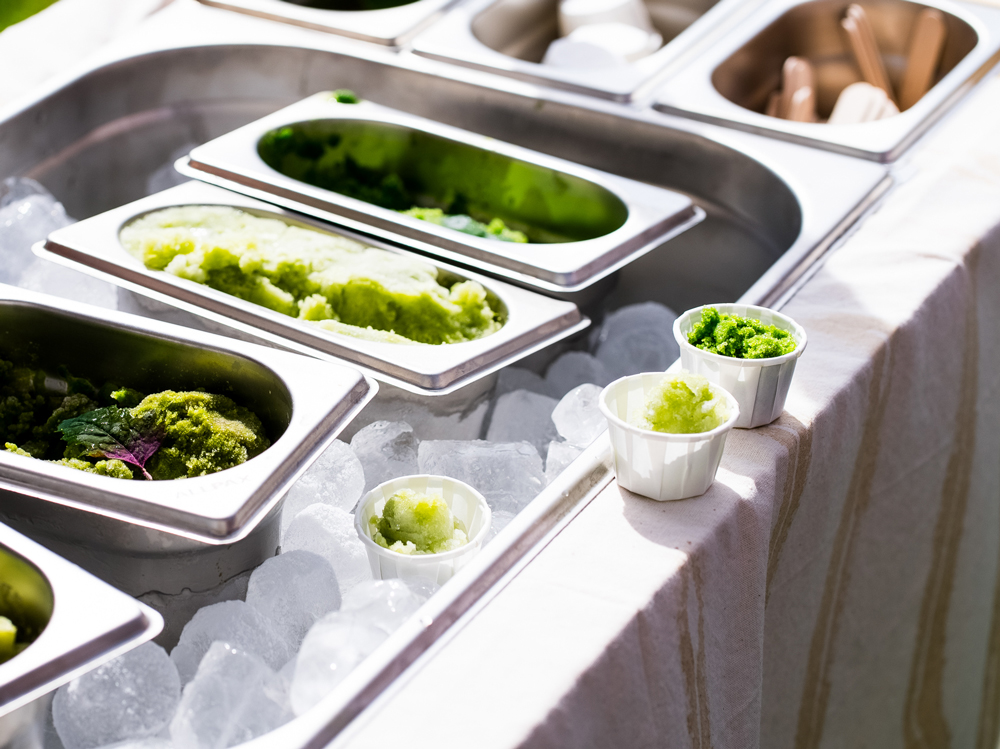
Tasting Photosynthesis - Wild Ice Cream Shop, 2025, image credit; Artemis Tsakiri
