28 august 2026, Wouter van den Eijkel
The studio of… Gerbrand Burger
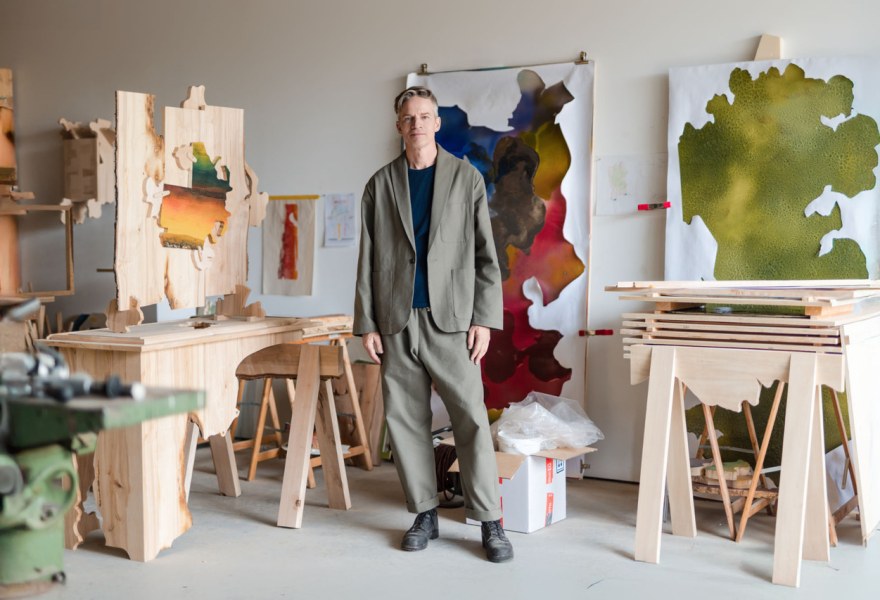
Gerbrand Burger is known for his wooden sculptures, which often refer to furniture, frames or display cases, representing what Burger calls the systems of knowledge that maintain a separation between humans and the living world.
Last year, Burger swapped his spacious studio in Amsterdam Noord for one in southern Finland. We spoke to him about the country where he will be working for the next two and a half years, how a smaller studio enables different ways of working, his circular practice and his Thinking Forest Foundation.
Work from his Note to Self series will be exhibited from 5 September at Galerie Fontana, Amsterdam, as part of An Encounter: Materials, Nature And Time, alongside work by Claudy Jongstra and Mirte van Laarhoven.
I understood from your gallerist that you are in Finland, a country known for wood, particularly bentwood furniture. Your material is also wood, so I wondered: are you there for work or are you on holiday?
Finland has influenced my choice of wood to some degree. My partner, Sara Bjarland, is Finnish and is doing a three-year residency here. We recently moved to Finland with the family. We now live in Ekenäs in a wooden villa by the water surrounded by forest. It's a little over an hour's drive from Helsinki. Officially, it's a city, but it feels more like a small town.
Was it a big change?
I know the country well since I've been coming here for around 20 years. The difference is that you're not in the city, as I was used to being in Amsterdam Noord, but to be honest, that's a relief.
 Gerbrand Burger, Note to Self #1, 2025, Galerie Fontana
You took a long route towards becoming an artist. You studied Latin American languages and cultures and political science in Leiden before attending the Rietveld Academy. Do those degrees actually feed into your work?
Well, he pauses, in a way they do. I escaped from the academic world halfway through. TCLA gave me a love of Latin American literature, which I sometimes refer to in my work, such as in the titles of work. At the Rietveld, I realised how useful that was. My fellow students found it more difficult to engage with theoretical ideas or to write about their work.
When did you know that being an artist was what you wanted to do?
I actually already knew after secondary school. My parents always told me that you should aim high. According to that logic, university was a better option than art school. I didn't initially dare go to art school either, so university it was.
I read that you built your own house and your own studio in Noord. It sounds like a dream for many people. How did you manage to do it?
Yes, building that house made me realise that I needed to make things with my hands, that this is where my abilities and joy lie. Until then, I had often struggled with other people's ideas about what art should be, with the emphasis on conceptualising things in advance getting in my way. My work emerges through the act of creation itself: I think with my hands.
I simply threw myself into it. I often talked about building my own house. A friend told me about plots for self-build projects, such as someone on IJburg who had built a house for less than a €100,000. I managed to get financing for it and then built it between 2011 and 2015.
And that gave you a taste for more?
Afterwards, I thought perhaps I should build a studio for myself as well. Niels Albers soon joined me, as did Jean-Marc Mathy, whom I also knew. I had heard about plots for businesses and after quite a few phone calls and emails, I got one in my name. We then looked for investors within our own networks. In the end, we raised more than €400,000 from investors and borrowed the rest from the bank. The construction crisis began in 2017 and after that, prices rose rapidly. We now own our building as a cooperative of 13 members, with 1,200 square metres of studio space.
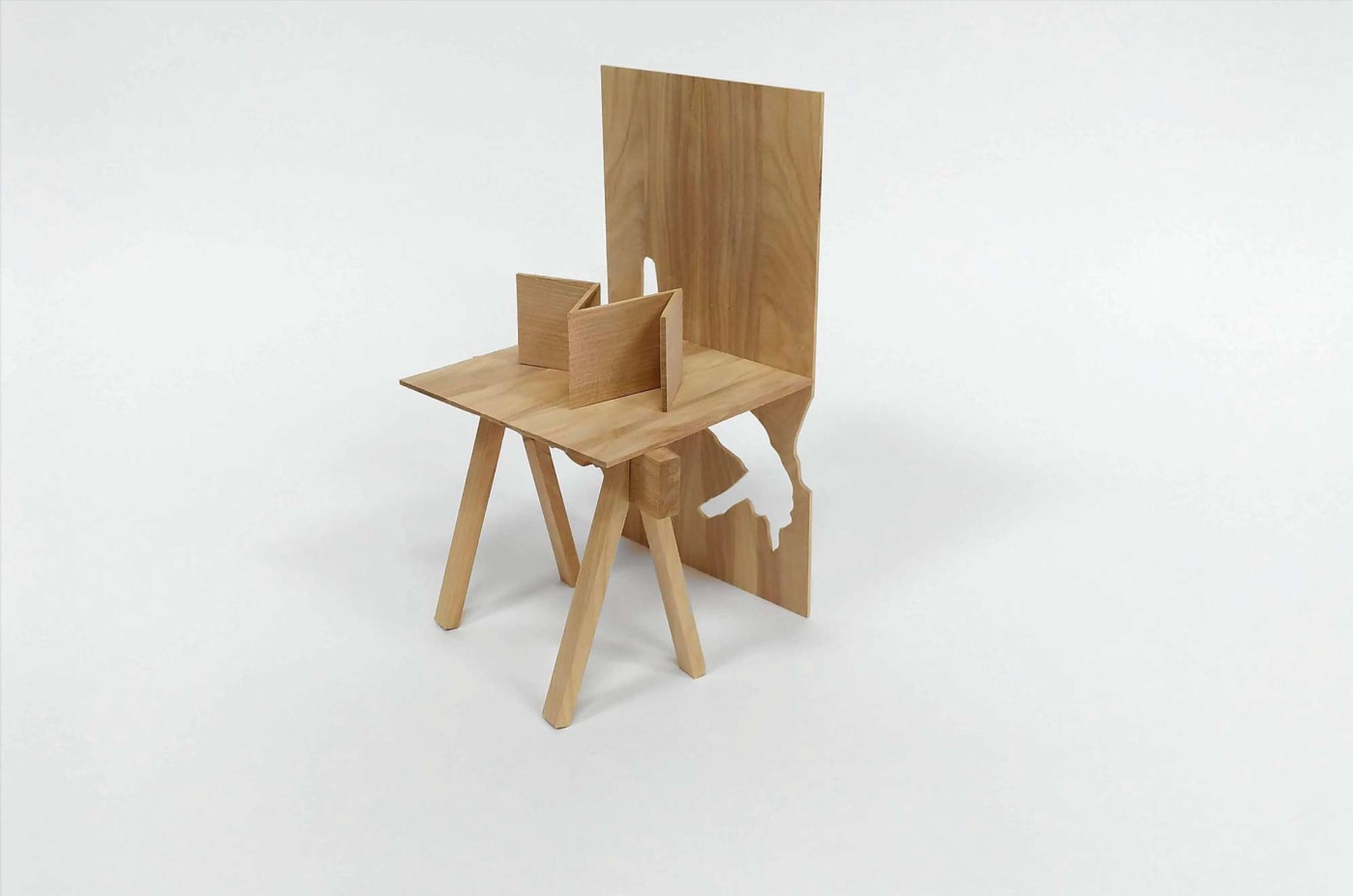 Gerbrand Burger, Juddlike Chair with Formitopsis Betulina, 2022, Galerie Fontana
I assume it's also the perfect studio for you?
Absolutely! It's 150 square metres with high ceilings, underfloor heating and good machinery. I deliberately didn't move all those machines to Finland. That encourages me to work more simply. Hand tools lead you towards smaller-scale work and often work that is more agile, too. When you have all those machines at your disposal, you also start coming up with ways to use them.
What does a typical day in the studio look like?
Well, I can tell you how I spend my days in Finland because I have a studio here, too, and a new ritual. In the morning, I exercise a bit and then go swimming from the jetty -- we'll see how long I can keep that up in autumn. I then bike to school with the children. I work in the morning and after lunch, I go for a ride through the forest on my gravel bike.
This is your first collaboration with Galerie Fontana. How did the partnership with the gallery come about?
I dropped by a few times a couple of years ago and had a chat. There was immediate enthusiasm, but it didn't lead to a partnership. This spring, Joris and Stefan asked if they could come and visit my studio. As it happened, I was going to be in Amsterdam the following day. They stopped by and the next day, asked if I wanted to partner up.
Your work is being shown alongside that of Claudy Jongstra and Mirte van Laarhoven. Are there similarities between your practices?
What appeals to me about Claudy's work is that she grows her own raw materials. That's why I had already wanted to collaborate with her through my foundation The Thinking Forest. Through her way of working, you learn to understand your place as a human being within the wider living world.
I already knew Mirte, too. I showed one of her works a few years ago at an exhibition by our studio cooperative. With her background in landscape architecture, she engages with similar themes in a very concrete way, such as biodiversity, change and the interaction between humans and nature.
Is it fair to say that all three of you have a circular practice?
I try to create circumstances in which my work has as little adverse impact on the living world as possible, and potentially even has a positive influence. This works with the wooden sculptures in the forest, which are made from wood sourced from the site itself and remain there to decay and eventually become part of the forest floor again.
 Gerbrand Burger, Note to Self #5, 2025, Galerie Fontana
There is a series called Note to Self at the exhibition. What do you want to remind yourself of?
It's an intuitive title, not so much a note from me to myself, but rather the work referring to itself. To a part of the frame, to be more exact. When I made the work, I wanted to show the wood of the frame. I arrived at that title because of the self-referential nature of showing the imprint and the positive in the same work.
In your sculptures, you often refer to furniture -- I've seen tables, desks and the beginnings of chairs -- as well as frames and display cases. I immediately understand the reference to furniture, but what are you saying with the display cases and frames?
With the display cases and frames, from which I partially cut away the glass, I want to inspire a conversation about the systems of knowledge that maintain a separation between humans and the living world. By opening them up, I embrace the transience of the work.
Is the reuse of wood the central theme of your work?
Yes, wood is the material from which the subjects of my work originate. That began about six years ago when I was standing in my new studio. It was completely full of crates and materials and I thought, I don't think this is a sustainable way to make sculptures.
I decided to work with wood and in a sense, give it back to nature. The first work I made was a wooden sculpture at Welna estate near Epe. I left it in the forest and it is now slowly decaying.
Around that time, I started reading a lot about trees, transience and long-term thinking, such as Richard Powers' novel The Overstory, as well as a great deal of scientific literature on these themes. This exploration led to the creation of my foundation the Thinking Forest Foundation.
A long-term partnership has now developed with Welna estate, with an annual commission for an artist. This year, Germaine Kruip presented her work Resonance Field at Welna. She created a sound artwork consisting of nine handmade sheep bells. The flock of sheep at Welna makes the work audible as they move through the landscape.
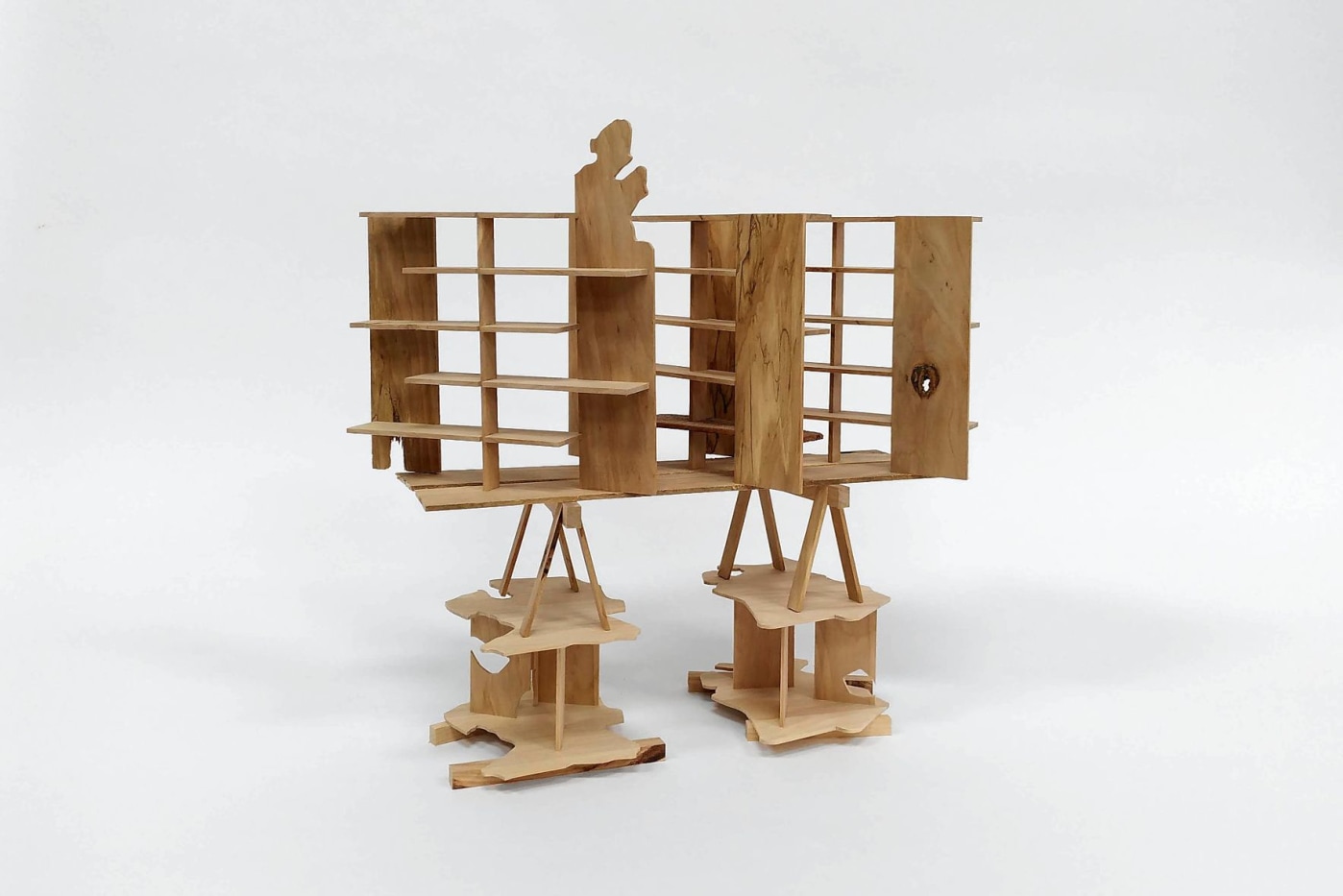 Gerbrand Burger, Josef Albert's for Walter Gropius with Fomitopsis Betulin, 2023, Galerie Fontana