10 july 2026, Flor Linckens
Last chance: the intuitive precision of Mario De Brabandere
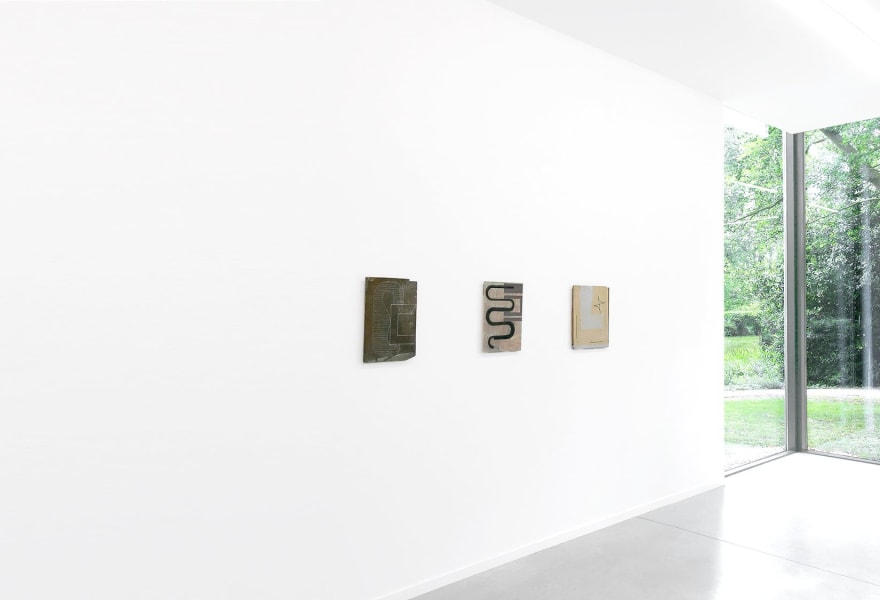
Until 19 July, Hilde Vandaele Gallery in Watou presents a second solo exhibition by Mario De Brabandere. In this presentation, the Belgian artist unveils a series of recent paintings and wall-mounted objects in which his visual language is once again distilled to its essence. His works are characterised by curved lines, abstract forms, geometric planes, bold fields of colour and restrained compositions. These works are often left untitled, as though nothing should distract from what truly matters: the optimal relationship between form, composition, colour, perspective and material. De Brabandere is constantly searching for a state of balance. Rather than arriving there through a preconceived concept, he reaches it through an ongoing process of observing, collecting and making.
Spanning four decades, De Brabandere has steadily built an impressive and diverse body of work. His paintings, drawings and sculptural objects are marked by a striking simplicity, carefully calibrated proportions and rigorous geometric forms. They draw inspiration from familiar motifs encountered in everyday life, ranging from flags to vehicles. At the same time, the artist is equally fascinated by the less attractive aspects of the world around him. Throughout his practice, De Brabandere explores the tension between spontaneity and control, abstraction and figuration, references to art history and newly developed abstract compositions.

In an interview with art journalist Hilde Van Canneyt, the artist offers a glimpse into his way of thinking:
“Everything, absolutely everything I do, is in service of art. Either I’m working with my hands or I’m working in my head. Anything can inspire me. It might be a shape I notice in the street or a particular combination of colours. I always carry something to write on, so I might jot down the curve of a line, for instance. Or if I come across an interesting shape, I’ll go back to analyse it properly and make a sketch. The only way I relax is by watching television. But even then, I find myself examining the background.”
This constant attentiveness to the world around him gradually finds its way into works in which our recognisable reality slowly dissolves into abstraction.
The artist also places great importance on his materials, which, in his view, are far more than neutral supports and instead determine a significant part of the work itself. De Brabandere regularly works with wood, cardboard and paper, often giving these materials a second life. More often than not, they already carry a rich history of their own. He subsequently applies paint in numerous thin, transparent layers, allowing traces of both the material and the making process to remain visible in the finished works.

In an interview with Manuela Klerkx for GalleryViewer, the artist described the sensation of knowing when a work is truly complete, when everything falls perfectly into place.
De Brabandere explained: “Imagine a safe with a combination lock. There is only one code that will open it. Every other code is wrong. Painting is like searching for that single brushstroke, that one colour capable of ‘unlocking’ a painting, like the secret combination of a safe. And just like a combination lock, there is only one way it can work. There is only one correct solution, and as a painter you have to find it. Again and again, with every new work. It isn’t easy, but once you find it... there is nothing more beautiful.”
When De Brabandere's work was presented at Galerie De Ziener in Asse in 2010, a gallery that closed its doors in 2024, it was introduced by Jan Hoet, founder and former artistic director of S.M.A.K. Hoet remarked: “The strong constructivism of [Mario De Brabandere] does not seek to change the world (...) the realised work is an end in itself.” He also described the work as “academic”, praising it for being “grounded in solid professional knowledge”. At the same time, De Brabandere approaches his practice with a deeply intuitive mindset.

Mario De Brabandere was born in Tielt in 1963 and currently lives and works in Ghent, where he studied painting and sculpture at the Sint-Lucas. His work has been exhibited at Teylers Museum and De Vishal in Haarlem, BOZAR in Brussels, the Roger Raveel Museum in Zulte, and Arti et Amicitiae and De Brakke Grond in Amsterdam. In the exhibition 'Van De Wereld' at Park Abbey, his work was shown alongside that of Ann Veronica Janssens and Marlene Dumas. His work is also held in numerous private collections as well as the collection of S.M.A.K. in Ghent.
