13 april 2026, Flor Linckens
Last chance: Wannes Lecompte at Kapel Rozenkrans
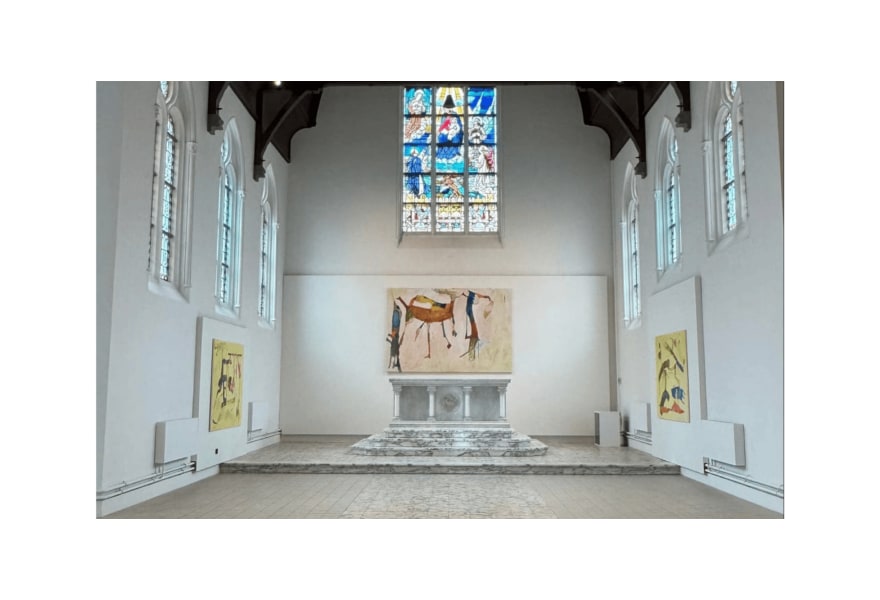
Until 19 April, Wannes Lecompte (EVA STEYNEN GALLERY) presents his work in a unique setting: Kapel Rozenkrans in Oostduinkerke. In the exhibition ‘Seven images and a book’, Lecompte shows exactly that: seven monumental paintings and a “book”, a work on the floor composed of loose, unstretched canvases. A selection of drawings by the artist is also on view at Westhoek Academie Koksijde. Together, the two locations offer a revealing insight into his artistic practice. Tip: on Saturday 18 and Sunday 19 April, Lecompte will give guided tours of the exhibition at 14.00 and 16.00.
For over thirty years, Lecompte has been developing a consistent body of work marked by a distinct slowness. His multidisciplinary practice centres on abstract painting, but also includes frescoes, drawings, performances, video works and installations. He repeatedly returns to the same starting point: not the image itself, but the process of making. Lecompte does not start out with a fixed idea of what he wants to depict. Rather, he is interested in the act of painting itself, as if the image already exists and only needs to be brought into view. For a long time, his credo was ‘The painting wants to be a painting!’.
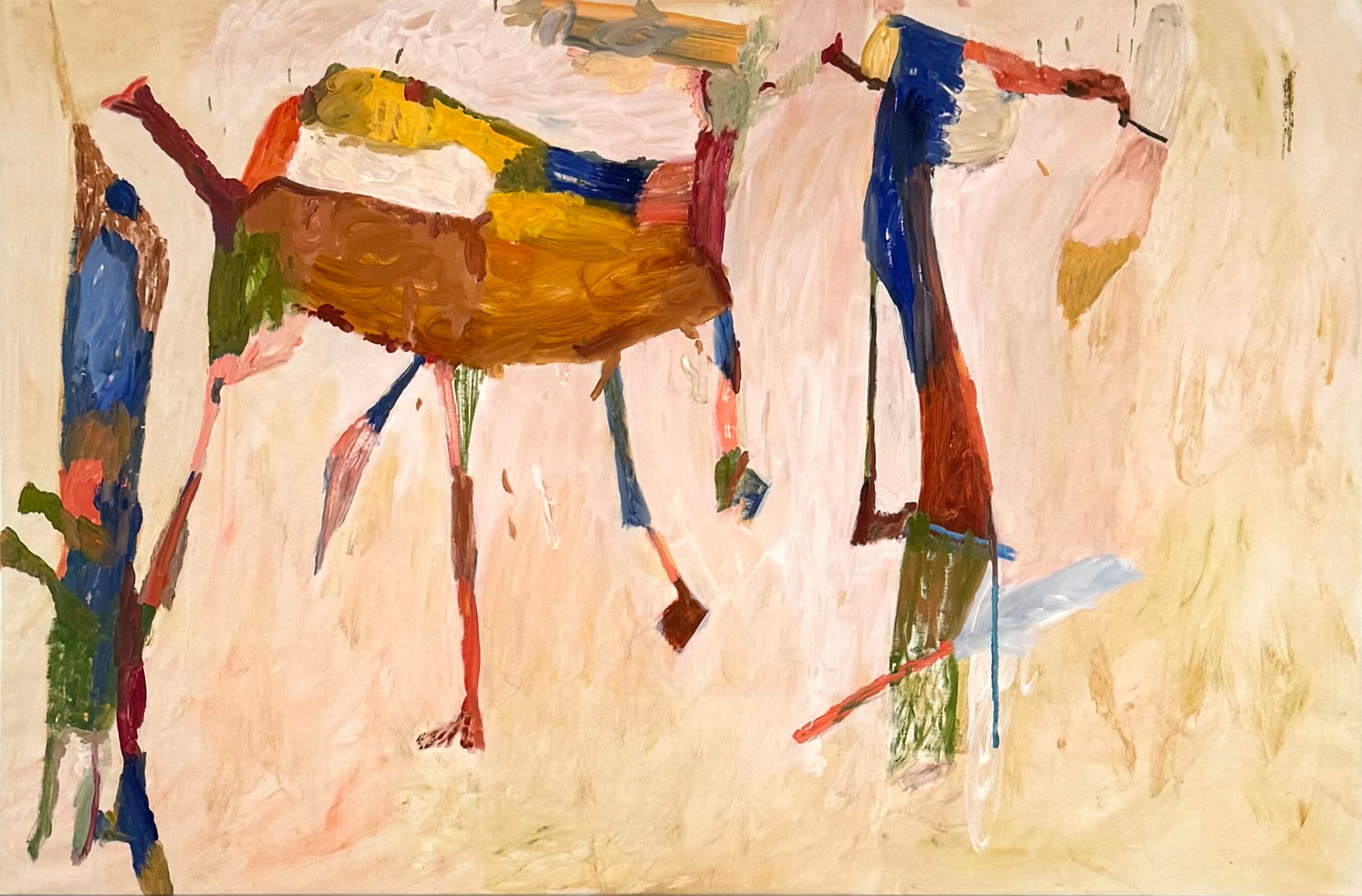
This approach is reflected in the way the works come into being. Lecompte spends quite a bit of time looking at the canvas before he starts, taking what is already there as his point of departure: the structure of the linen, small irregularities or a tension that came into being during the stretching of the canvas. From there, the painting develops without a predetermined end point, through a process of adding, painting over, correcting, experimenting and removing. That is a physical and direct process. His use of colour is equally intuitive, with hues sometimes mixed directly on the canvas itself.
The result is the accumulation of a series of decisions. This also means that the viewer’s gaze is not actively being directed. The mind searches for meaning, while the image seems to shift as the eye adjusts to it. Your eyes follow an arrangement of colour, rhythm, texture, form and direction, and the ways these elements relate to one another within the composition, without a clear hierarchy. At times, something figurative appears to emerge from the abstraction, only to dissolve again. Lecompte’s paintings require time, and he invites us to consider looking as an active effort.

Within the chapel, the works take on an additional dimension through their setting. It is not the first time Lecompte has presented his work in a religious context. In 2017, he exhibited work in the Oude Sint-Agathakerk in Sint-Agatha-Berchem. Two years later, he was commissioned by the municipality to realise a fresco of 184 m² on the corner of Joseph Mertensstraat and Kerkstraat. He executed it using the historical wet-on-wet technique, applying paint to wet plaster, the same technique that was used in the Sistine Chapel.
The work on the floor is also an essential part of the exhibition. It consists of 26 loose canvases, arranged as an open bundle in the space, forming a kind of book that you are allowed to leaf through. By removing the paintings from their frames, they lose their fixed form and turn into something more fluid. It prompts a different way of looking.

Wannes Lecompte was born in 1979 in Etterbeek, Brussels, and knew from an early age that he wanted to become an artist. In an interview with Bruzz, he recalls making a ceiling painting in his childhood home, and discovering years later, upon returning, that it was still visible. He later studied painting at the Weißensee Kunsthochschule in Berlin and at Sint Lucas in Antwerp and Ghent. His work and performances have previously been shown at S.M.A.K., CC Strombeek and De Cacaofabriek, and his work has been included in the collection of the Flemish Community, on loan to S.M.A.K. in Ghent.
In Antwerp, EVA STEYNEN GALLERY concurrently presents the group exhibition ‘The Quiet Between Things’ (until 25 April), featuring sculptures by Veroniek Van Samang and paintings by Chris Meulemans and Ann Grillet.
