02 april 2026, Flor Linckens
Emmeline de Mooij: a female body that takes up space
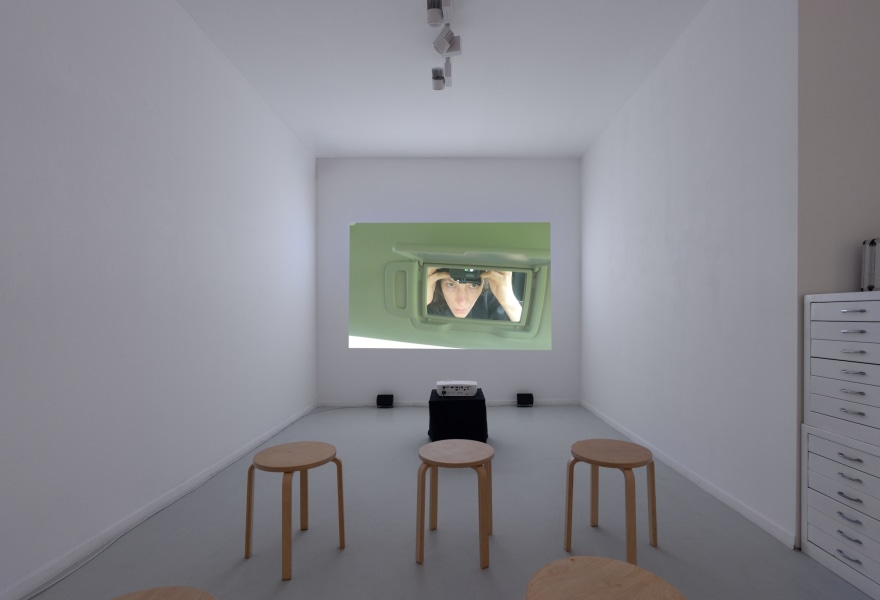
Until 11 April, andriesse~eyck gallery in Amsterdam presents the solo exhibition ‘HELL HOLLE’ by Emmeline de Mooij. She works with installation, performance, sculpture, textile and video, and her practice explores subjects such as care, repair, emotional labour, the female body, female strength and motherhood. Her work departs from the idea that a human being never exists in isolation, but is always connected to other people, to materials and to society in a broader sense. From that perspective, she also raises questions about value: why is care, traditionally coded as ‘female’ labour, structurally undervalued compared to labour that is recognised as ‘economic production’? In her most recent work, other themes come more explicitly to the fore: sexuality, desire and bodily autonomy.
In ‘HELL HOLLE’, De Mooij connects these subjects with female mythological figures and historical representations of the female body, in particular the body that no longer fits within the classical ideal of youth, beauty and fertility. The exhibition therefore touches on themes such as fertility, shame, ageing and menopause, but also on a deeper cultural anxiety surrounding the female body that is no longer oriented towards reproduction. De Mooij approaches that body not as something that has lost its value, but rather as a source of knowledge, experience and strength. In doing so, she shifts the perspective: instead of shame and loss, she foregrounds strength and autonomy.

In 2023, De Mooij travelled to Ireland to research the so-called Sheela na Gig, medieval stone figures depicting thin, older women, opening their vulvas with both hands. These figures, found on churches and castles, are often half hidden by moss and neglect, a striking metaphor. Their meaning has never been definitively established it seems, whether fertility symbols, warnings or signs of regeneration, but it is precisely this ambiguity that seems to interest De Mooij. The research resulted in the exhibition ‘Hell Holle’. At the centre of the presentation is the video work "GoPro HERO" (2026), a reference to the action camera frequently used in male-coded online content such as the world of extreme sports and adventure TikTok creators. De Mooij deliberately reverses that connotation: she is the one who carries the camera, climbs over fences, moves through the Irish landscape and ultimately also shows her own vulva. The film effectively shows what happens when a woman takes herself seriously as an explorer of her own history.

Alongside video, De Mooij also presents textile works, sculptures and etchings on paper depicting Sheela na Gig figures. On the wall, you can see the sweater "HELL HOLLE" (2026). De Mooij spun the wool herself, thread by thread, from French lambswool that she selected for its softness. During the process, she knitted black letters into the surface: Hell and Holle, two names from centuries-old traditions in which older women played a central role. For De Mooij, the choice of material and process is never decorative. The time the making requires and her physical involvement become part of the meaning. Spinning yarn, repairing clothing and endlessly repeating stitches and actions are, for De Mooij, ways of thinking. These are slow processes that run counter to a culture focused on speed, efficiency and continuous production. This connects to her ongoing interest in forms of labour that often remain invisible, precisely because they are so closely tied to care and daily maintenance.
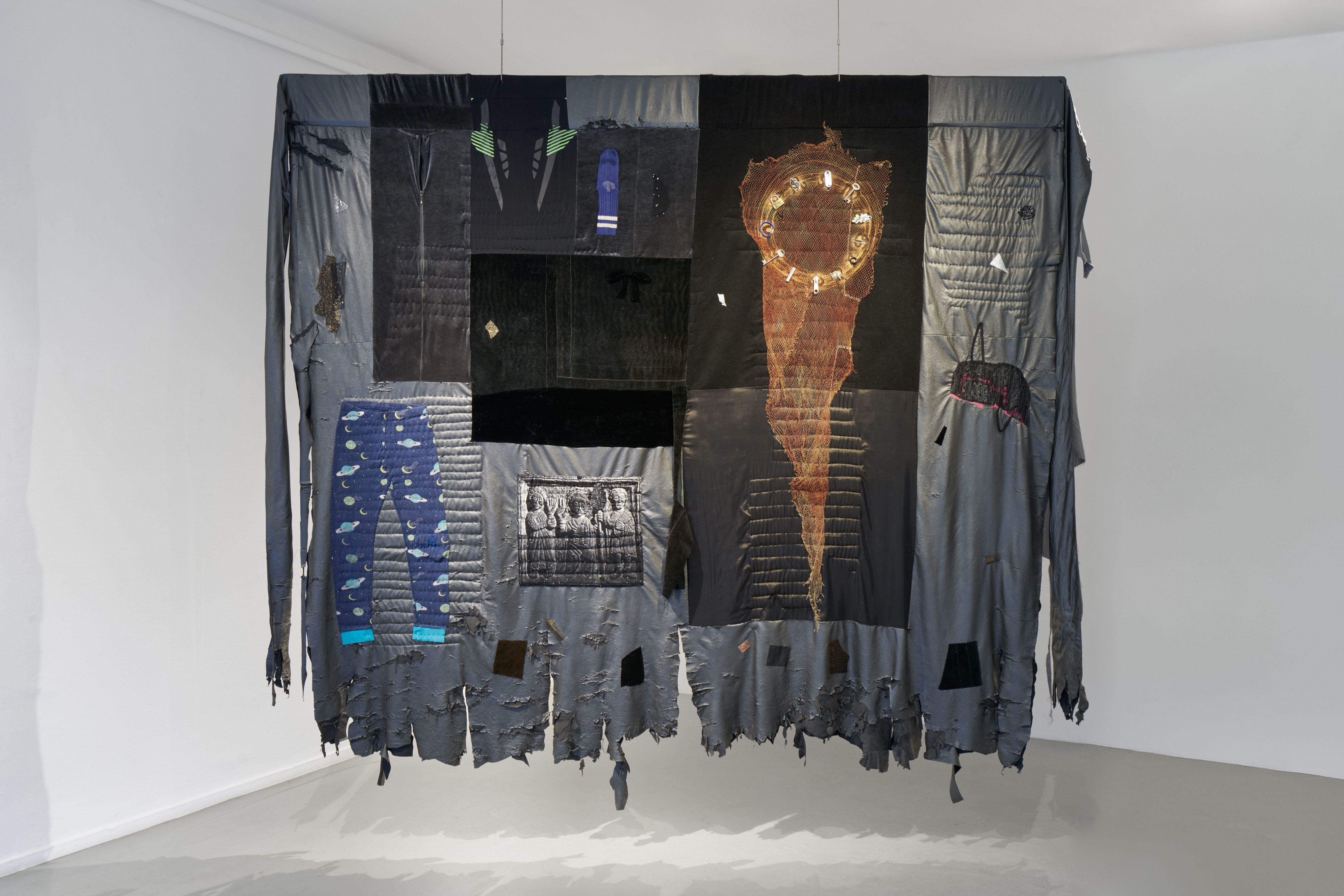
In 2019, De Mooij co-founded the Feminist Handwork Party, an artists’ movement she established together with theatre maker Margreet Sweerts. Through workshops, lectures and so-called sewing circles, they investigate the political and historical dimensions of textile production. Textile was long positioned outside art history precisely because it was associated with women and the domestic sphere. Within the movement, this craft and its inherent intergenerational knowledge are examined as a coded history of women’s lives, and as a form of repair. For De Mooij, material is never neutral, because fabrics carry traces of time, use and the people who have handled them.
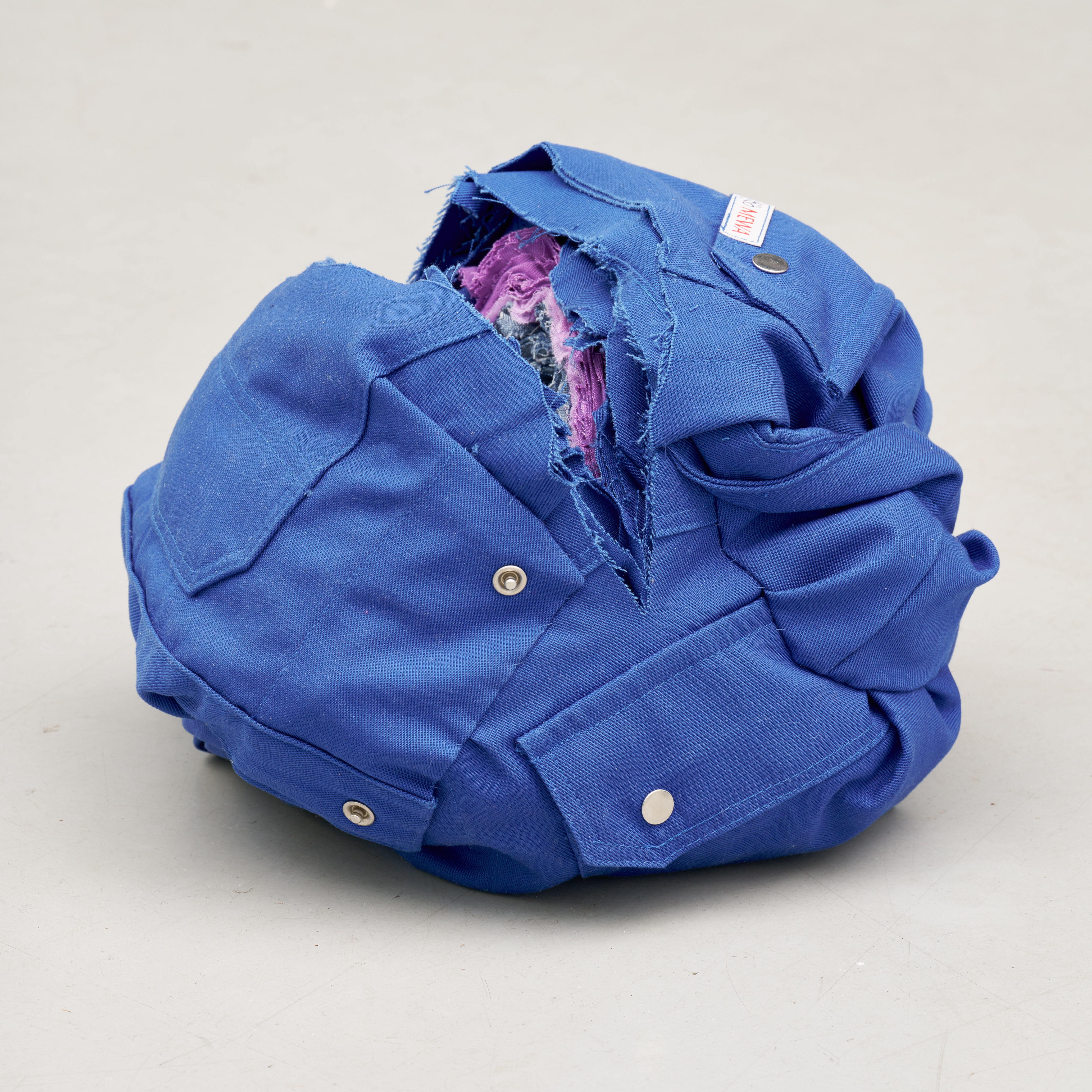
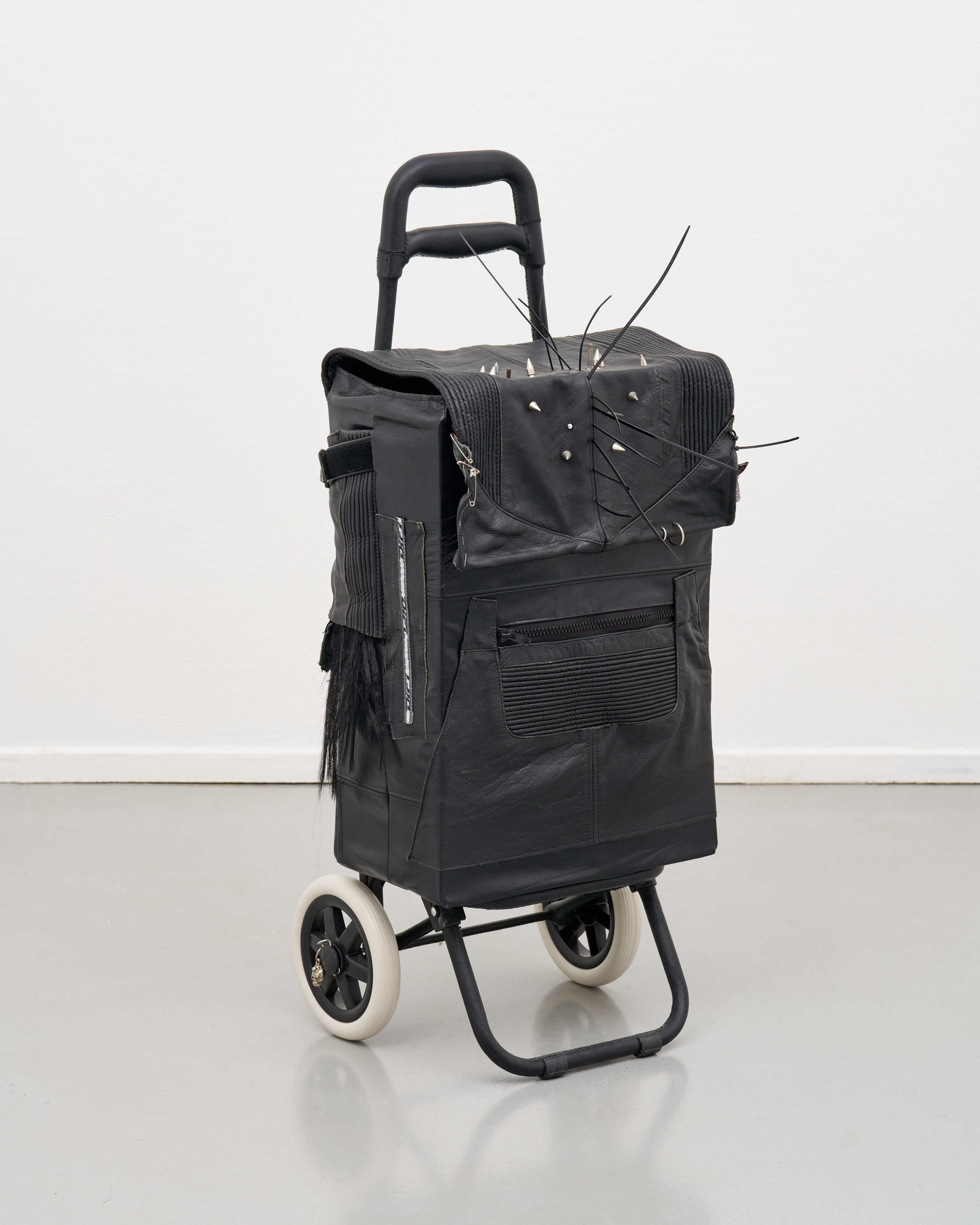
The exhibition also includes the work "Apron of the Giantess" (2026), a large textile work constructed from materials such as cotton, leather, aluminium, rubber and plastic. For her works, the artist frequently uses found materials and old clothing belonging to her children. Here, she presents a frayed apron of superhuman scale, which not only renders the object unusable but also suggests a sizeable mythical body. Elsewhere in the exhibition, you can spot an apparently everyday shopping trolley, often used by older women. But on closer inspection, the metal spikes and the material become visible: leather from found motorcycle trousers. Here too, De Mooij plays with expectations surrounding femininity, age and strength. Some of the textile works, tightly bound into open, spherical forms, evoke the vulvas of the Sheela na Gig.
Emmeline de Mooij was born in 1978 in Delft. She studied Fine Art at the Maastricht Academy of Fine Arts and Design, fashion design at the Gerrit Rietveld Academie, completed a minor in philosophy at the University of Amsterdam and obtained a master’s degree at Bard College in New York. Her work has previously been shown at the Centraal Museum in Utrecht, which acquired her work for its collection, Museum Kranenburgh, Stedelijk Museum Schiedam and the Amsterdam Museum. She was nominated for the Volkskrant Visual Art Prize and the Prix de Rome.
Tip: On 4 April (16.00), Prof. Dr. Hanneke Grootenboer, professor of early modern art and visual culture at the University of Amsterdam, will enter into a (Dutch) conversation with Emmeline de Mooij about the themes addressed in the exhibition. Registration is possible via the gallery’s website.

