19 march 2026, Yves Joris
SOLO, uno, dos, tres, … Leen Van Tichelen at the Settantotto Gallery
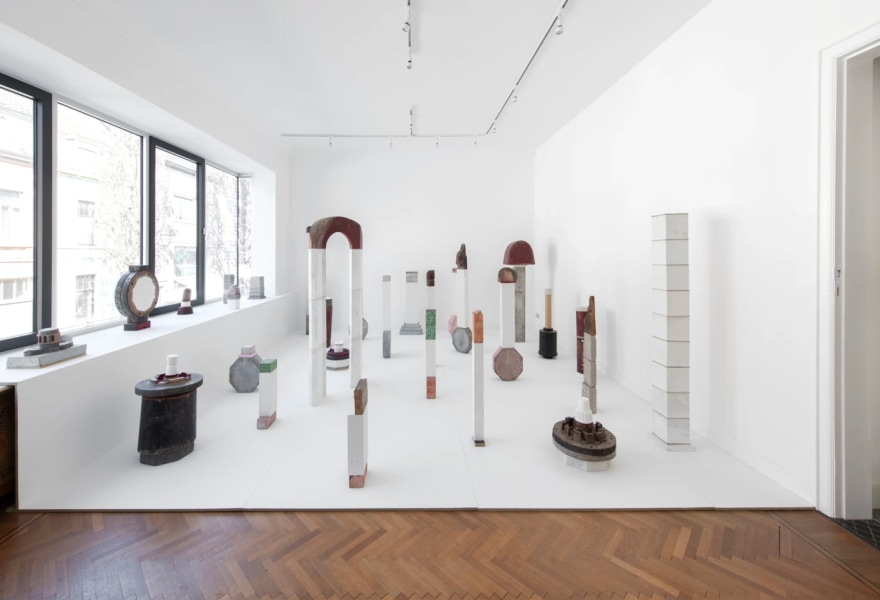
Sometimes, you stand so close to art that the close proximity blocks your view and understanding. I realised this when I saw the different sculptures as grouped together and then took a step back to gain a better overview.
That is how this exhibition works: you get closer than you intended without quite knowing why. The white space the artist constructed for this presentation at Settantotto reinforces that feeling. The floors are white, the field of vision stripped bare, everything reduced to a quiet background in which nothing calls for attention. It is not a theatrical white cube, but rather a space that detaches items from their surroundings, their past and the need to explain anything.
Leen Van Tichelen is presenting her second solo exhibition at the gallery. In contrast to the mysterious title A CONATIVE INTERACTION of her first exhibition, the new title SOLO sounds almost childishly simple and uneventful. The works are numbered in Spanish — uno, dos, tres, … — a sequence that has been growing since 2021 without much explanation. Why Spanish, I asked? The answer I received via Dely was disarmingly simple: there is no real reason. Sometimes, something just is.
And that is precisely where this exhibition begins: not with meaning, but with presence.

Leen Van Tichelen, SOLO, ciento diecisiete - boog, 2026, Settantotto Art Gallery
First, you try to understand
You do what you always do: search for structure, for a reason why a shape stands where it stands, why weight rests here and not there. But with Van Tichelen, you quickly notice that this search leads nowhere.
The exhibition unfolds as a field of separate concentrations. On the windowsill, the floor, against the wall are stacks of concrete, wood, paper, textile and industrial residual forms that are not presented as compositions, but as events. Some elements are easier to recognise: a mould, a fragment, a form that once served a purpose somewhere. But just when you think you understand it, the meaning slips away again.
The work SOLO, ciento diecisiete – arch stays with me as a kind of tipping point: two narrow white columns with a reddish-brown arch on top, both passageway and body. And yet we only see one moment within a larger movement. Elsewhere, forms close in again, compact and concentrated, as if holding their own weight together.
Many of these elements have had another life. Some pieces of coloured wood served as moulds for train carriages, while other fragments come from foundries or renovation sites. They have already carried, shaped, functioned. Here, they carry only themselves.
The sculptures are without pedestals. Or rather, they are placed on windowsills and floors that refuse to be pedestals at the same height as the viewer. This gives them something oddly familiar, as if they have always been there.
I kept searching for logic for too long. The work clearly had no interest in that. After a while, something simple happened: I gave up and logic made way for intuition.
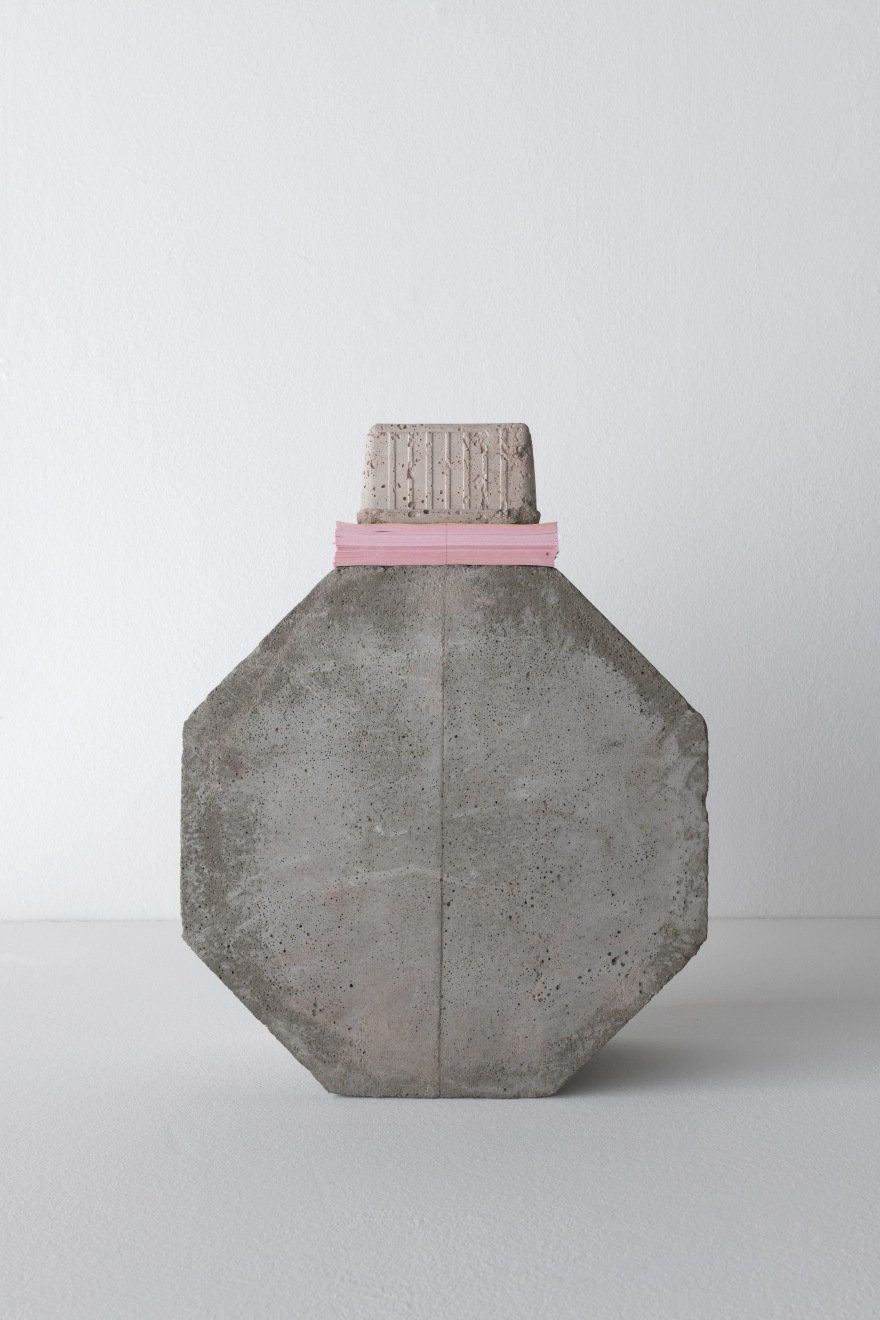
Leen Van Tichelen, SOLO, ciento catorce, 2026, Settantotto Art Gallery
Until it was right
In conversation, Dely explained how the initial arrangement felt too reasoned. There was a plan. Everything was correct, but it did not work. Only when Van Tichelen began shifting pieces without explanation did it suddenly come together.
He said it almost casually: 'until it was right'.
That phrase describes not only the installation, but the entirety of the work. Materials are collected, stacked, removed, placed again. Not until all possibilities are exhausted, but until nothing more needs to be changed. The moment when you feel that this is it.
Nothing is glued. Everything is in its own place. The window remains closed because a sudden gust of wind would send the loose stacks of paper flying.
That fragility is part of the experience. You look more attentively, move more slowly, become aware of how precarious balance can be. What seems simple turns out to be concentrated.
Almost all the sculptures close in on themselves. They concentrate inward, as if holding their own weight together. Open shapes are exceptions — and stay with you for precisely that reason.
The exhibition is not a route, but a series of viewpoints. You move from place to place without direction, continuously reorienting yourself.

Leen Van Tichelen, SOLO, ciento y tres, 2026, Settantotto Art Gallery
Just looking
Dely suggested seeing the sculptures first and then the drawings. From that three-dimensional world, you begin to recognise shapes that return on paper. Stripped of a dimension, the sculptures become circles, octagons, elongated structures. Recognition is different from understanding.
The drawings are independent of each other, arranged in a grid of four rows in which one drawing is always missing. Layers of diluted paint and ink lie over each other like sediment. Sometimes a shape seems to emerge — an animal, an object — but remains out of reach.
Here, too, the logic of stacking repeats itself. Like the sculptures, they consist of layers that support one another without merging. They seem to exist both before and after: sketch and echo.
The same happens among the sculptures. You linger, move on, return. Some work draws you in immediately, others only later. And without reason.
Weight that rises
What Van Tichelen shows here is not a story, but a condition. Her sculptures carry their weight without showing it. Heaviness becomes tension. Mass becomes balance.
The white space makes this visible without emphasising it. Everything becomes proportional: object and space, material and air, viewing and time.
Only when I stood outside again did I notice what the exhibition had accomplished: nothing spectacular, but something elementary. I looked differently at how things were placed.
Perhaps that is the strongest aspect of the exhibition SOLO: that it explains nothing — and stays with you for precisely that reason.

Leen Van Tichelen, SOLO, Settantotto Art Gallery
