12 february 2026, Flor Linckens
Sophie Järvinen Postma: an invitation to feel
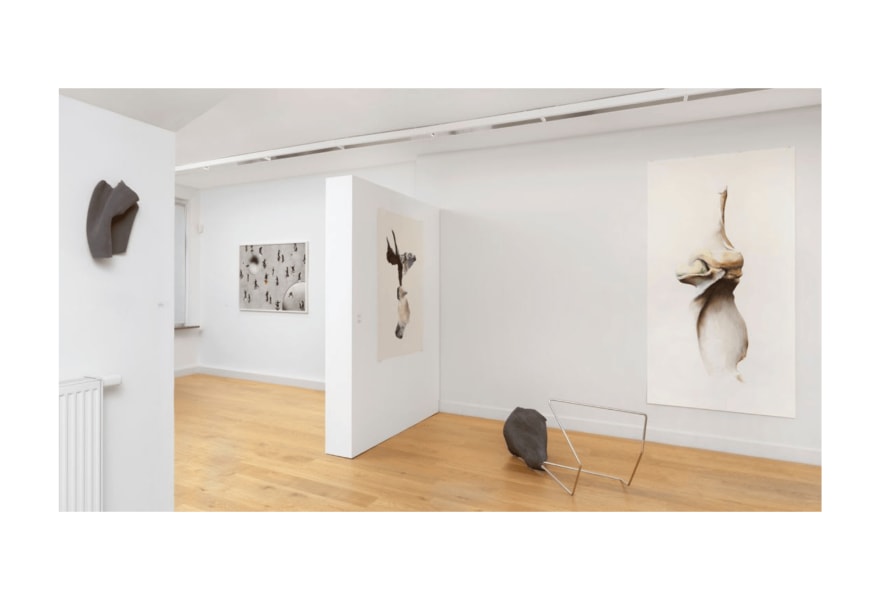
Sophie Järvinen Postma creates two-dimensional works that appear strikingly spatial. Until 28 February, her work is on view at Bradwolff & Partners in the group exhibition ‘First Light’. The exhibition centres on that fleeting, still nameless moment in which something becomes visible and a first, elusive spark occurs, before meaning, interpretation or current affairs take hold.
Postma is also interested in the sensory experience of her work. Her sculptural forms hover between abstraction and figuration and therefore retain an elusive quality. In several drawings, associations arise with flowers or bone structures: organic, elongated and asymmetrical configurations, often constructed along a vertical axis. The carefully composed forms appear dynamic and seem capable of shifting at any moment. They float in an undefined space, weightless and without context, yet at the same time convey a tangible sense of gravity. On 2 April, a solo exhibition of her work opens at Bradwolff Projects in Amsterdam East, the sister project space of Bradwolff & Partners. The exhibition will run until 18 April 2026.

Sophie Järvinen Postma was born in Amsterdam in 1980. She grew up in a creative household and began drawing at an early age. After taking drawing lessons in Florence, she studied Art History at the University of Amsterdam, followed by Architectural Design at the Gerrit Rietveld Academie. This distinctive combination of reflective and practice-based training remains evident in her work. It has shaped her understanding of how images can be constructed with precision.
Within her practice, the artist seeks a refined tension between colour, form, proportion, material and line. Perception and gesture remain central throughout. Postma hopes to engage the viewer, by first seeking a connection with her own feelings and inner experience. She often works on a monumental scale. Two works currently on view at Bradwolff & Partners measure 233 by 125 cm and 141.5 by 100 cm respectively. The white of the paper remains notably present. It does not recede into the background but functions as an active element within the image: the form never occupies the entire sheet.

Postma’s clear compositions frequently arise intuitively, supported by a skilled command of her materials, primarily ink and pastel on paper. The works retain incidental imperfections and capture a certain essence. As preparation, the artist creates physical forms in clay, without deliberately imposing structure upon them. These sculptural experiments then serve as the starting point for her works on paper. She explores how principles of form and spatial presence can be translated into two dimensions. Among her sources of inspiration are Barbara Hepworth and Henry Moore, two sculptors who similarly succeeded in transferring a three-dimensional vision onto paper in compelling ways.
The work of Sophie Järvinen Postma has been included in the collection of the AkzoNobel Art Foundation. In addition to her visual practice, Postma authored the poetry collection ‘Glazen huisjes’ ('Little Glass Houses'), a personal work that captures the rich inner world of a highly sensitive child, for whom sensory experience is not always easily directed or channelled.
