28 november 2025, Yves Joris
Room for dialogue at the TaLe Art Gallery
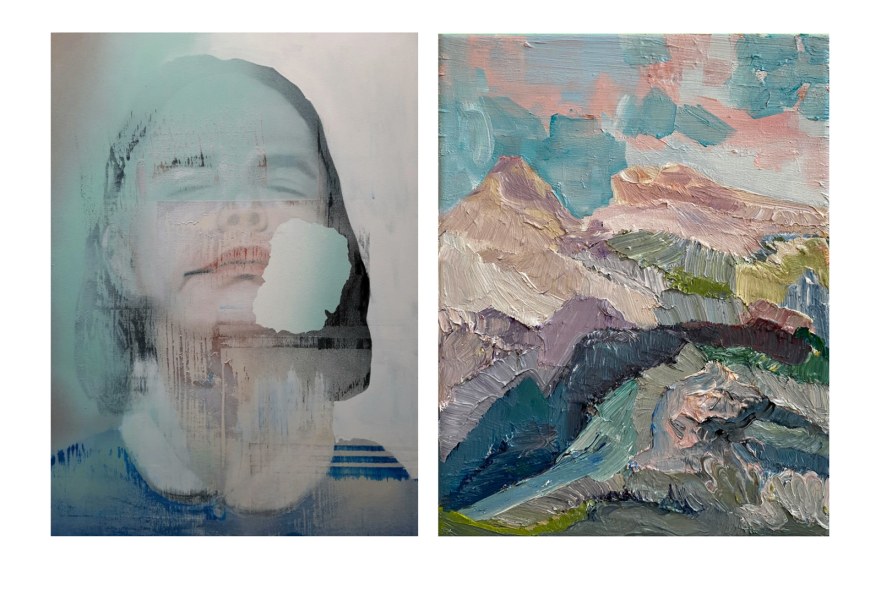
Over the years, I have learned that there are two types of exhibitions: those that tell you what you should see and those that merely leave the door ajar and wait for you to form your own judgment. For me, RE-ASSEMBLED belongs to the second category. It is an exhibition that does not think in summaries or coherence, but in terms of an encounter, shifting, proximity and unexpected friction.
In the exhibition space of the TaLe Art Gallery, Tanja Leys places 11 artists side by side who at first glance seem to have very little in common except for the fact that they all exhibited during the gallery’s first year. Their subject matters differ, their materials do not relate to one another and their rhythms move in opposite directions. And it is precisely for that reason that something can emerge here that none of the individual works achieves on its own: a whole that is not construed, but illuminates through its surroundings, as if each work were a single letter and the sentence that they together form was whispered by no one, yet still rings true.

Annouk Thys, Werk 970, 2025, TaLe Art Gallery
The whole that detaches itself from the parts
Aristotle could never have imagined that his centuries-old insight would become so tangible in a white gallery space. Yet that is exactly what has happened here. His notion that the whole is greater than the sum of its parts is not written as a quote on the wall, but made palpable as an experience in the room. The group of artists gathered here does not form a family, movement or aesthetic community. They share no style, no thematic foothold, no common origin. These artists do not move in each other’s wake—in fact, they refuse to do so. Each work guards its autonomy like an island that insists on defining its own shoreline. And yet, when these islands are placed together in one space, an archipelago is created that no one could have designed in advance. The whole is not stronger because it surpasses the parts, but because it allows them to remain true to themselves. The power lies not in harmony, but in the precise way in which heterogeneity produces meaning.
In RE-ASSEMBLED, the viewer experiences that art is never a monologue. It speaks in dialogue. In the space between an abstract colour field and a ceramic skin, between a portrait and a graphic line, between a digital manipulation and an object that feels almost archaeological, meaning emerges that was not contained in the work itself. The exhibition exists in that in-between space. Here, the unexpected emerges: the whole that detaches itself from the parts and starts to suggest something none of the individual works intended. It is precisely in that suggestion that the exhibition comes to life.
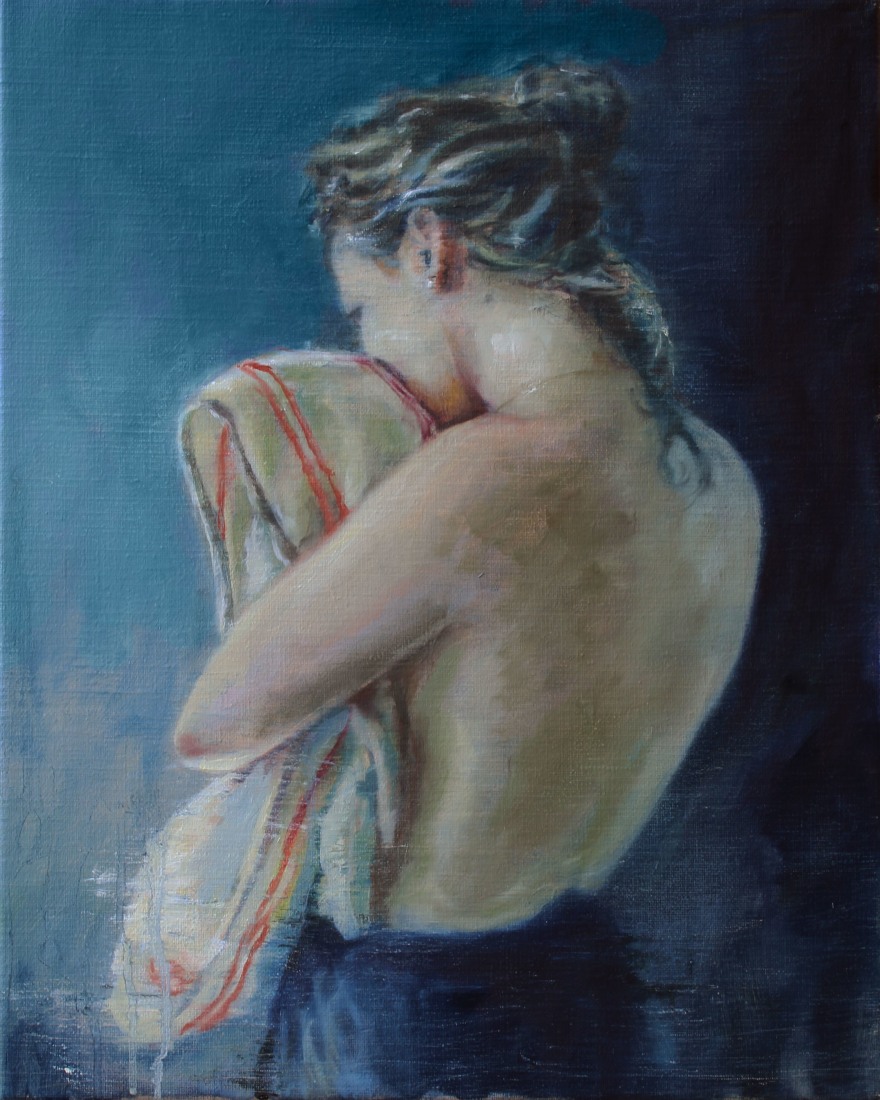
Hervé Martijn, Limited protection., 2025, TaLe Art Gallery
The beauty of not coinciding
The greatest risk of such a group exhibition is that the individual works will confirm each other, reinforced by the curatorial line. RE-ASSEMBLED chooses the opposite route and breaks the reflex of coherence through coherence. The exhibition space brings together artists who do not extend from one another, artists who would never be grouped on the basis of style or theme, but who are brought together because it is the unexpectedness of that combination that creates space.
The beauty of this heterogeneity lies in the fact that nothing here coincides. The works do not touch each other in content or form, but in desire—a desire to show a world that is never singular, but always appears in multiplicity. By not smoothing out the differences, a subtle web of unexpected connections arises: a colour note that seems to resonate in a sculpture, a line that finds an echo in an urban image, a shadow that suddenly suggests a shared ground between two entirely different oeuvres.
It is this search for points of contact that gives the exhibition depth. The visitor does not look for what is common, but discovers how the eye itself begins to assemble. Not consuming, but interpreting. Not following, but discovering. The whole then becomes a space for thinking, a place where different ways of looking intersect.
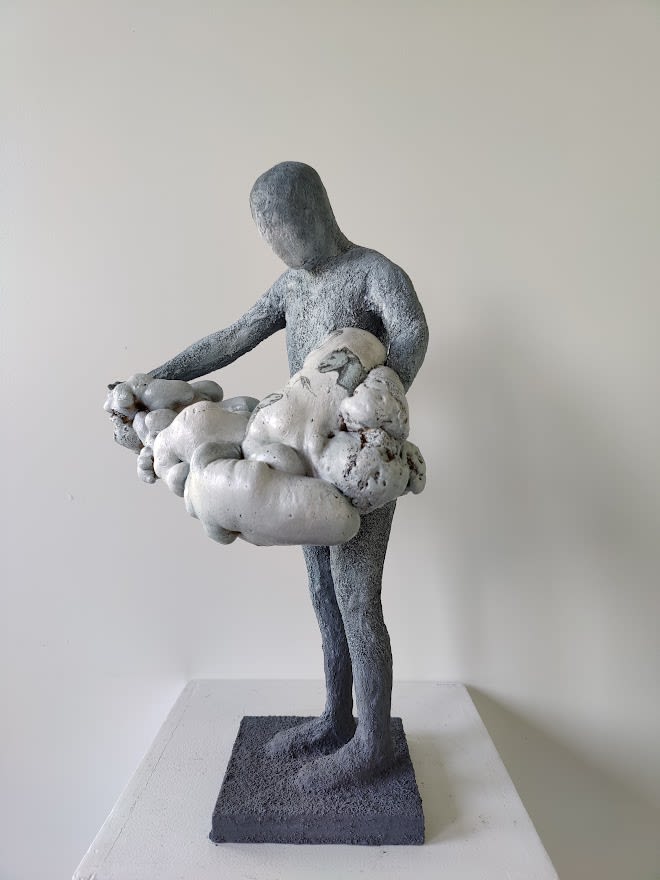
Hilde Van de Walle, IN THE MIDDLE, 2024, TaLe Art Gallery
RE-ASSEMBLED as a philosophy of enablement
The title of the exhibition turns out to be more than a curatorial choice. ‘Re-assembled’ is not a technical term, but a philosophical attitude. The word does not suggest that something was broken and now needs repairing, but that every fragment—however small, strange or incomplete—can become a carrier of new meaning when placed in a different constellation. Re-assembly is not a return to an original form, but an invitation to renewal.
In that sense, the exhibition shows that the world itself is in a constant state of incompleteness. Nothing is finished. Everything moves. (Do we hear Heraclitus in the background?) Everything shifts. Art does not simply confirm this, it reduces it to a human scale, allowing us to perceive it. Every work in RE-ASSEMBLED carries traces of time, attention, failure, reformation and chance. Precisely because of this, it can be absorbed into a whole that is more than its origin. A colour field becomes a memory in a new context, a portrait becomes the echo of a landscape, a ceramic surface becomes a playground for light, meanings shift without losing their core.
WWhen leaving the exhibition, you realise that no single work leaves a lasting impression, but rather the way in which the 11 artists (Hervé Martijn, Philippe Badert, Chris Vanderschaeghe, Anne Vanoutryve, Johan Clarysse, Inge Dompas, Stephanie Gildemyn, Annouk Thys, Manon De Craene, Kathleen Ramboer, and Hilde Van de Walle) have offered each other the opportunity for dialogue.

Inge Dompas Fear of missing out, 2024, TaLe Art Gallery
