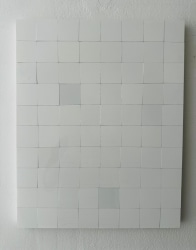
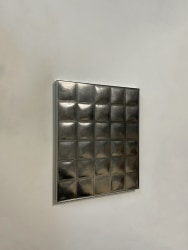
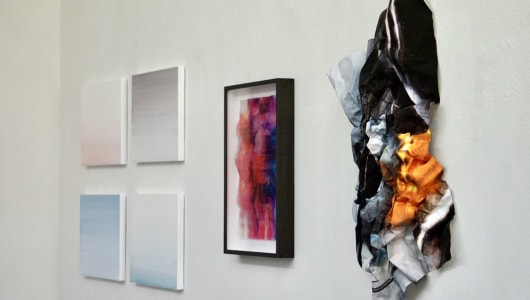
'Like our personality, our reality is not static but in a state of constant shift and change. Nothing is as it appears. A change in perspective sometimes changes everything. This is a mesmerizing aspect of the works of Julia Schewalie, which have an inherently ephemeral and fleeting quality often juxtaposed with a perplexingly unusual use of materials. What at first glance seems to be a perfectly monochrome is, upon closer examination, much more variagated. All of her works unfold in relationship to their surroundings and depend on the light, shadows, movement in their given environments. The way they continuously change their appearance characterizes appeal. The way the surfaces alternate with the light lends the works a dynamic quality; something is put in motion by the viewers and their shifting positions or the change of lighting conditions in the space.'
–from “Beneath the Surface - On the works of Julia Schewalie” by Anna Wondrak (art historian M.A.)
Julia Schewalie’s works are the result of a process of fragmentation that began on canvas and, since 2009, has led to a gradual dissolution of the figure in her work. To overcome what she saw as the apparent stasis of painting, she experimented with various materials, such as cement and shellack, and she produced silkscreens inspired by material studies from Art Informel. Through means of sculpture, she ultimately integrated the element of movement into her work in 2010/2011 and produced her first black paintings.
–from “Beneath the Surface - On the works of Julia Schewalie” by Anna Wondrak (art historian M.A.)
Julia Schewalie’s works are the result of a process of fragmentation that began on canvas and, since 2009, has led to a gradual dissolution of the figure in her work. To overcome what she saw as the apparent stasis of painting, she experimented with various materials, such as cement and shellack, and she produced silkscreens inspired by material studies from Art Informel. Through means of sculpture, she ultimately integrated the element of movement into her work in 2010/2011 and produced her first black paintings.
Artworks
Articles
Media
Highlights
Recommendations
Collections
Shows
Market position
CV




Media
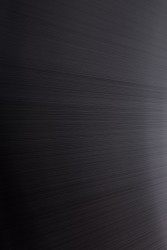
Charred Wood, 2018
Like our personality, our reality is not static but in a state of constant shift and change. Nothing is as it appears. A change in perspective sometimes changes everything. This is a mesmerizing aspect of the works of Julia Schewalie, which have an inherently ephemeral and fleeting quality often juxtaposed with a perplexingly unusual use of materials. What at first glance seems to be a perfectly monochrome is, upon closer examination, much more variagated. Her works unfold in relationship to their surroundings and depend on the light, shadows, movement in their given environments. The way they continuously change their appearance characterizes appeal. The way the surfaces alternate with the light lends the works a dynamic quality; something is put in motion by the viewers and their shifting positions or the change of lighting conditions in the space.
–from “Beneath the Surface - On the works of Julia Schewalie” by Anna Wondrak (art historian M.A.)
About
Beneathe the Surface
On the works of Julia Schewalie
Anna Wondrak
Like our personality, our reality is not static but in a state of constant shift and change.
Nothing is as it appears. A change in perspective sometimes changes everything. This is a
mesmerizing aspect of the works of Julia Schewalie, which have an inherently ephemeral
and fleeting quality often juxtaposed with a perplexingly unusual use of materials. What at
first glance seems to be a perfectly monochrome is, upon closer examination, much more
variagated. All of her works unfold in relationship to their surroundings and depend on the
light, shadows, movement in their given environments. The way they continuously change
their appearance characterizes appeal. The way the surfaces alternate with the light lends
the works a dynamic quality; something is put in motion by the viewers and their shifting
positions or the change of lighting conditions in the space.
Julia Schewalie’s works are the result of a process of fragmentation that began on canvas
and since 2009 has led to a gradual dissolution of the figure in her work. With the aim of
overcoming what she saw as the apparent stasis of painting, she experimented with various
materials, such as cement and shellack, and she produced silkscreens inspired by material
studies from Art Informel. Through means of sculpture, she was ultimately able to integrate
the element of movement into her work in 2010/2011 and produced her first black
paintings.
In conversation with the artist it become immediately clear how fascinated she is by each
individual surface that she describes—an enthusiasm that is readily conveyed to the viewer.
Schewalie’s artwork is not made for rapid consumption and does not reveal itself at first
glance. One must be willing to engage with the reflections, shades, disruptions, and unique
qualities of the surfaces.
The inception of each work is indebted to the artist’s keen eye, which is constantly searching
for unusual reflections. Various materials spark her curiosity, which she then sensitively
combines into a cohesive whole. Taking a minimalistic and conceptual approach, Schewalie
shapes the materials and form of her works but removes herself from the final result, in
order to allow viewers to fully engage in a dialogue with the work itself. Even given the
reductiveness of her work a personal signature is noticeable throughout her oeuvre. She
painstakingly arranges finely sawed and sanded slivers of vinyl records, spanned nylon
threads, specially cut rods of glass, or singed strips of wood into multiple rows or squares.
Piece for piece she minimally alters the angle of the elements employed, as if setting up a
sequence of dominos, arranged in a neat but not static alignment. The light that falls on the
work breaks in a different way depending on the arrangement and creates a lively and
constantly changing surface. Gleaming structures consisting of PVC, asphalt, or automobile
coatings—Schewalie investigates highly unusual materials in a way that does not
immediately convey their origins. Combining sculptural processes with a painterly sensibility,
her aggregate surfaces often leave viewers uncertain as to their consistency.
Although not all her works are black, they all share a monochromatic tonality. At the core of
each work is always the artist’s interest in structures and reflections, not the original use of
the materials. Above and beyond their history, purpose, and significance, the artist is
concerned with the effect of her materials in the here and now, since one perceives each
element differently due to its unique make-up.
Sometimes she creates series of works based on a certain material. In the process the artist
explored the full range of qualities a material possesses and consciously accepts potential
changes. Light is not always the same; every surface fractures light in a different and exciting
way and behaves differently.
Capturing the fleeting instant while losing oneself in the moment, being still. Julia
Schewalie’s works generate contemplative situations. They encourage passing viewers to
take another look, pull them in, invite them to come closer and concentrate on a briefly
illuminated moment of reflection. This conscious immersion and engagement with the
moment also has something comforting. The artist has always found the mood generated by
the masterful lighting effects in Byzantine churches very special, which manages to convey
an almost meditative reverence and thus causes people confront the fleeting nature of their
existence within the eternal cycles of nature. This tension between the finite and the infinite
is palpable in the contemplation of Schewalie’s works. The artist takes us with her on her
journey, searching for a new, transcendental means of perception and enabling us to take
part in her poetic and emotional process of discovery—in which, again and again, she probes
the veracity of materials.
Julia Schewalie was born in 1988 in Krasilovka, in the region of Pawlodar in the Kazakh SSR, today the Republic of Kazakhstan, and she came to Germany in 1996, when her family was repatriated due to its German heritage. She studied at the Academy of Fine Arts in Munich from 2009 to 2015 with Anke Doberauer and Hermann Pitz. She graduated with a “Diplom” in Fine Art. Her works have been shown in solo and group exhibitions in Germany, Russia, Great Britain, Poland, the Netherlands, and Austria. She has not only received two residency fellowships (Center for Polish Sculpture in Orońsko, Poland in 2018 and Vila Paula, Klenová, Czech Republic 2021), but her works have also been purchased by the Bavarian State Painting Collection in 2017 and 2018. In 2018 she was the winner of the Kunstverein Aichach art fellowship.

Anna Wondrak
Shows



Market position
Julia Schewalie was born in 1988 in Krasilovka, in the region of Pawlodar in the Kazakh SSR, today the Republic of Kazakhstan, and she came to Germany in 1996 when her family was repatriated due to its German heritage. She studied at the Academy of Fine Arts in Munich from 2009 to 2015 with Anke Doberauer and Hermann Pitz. She graduated with a “Diplom” in Fine Art. Her works have been shown in solo and group exhibitions in Germany, Russia, Great Britain, Poland, the Netherlands, and Austria. She has not only received two residency fellowships (Center for Polish Sculpture in Orońsko, Poland, in 2018 and Vila Paula, Klenová, Czech Republic, 2021) but her works have also been purchased by the Bavarian State Painting Collection in 2017 and 2018. In 2018, she was the winner of the Kunstverein Aichach Art Fellowship.
Free Magazine Subscription
Articles, interviews, shows & events. Delivered to your mailbox weekly.