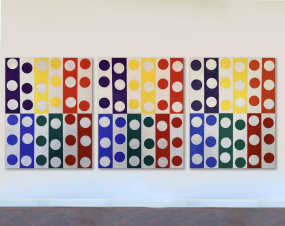
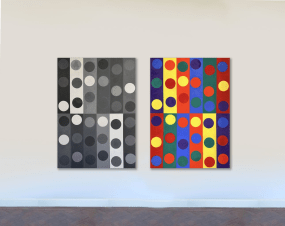
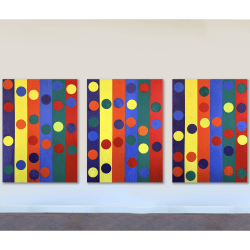
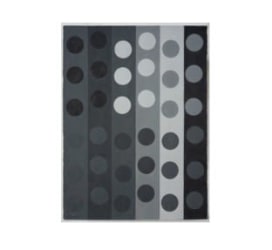
The work of Piet Dieleman is characterized by a precise yet playful discipline. His paintings often present a dialogue between vibrant color fields and more restrained grey works. Together they create a visual tension: the colorful pieces explore the intensity and nuance of color, while the quiet grey surfaces enhance the experience of looking.
Central to his work are the dots—carefully placed spheres that introduce rhythm and structure to the pictorial field. They subtly guide our perception of color. A green dot on yellow feels natural, while the same dot on orange creates tension. Against a blue background, that same green dot almost dissolves into the surface. In this way, Dieleman explores color perception in a manner related to the tradition of Bauhaus color theory.
The dots generate a visual rhythm reminiscent of music. Variations in distance, scale, and density create moments of harmony and imbalance. Large fields with widely spaced dots feel open and spacious, while denser fields concentrate tension. Within this apparent simplicity, Dieleman’s paintings develop a complex interplay between color, rhythm, and perception.
Central to his work are the dots—carefully placed spheres that introduce rhythm and structure to the pictorial field. They subtly guide our perception of color. A green dot on yellow feels natural, while the same dot on orange creates tension. Against a blue background, that same green dot almost dissolves into the surface. In this way, Dieleman explores color perception in a manner related to the tradition of Bauhaus color theory.
The dots generate a visual rhythm reminiscent of music. Variations in distance, scale, and density create moments of harmony and imbalance. Large fields with widely spaced dots feel open and spacious, while denser fields concentrate tension. Within this apparent simplicity, Dieleman’s paintings develop a complex interplay between color, rhythm, and perception.
Artworks
Articles
Media
Highlights
Recommendations
Collections
Shows
Market position
CV


Shows


Free Magazine Subscription
Articles, interviews, shows & events. Delivered to your mailbox weekly.