Edoardo Cozzani (Roma 1993) began his artistic and creative journey in
photography, moving to New York to study at the International Center for
Photography. He remained there to continue his experimentation, which has led
his work to evolve in increasingly multimedia and installation-based directions. His
artistic practice today spans photography, installations, and ephemeral
interventions in the landscape, as a means to investigate the relationships
between human beings and the environment, and to explore potential
integrations and symbioses between anthropic intervention and nature. Particular
attention is given to the study of geological phenomena products of stratification
and chemical processes that the artist often studies, analyzes, and replicates
through the various media in which his practice unfolds. From this approach
comes, for example, the idea of intervening in the landscape with temporary
aluminum elements, using photography to document the integration between
industrial waste materials and the natural environment creating a kind of
archaeology of the future.
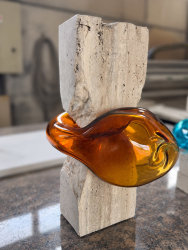
In his photographic work related to these interventions, Cozzani demonstrates a
particular sensitivity in identifying natural textures organically formed through
geological processes. From this body of work, the artist has moved toward a more
sculptural approach, seeking to mimic or test the same biological processes by
combining organic and industrial materials.
Cozzani’s approach to matter is inspired by the latest theories in scientific and
molecular research, particularly assembly theory, which posits that our current
concepts of life, living beings, and evolution are highly limited, given that every
entity is the result of particles in constant motion, recombination, and rebalancing
into new equilibriums. In this sense, Cozzani’s material and photographic
topographies explore, in an avant-garde manner, an optimistic vision of an
alternative and process-based synthesis between the organic and the industrial,
the natural and the artificial thus dissolving the boundaries between anthropic and
natural space.
The aesthetic and environmental presence of his works especially in their recent
integration with light and surroundings has gradually allowed the artist to intersect
his practice with the fields of design and architecture.
Despite the rapid evolution of his work in recent years, Cozzani’s practice still
appears to be in a phase of research and development, seeking ever more
refined syntheses between the aesthetic and scientific spheres, while deliberately
avoiding the risk of falling into mere decoration.
photography, moving to New York to study at the International Center for
Photography. He remained there to continue his experimentation, which has led
his work to evolve in increasingly multimedia and installation-based directions. His
artistic practice today spans photography, installations, and ephemeral
interventions in the landscape, as a means to investigate the relationships
between human beings and the environment, and to explore potential
integrations and symbioses between anthropic intervention and nature. Particular
attention is given to the study of geological phenomena products of stratification
and chemical processes that the artist often studies, analyzes, and replicates
through the various media in which his practice unfolds. From this approach
comes, for example, the idea of intervening in the landscape with temporary
aluminum elements, using photography to document the integration between
industrial waste materials and the natural environment creating a kind of
archaeology of the future.
In his photographic work related to these interventions, Cozzani demonstrates a
particular sensitivity in identifying natural textures organically formed through
geological processes. From this body of work, the artist has moved toward a more
sculptural approach, seeking to mimic or test the same biological processes by
combining organic and industrial materials.
Cozzani’s approach to matter is inspired by the latest theories in scientific and
molecular research, particularly assembly theory, which posits that our current
concepts of life, living beings, and evolution are highly limited, given that every
entity is the result of particles in constant motion, recombination, and rebalancing
into new equilibriums. In this sense, Cozzani’s material and photographic
topographies explore, in an avant-garde manner, an optimistic vision of an
alternative and process-based synthesis between the organic and the industrial,
the natural and the artificial thus dissolving the boundaries between anthropic and
natural space.
The aesthetic and environmental presence of his works especially in their recent
integration with light and surroundings has gradually allowed the artist to intersect
his practice with the fields of design and architecture.
Despite the rapid evolution of his work in recent years, Cozzani’s practice still
appears to be in a phase of research and development, seeking ever more
refined syntheses between the aesthetic and scientific spheres, while deliberately
avoiding the risk of falling into mere decoration.
Artworks
Articles
Media
Highlights
Recommendations
Collections
Shows
Market position
CV
Artworks by Edoardo Cozzani

Free Magazine Subscription
Articles, interviews, shows & events. Delivered to your mailbox weekly.