20 october 2026, Yves Joris
Maxime Brigou: the closer you get, the less you see
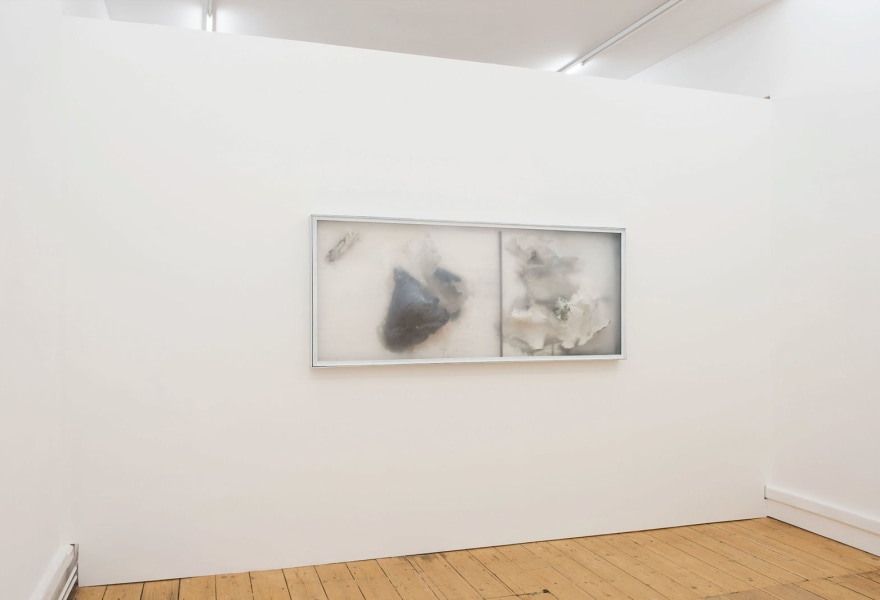
For Maxime Brigou (Roeselare, b. 1992), a work of art does not begin with a plan, but with material that refuses to be easily tamed. Plastic, light, gravity and coincidence all help determine the direction of her sculptural paintings. What at first appears to be an image held in check turns out to be a work in constant motion that challenges the viewer to look longer, move closer and then discover that not everything readily reveals itself.
This month, her work can be seen at three different locations: Fred&Ferry in Antwerp, W/LD W/ND at Re-Rom in Ghent and now also at Barbé Gallery. We met at Ontsteking, the artist-run space she co-runs and where she has her studio, and talked to Brigou about her transition from painting to sculpture, the influence of Peter Buggenhout, the need to work without compromise and her growing impatience with an art world that wants to understand everything in a single sentence.
Your work seems to be everywhere at once. Should I be concerned?
I think it’s a coincidence. I didn’t create very much for a year. It wasn’t a slump — I’ve never really had one — but it did take a while. Now I’m completely back in the game. Three exhibitions at once is a lot, but I work well under pressure. Without a deadline, I start a thousand different things and finish none of them. I think you can feel that in the work, too. I try to make something that is always changing.
Your work hangs on the wall, but I suspect it wanders off at night.
You experience them as paintings, but they’re actually sculptures. Daylight is hugely important, as is the movement of the viewer. When light falls on them, these objects cast their own shadows on the panel behind them. Those shadows are constantly shifting. My heart is still in painting, but there’s an element I can’t achieve with paint alone: light. You can try to paint light, but it’s not really possible. The greatest quality of light is precisely that it continually changes.
 Maxime Brigou, Coup d’œil #27, 2022, FRED&FERRY
At some point, you put down your paintbrush.
That’s putting it rather strongly. Until I was 20, I did nothing but paint, every day, in every format. I showed up to the entrance exam in painting at KASK with about a hundred paintings. I had one photograph of a sculpture with me, a compulsory exercise from secondary school. Philip Metten was on the panel. I gave them my whole spiel and he said, “You haven’t been accepted for painting, but you can come and study sculpture.” I was devastated. Was it really that bad?
Did you ever find out why?
That was the first thing I asked him. I was a bit angry that first week. He said, “You’re going to get bored.” I thought: how could he possibly know that? But he turned out to be one hundred per cent right.
Why does boredom creep into the canvas, but not into the sculpture?
Over the past ten years, I’ve tried to return to classical painting several times. Oil and canvas. There’s something wonderful about that immediacy and paint is a beautiful material. But I can’t keep surprising myself with it.
I need to work with materials I can’t control. Something breaks off. Gravity and UV light change things. I never start with a sketch either, but with whatever happens to be lying around on the floor of my studio. You can’t plan anything and that’s precisely what produces the most surprising results.
Surprising for you and sometimes for the curator as well.
The work at Benedicte Goesaert’s space, Re-Rom, was originally very elongated. The day before I was supposed to deliver it, it just didn’t feel right. I sawed a section off, leaving about two-thirds of the original and suddenly it was right. She’d already seen photographs of something restrained in black, white and grey, with a little pink. She’d even sent them on. When I unpacked the work, the difference was glaring. Her face said it all: oops. But I think that should be allowed.
You want light and movement, yet you seal everything off hermetically. Behind something that is almost, but not quite, transparent.
The work grew out of that contradiction. I think sculpture is a wonderful medium, but a difficult one. A sculpture occupies a space we could occupy ourselves. A painting hangs within a frame and is much easier to grasp, also for the artist. In a way, this frame provides a necessary boundary. Without boundaries, I just keep wandering. From the very beginning, I noticed that I was always pushing my sculptures into a frame, a display case or a corner. I needed that enclosure or it would just go on and on. It’s a constant struggle.
And then there’s the plastic.
It’s a vehicle. You see a piece of polystyrene and immediately define it. That blocks your vision. With the plastic, I show you something, but not quite everything. I don’t want to make ‘dead’ work, a finished story on a sheet of paper saying: look, this is what you are seeing and this is what you should think about it. You have to look inside rather than at me to find the answer. People want to see more, so they move closer. Naturally. But the closer you get, the less you see. Some people get genuinely irritated by that. I find it quite funny.
So, the further people move away from your work, the happier you are?
It’s about the elusive. The title Coup d’œil can be translated as ‘glance’, but it can also suggest a coup, an occupation of the eye, something that captures your attention without revealing itself. It exists beneath the surface.
I’ve always been fascinated by the unknown. Out of curiosity, but also out of a naive belief that you might discover something nobody else knows, only you. I’ve always been drawn to what is forbidden as well. A kind of underworld, places where you’re not supposed to be, things that reveal themselves when they were never meant for your eyes. You catch something out of the corner of your eye and suddenly it’s gone.
These are images that exist in my head, but I can’t summon them back literally. They have no clear outlines. They’re the essence of something. That is what I’m pursuing. I’m looking for a kind of honesty, not just for myself, but as a gift to whoever looks at the work.
But plastic is just plastic, right?
That’s what everyone says. It started with a single roll I was given that measured ten by four metres. One day, I started heating it. I can’t remember why. You can see the molecules shifting. At first, everything sags and then, as it cools, it tightens up incredibly hard. I was almost in a trance. So, I looked into where it came from. It turned out to be recycled plastic from a single batch with precisely these properties. I found one more roll in Antwerp. Now it’s gone. New plastic is UV-resistant; this stuff isn’t. But I actually like the fact that it’s finite.
Is there any material you would never touch?
Valuable materials. We went to Carrara for ten days during art school. The marble there is so beautiful it stopped me in my tracks. I also have very little patience, so at a certain point, treating that material with the respect it deserves becomes impossible. The same goes for wood that’s hundreds of years old. Who am I to destroy it in one go? If you have too much respect for your material, it doesn’t work.
Your work made me think of a confined Peter Buggenhout, with a touch of Berlinde De Bruyckere.
I’m Peter’s assistant and started working with him as an intern ten years ago on the recommendation of a fellow student, but without knowing who he was. Peter looked at my work and said, “I can see why you’re here.” Of course, I didn’t dare tell him I had no idea who he was. He’s 30 years older than me, but when it comes to creating art, we’re on the same wavelength.
People always notice the connection. I found that difficult when I hadn’t yet developed a language of my own. Now I see it more as a compliment. In the meantime, I know very well which ideas and principles I agree with and which I don’t. But everything you surround yourself with has an influence. It’s impossible to imagine what I would have created without him. Visually, the affinity is obvious. In terms of content, I think I’m moving further away.
 Maxime Brigou, FRED&FERRY
What has he taught you?
That you have to show up. Even when you don’t feel like it. Forget that romantic idea of inspiration. Spending a day staring at the wall creates the frustration that fuels the following day’s work. That frustration drives you. If you’re too comfortable, you don’t feel the need to create anything. But being completely depressed blocks you equally as much. You need that grey area, somewhere between necessity and belief.
Perhaps you start tidying up and suddenly see something. You have to create those coincidences for yourself. Make bad work and then destroy it again. Keep tinkering, keep struggling. Every so often, there’s a magical moment. Nothing compares to it, but it disappears just as quickly. So, you carry on.
That feeling only comes when you dig deeply into yourself while creating something. If you don’t throw yourself into it completely, life is easier. But the reward never comes either.
Did you grow up with art?
Absolutely not. My father is actually very good at drawing, but he never did it. The only art book in the house was something he got for free somewhere. Bosch. Every Sunday afternoon. I know it by heart and it’s deeply ingrained in me. Apart from that, I read my way through the entire library in Roeselare.
School just didn’t work for me. I wasn’t defiant, but my mind was simply always somewhere else. I am a dreamer and extremely forgetful. I find it impossible to concentrate on things I find boring or pointless. It feels like torture. At the same time, I can become obsessively absorbed in something and I have a lot of discipline. A good combination, but not one that helps you do well in school. I simply couldn’t follow rules that seemed pointless to me. Through someone who knew someone I heard about a school where you could study drawing. That’s how my life has been: no plan.
Bosch on Sunday afternoons. Has that always stayed with you?
I don’t get my inspiration so much from other artists as from ideas and everything I surround myself with in everyday life. But the Old Masters are important if you want to understand my work, especially the Christian scenes. You can see it in the colours and compositions. It happens almost instinctively.
What affected me was never the horror depicted in those paintings or their glorification of it, but the feeling they gave me. I often had no idea who was being depicted or why someone’s head had to be chopped off. But that didn’t make the impact any less powerful.
It’s the same with films. I get so absorbed in the images that the story passes me by completely. I just watch a succession of images.
How much of a story does an artwork actually need?
That’s exactly the question behind the series of large works I’ve made over the past two years. They’re called Who Needs Action When You Got Words, after the Meat Puppets. How much of a story do you need to evoke a feeling?
Not in the way Rothko does it, as his work is genuinely abstract. My work isn’t abstract, but it isn’t really figurative either. Where does one end and the other begin? And at what point in that in-between space does the story disappear?
That’s where something emerges that your gut and your heart recognise, without you being able to put your finger on it straight away. I don’t want to fill in all the blanks. There has to be the opportunity for people to contribute something: memories, associations, feelings.
And now you’re learning Arabic.
I’d become a little bored with always approaching things through the lens of our own Christian history. I was looking for a fresh perspective on that question of narrative. I started learning the language because it’s so poetic and visual, completely different from anything I’d ever experienced in language before.
In the religious art of the Islamic world, the divine becomes tangible through calligraphy, geometry and ornament, without being represented in human form. Letters, rhythm and repetition carry the meaning. It’s the same question I ask in my own work. How do you make something tangible without depicting it? And how much do you need to recognise to be moved by it?
 Maxime Brigou, FRED&FERRY
From Bosch to Rothko to calligraphy. So, what actually drives you?
Dissatisfaction usually. I’m permanently dissatisfied.
I’ve rarely seen anyone laugh so hard at those words. Normally, you’d expect a rather sour expression.
I am happy, but dissatisfied. As a student, I read a lot of German philosophy and went too deep into nihilism. Sometimes you read a book and think: I’ve already figured that out. That’s what happened with Nietzsche and Hegel.
As a student, you haven’t read all that much yet, so you identify too strongly with the first thing you recognise yourself in. Hence that brief but intense period. Since then, I’ve read much more and can now put certain lines of thought into perspective. The nihilism itself is no longer there, but I carry its essence with me. The search for value, for meaning, remains part of who I am. You can find peace in the notion that you don’t matter. You then simply have to find your own sense of worth.
What’s the best compliment you’ve ever received? Something that gave you wings for a few days, nihilistic wings perhaps.
As a West Fleming, you’re not supposed to blow your own trumpet. Honestly, I don’t get that many reactions or I don’t believe them. Experiencing art is personal, just as its creation. As with so much in life, that’s an enormous contradiction.
Sometimes, that loneliness makes me very sad. At the same time, it’s the most beautiful thing around: experiencing something so completely on your own that you can’t explain it to another soul. A musician gets an immediate response while on stage. Someone who comes up to me and says they like my work has already rewritten that sentence in their head 30 times. How spontaneous is it by that point?
Young artists today have to fit into a box.
And that box is called standing out. An impossible contradiction really. Your work has to be marketable and summed up in a single catchphrase. What is your work about? Sorry, it’s about so many things. By the sixth sentence, I can see people have already stopped listening. People don’t make time any more.
Five hundred likes, four hundred and ninety people at the opening. They remember what they drank.
But not the artist’s name.
With Ontsteking, you’re doing something about that. Is it a gallery?
Absolutely not. It’s an artist-run space. Eva Dobbels and I have been running it for ten years now. Lenny Vervaeke joined us four years ago. As recent graduates with no money, we couldn’t find anywhere to show our work professionally. We then got this space. There was nothing here: no stairs, no door, no water, no electricity. We spent two years renovating it, every weekend and every holiday.
The city supports us just enough to cover the artists’ fees, insurance and rent. We want to occupy that grey area: too early in their development or too edgy for an institution, not commercially viable enough for a gallery.
You’re represented by Galería Hilario Galguera. What are your experiences with the art market?
It’s a double-edged sword. A gallery supports you, but also pushes you towards selling. Everyone thinks my work is large. To me, these are the small pieces. I’m trying to work on a smaller scale now because there’s demand for it, but it doesn’t feel right yet.
That’s why I continue to work for Peter. Everything the studio earns goes right back into the studio. That way, I don’t have to compromise. If it were about money, things could move faster. In that case, I’d be in the wrong line of work.
And when someone does buy a piece?
I think: wow, thank you. People are spending their hard-earned money on it. And they want to live with it and hang it above their sofa. I think that’s fantastic.
I don’t have any art in my own home. There’s already so much to take in here. If I’ve seen something, that’s enough for me. Roland Barthes writes that you don’t want to own a good photograph. You want to be inside it. That’s how art works for me as well.
 Maxime Brigou, FRED&FERRY
