20 october 2026, Yves Joris
Quand le fleuve devient arbre: George De Decker at Gallery Sofie Van den Bussche
For George De Decker, the idea for this exhibition began with a stone. It was neither a monument nor a gravestone, but an irregularly shaped lump, green and grey, with lichen caught in its folds, the sort of stone you pick up when on a walk and take home with you to put on your desk, where it then sits silently, offering inspiration.
De Decker was unable to paint for a year due to circumstances, as the discreet euphemism goes. A painter who does not paint is like a river at low tide: the riverbed is still there, but the water is gone. He surrounded himself with sketchbooks, while others devote themselves during difficult times to bottling jam or working in the garden. The stone lay on his desk. Slowly, the pages began to fill with small drawings.
In ancient China, scholars would place an oddly shaped stone on their writing desks. They called such a stone a gongshi (a scholar’s rock): a mountain in miniature through which the mind could wander without ever leaving the room. I don’t know whether De Decker knew this. It doesn’t matter. The stone knew.
At first, he wanted to paint the stone in painstakingly realistic detail. It didn’t work. It wasn’t De Decker. Painting a stone is a little like keeping a river in a bucket: you have the water, but you’ve lost the current. Incidentally, his attempt can be seen in the exhibition: a stone in grey and white against a black ground, neat, convincing and a little self-conscious, like a first version that knows it is a first version. He left the work linger for a while. On his website is the sentence that sums it all up: It started with one line. From that single line came others. The paintings followed one after another and they kept on coming.
 George De Decker, Quand le fleuve devient arbre I, 2026, Gallery Sofie Van den Bussche
Quand le fleuve devient arbre
The title is French, which is no coincidence. There are two words for a river in French: a rivière flows into another river, while a fleuve flows into the sea. It is the river that comes to an end, that loses itself in something greater. De Decker chooses the word for the current that disappears, but instead of allowing that current to vanish into the sea, he lets it become a tree.
Anyone who has looked down on a river landscape from an aeroplane will recognise the image. A river and its tributaries branch out like a tree’s crown. The water finds its way, divides and comes together again. Look long enough and you no longer see a river, but a tree. Nature seems to pay little attention to the boundaries we draw between things.
And then there is the reflection. A tree on the riverbank stands twice: once in the air and once upside down in the water, its crown resting in the riverbed. In the reflection, the tree itself becomes a river, its branches flowing out across the surface of the water until the slightest breeze makes the image fall apart.
It can be read the other way round as well. A tree is a river that has learned to stand upright. Its sap flows upwards, against gravity, towards the light. And anyone who has looked at a tree reflected in water knows how fleeting such an image is. A single gust of wind is enough to turn what was a tree a moment ago into lines and ripples.
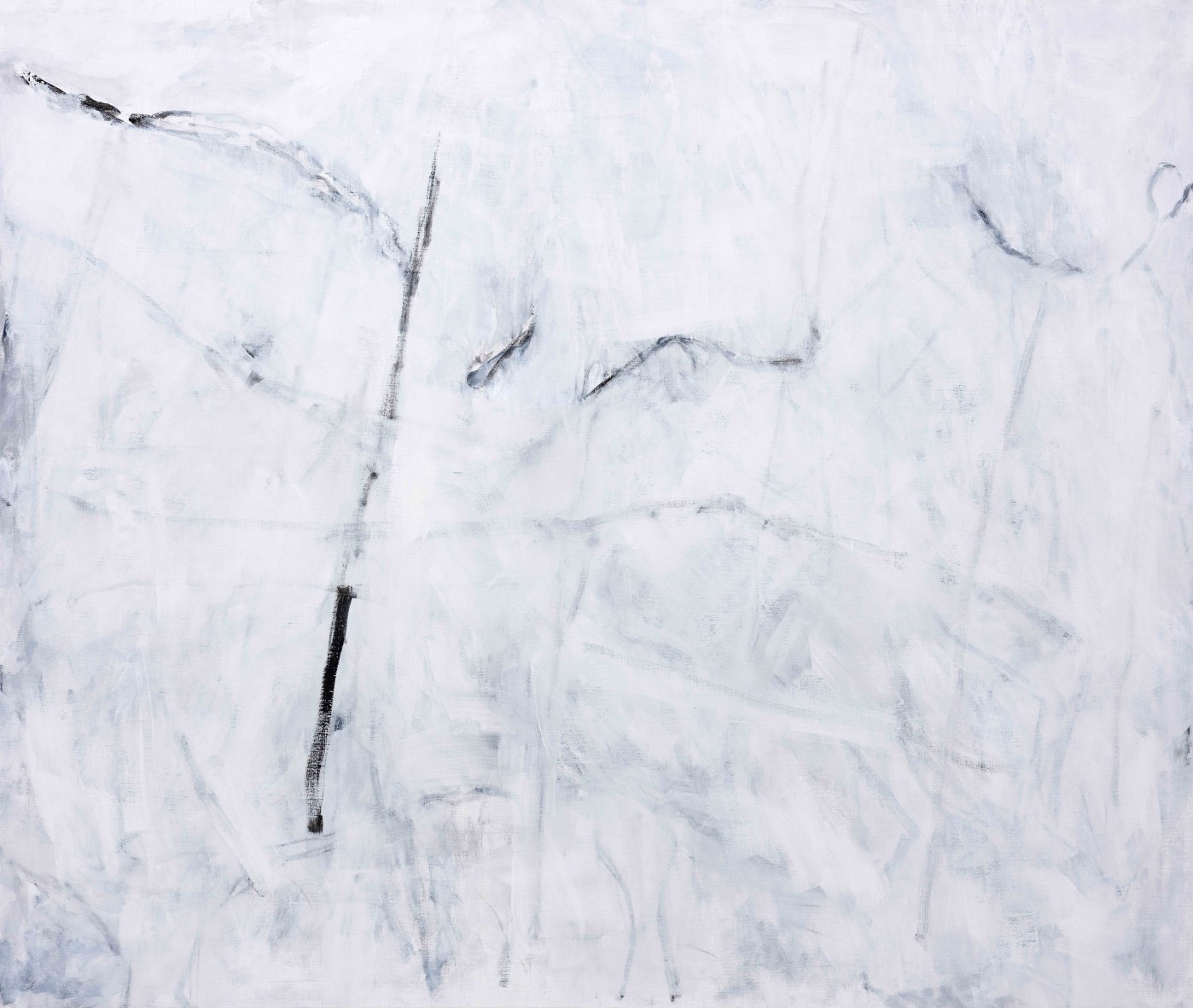 George De Decker, Quand le fleuve devient arbre II, 2026, Gallery Sofie Van den Bussche
The white that isn’t white
The dark works of art preceded the lighter ones. They emerged during a dark period, explains Sofie Van den Bussche, until the moment came when he thought: c’mon, it’s time to get past this. Circumstances gradually improved. Things began to bud, she says, and the light began to emerge. It is a much nicer word than recovery. Recovery sounds like a rehabilitation centre. Budding sounds like March, even in October.
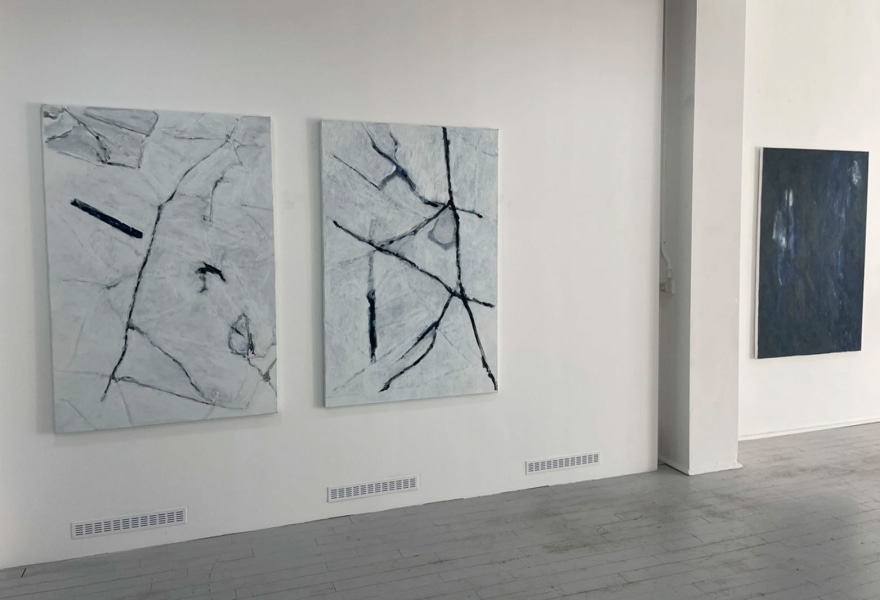
Take the large canvas covered in black lines, for instance. A white surface, but not an empty white. Beneath it, grey traces shimmer through: old lines that have been painted over but continue to be visible. In a river landscape, such severed meanders are known as oxbow lakes: channels in which the water once flowed, still bearing witness to the river that shaped the land. The canvas is full of them. The white is not a background, but a riverbed.
Across it run black lines in charcoal and paint. They are branches, cracks, veins, rivers on a map — all at once. Some descend towards the bottom edge and stop abruptly, like roots searching for water or branches letting go. The work is definitely abstract, but not in the way a geometric plane is abstract. It is abstract in the way a reflection is abstract: you recognise everything and yet cannot grasp anything.
Robert Ryman devoted his life’s work to proving that white is not emptiness. De Decker has no need for that proof. He simply uses white as a river uses its banks: to flow somewhere in between.
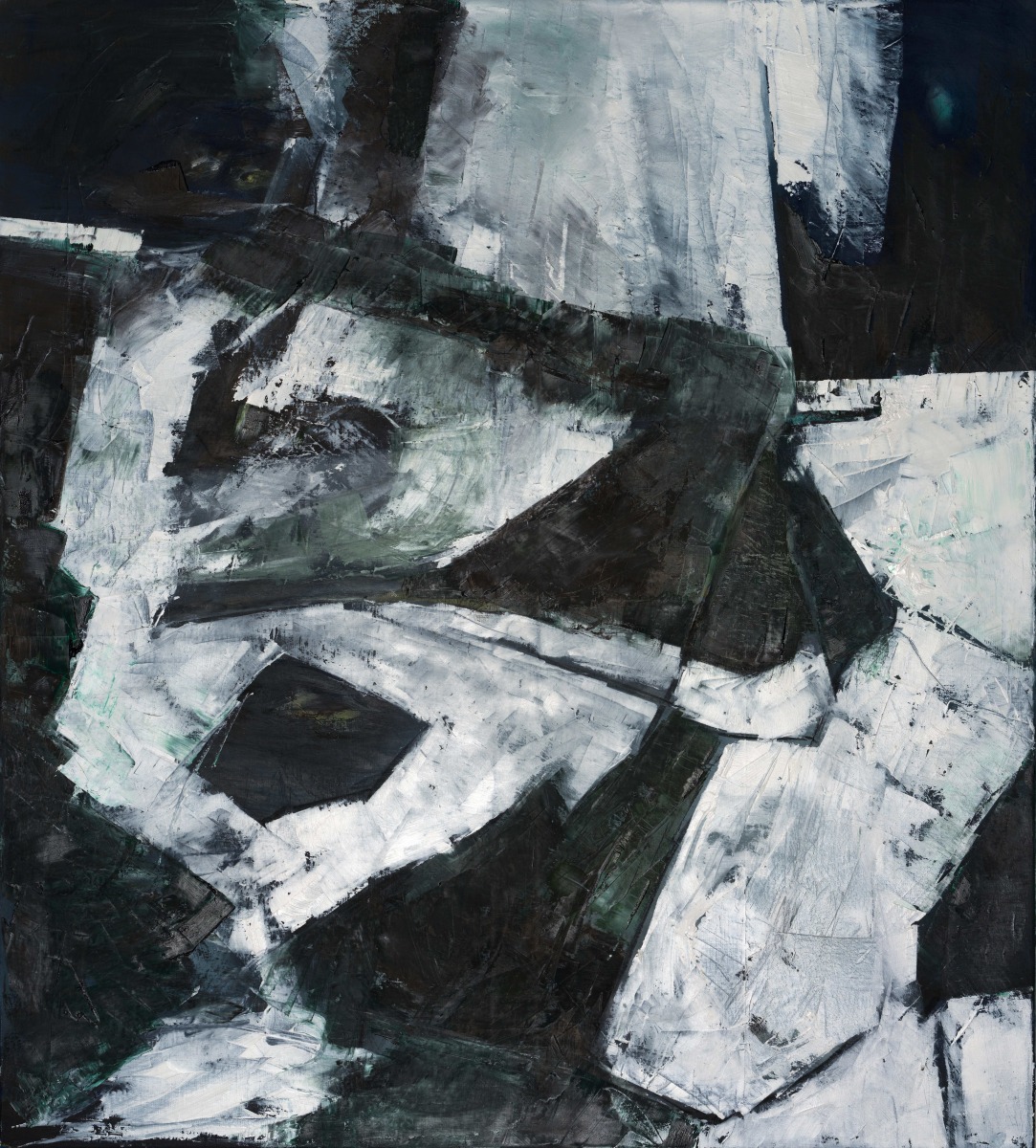 George De Decker, Quand le fleuve devient arbre XI, 2026, Gallery Sofie Van den Bussche
Downstream in the riverbed
Descending the stairs, you enter a small room with an armchair. It is quiet, intimate, secluded. You are given time or you take the time. Three short videos play in the room: reflections of trees in water, branches rippling, settling and rippling again.
De Decker is also a composer. He usually writes the music first and paints afterwards. This time, he took a different approach by painting and composing simultaneously. Two currents from a single source. The images are also based on the music. Anyone familiar with Wit in wit, his reworking of Bach’s Goldberg Variations, will recognise his way of thinking: a single theme that keeps branching out until the variations form a crown.
The real masterstroke of this exhibition is the staircase. Having been downstairs and returned to the ground floor, you see the canvases differently. The lines are moving now. The water is in your eyes. It keeps growing, says Van den Bussche, and she is right. A painting hangs still, but in the meantime your gaze has become a river.
Under the glass dome
And the stone? It stands in the window beneath a glass dome on a black plinth, like a relic in a cathedral. It is small and the oldest object here. On the wall beside it hangs its painted counterpart. Model and portrait in the same room, the kind of encounter that tends to be awkward between people. But the stone seems untroubled by it.
The street is reflected in the glass dome. You can see the façades of the buildings and a construction crane rising above the rooftops like a steel tree. Cars, cyclists, passers-by: the bustle that comes knocking at the front door once more. Everything slides across the dome’s curved glass surface, distorted and fluid, while the stone beneath remains utterly unmoved.
Perhaps this is the finest image in the entire exhibition and it does not hang on a wall. Around the stone, the city becomes fluid, just as it does in the videos downstairs. The river becomes a tree, the city becomes water and the stone looks on. It set everything in motion without shifting a millimetre. That is the privilege of stones. And of muses.
George De Decker - Quand le fleuve devient arbre is on view until 7 November at Gallery Sofie Van den Bussche in Brussels.
 George De Decker, Quand le fleuve devient arbre, Gallery Sofie Van den Bussche
