25 september 2026, Yves Joris
Flesh and fiction: BARBÉ plays on two boards at once
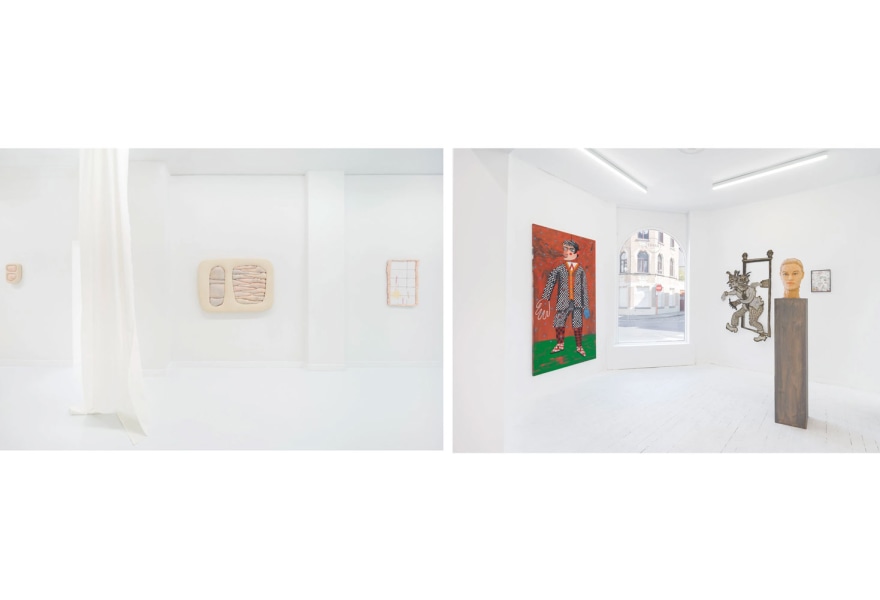
On the one hand, there is a skin that keeps growing. On the other, there is a soul that refuses to be pinned down. BARBÉ has both, one door apart, and yet they feel like two extremes of the same question. What is a body without a story? And what is a story without a body? I walk from one space to the other, noticing how quickly the switch flips. With Jens Kothe, you are looking outwards, at surface, at skin. With Balkenhol, Jacques-Vossen and Lutgens, you are looking inwards, at exactly who is hiding beneath that skin. Together, they do not form a double exhibition so much as a conversation between two rooms that happen to share the same owner.
Standing beside a wall-mounted work by Jens Kothe, gallery owner Oliver Barbé tells me that with this artist, he has the sense that the work would keep growing if you left it hanging for a year, as if pieces would have been added to it.
Kothe, born in 1985 in Germany, lives and works in both Bochum and Düsseldorf. He studied with none other than Andreas Gursky, although there is nothing of his teacher's subject matter found in his work. While Gursky flattened the world into a surface of a thousand details, Kothe zooms in on a single fold of skin. Photography, he claims, is structurally embedded in his sculpture. You zoom in on a hand and end up in a landscape of nail, skin and hair. Barbé shows me a photograph of someone who has just come out of a swimming pool and if you look closely, you can see the ripples in the water, the variations in colour across the skin, the shadow that makes the body seem alive. You then look at the walls beside it and see the same impression translated into stuffing and silicone.
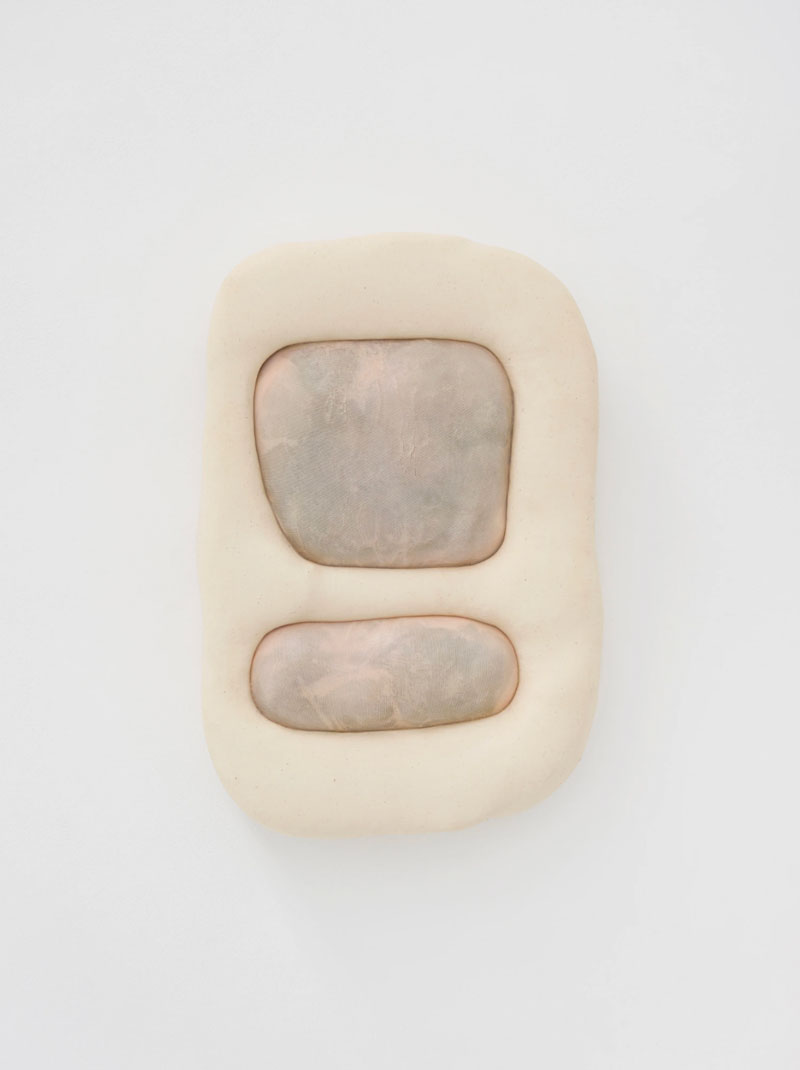 Jens Kothe, Stressed Membranes Tiny VII, 2026, BARBÉ
Literally, as well. A work such as Stressed Membranes Tiny VII is made from stuffing, wood, staples, acrylic, pigments, fabric, stretch film and epoxy: two muted, skin-coloured cushions embedded in a softer frame, directly reminiscent of a fingerprint without ever actually being a finger. It is this ambiguity that Kothe seeks to achieve. His forms suggest parts of the body, but could just as easily be a piece of upholstery or industrial component, and that uncertainty gives the work its strange, almost hungry presence.
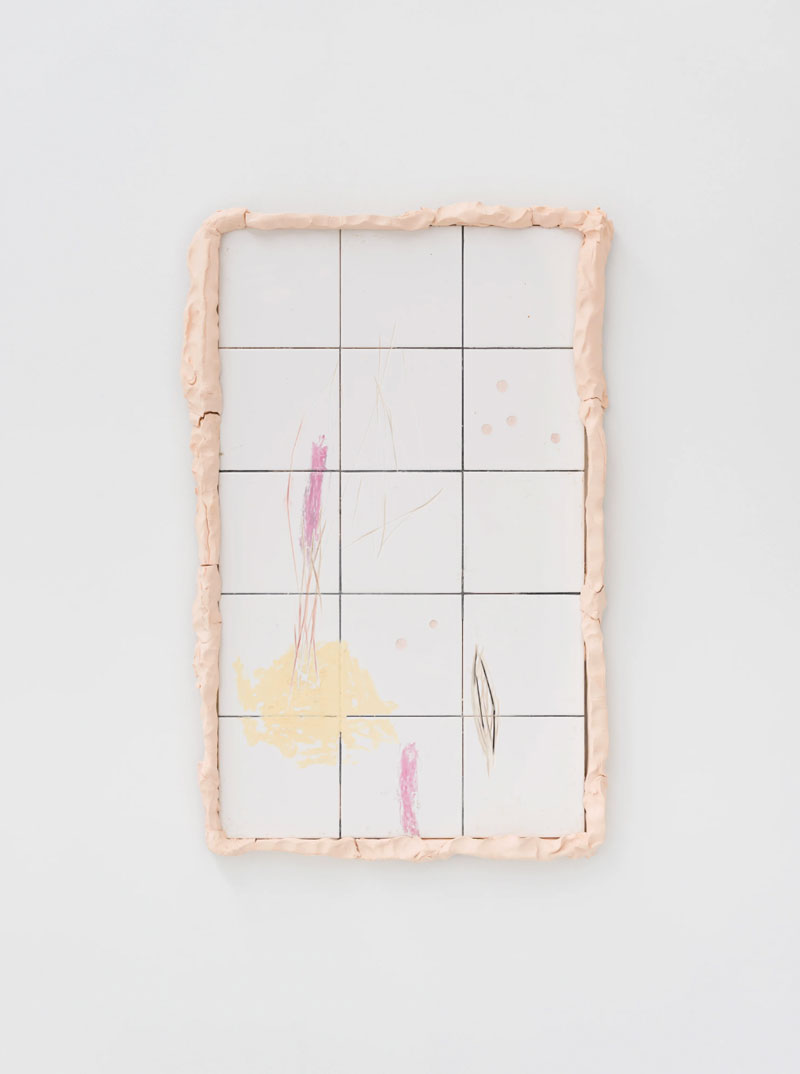 Jens Kothe, Keramikraster 1, 2026, BARBÉ
What strikes me even more than the organic quality is how far Kothe extends this logic beyond the body. Keramikraster 1 is – as the title suggests – a grid of unglazed ceramic tiles, marked with traces of oil pastel and silicone and placed within a roughly kneaded border. At first glance, it appears to be a tiled floor, a bathroom wall, something domestic and orderly. But the stains and hairs scattered across it do not belong there and it is precisely this alien element that turns the domestic into something vulnerable. You have to see it to believe it and once you have seen it, you will no longer look at a tiled floor in quite the same way.
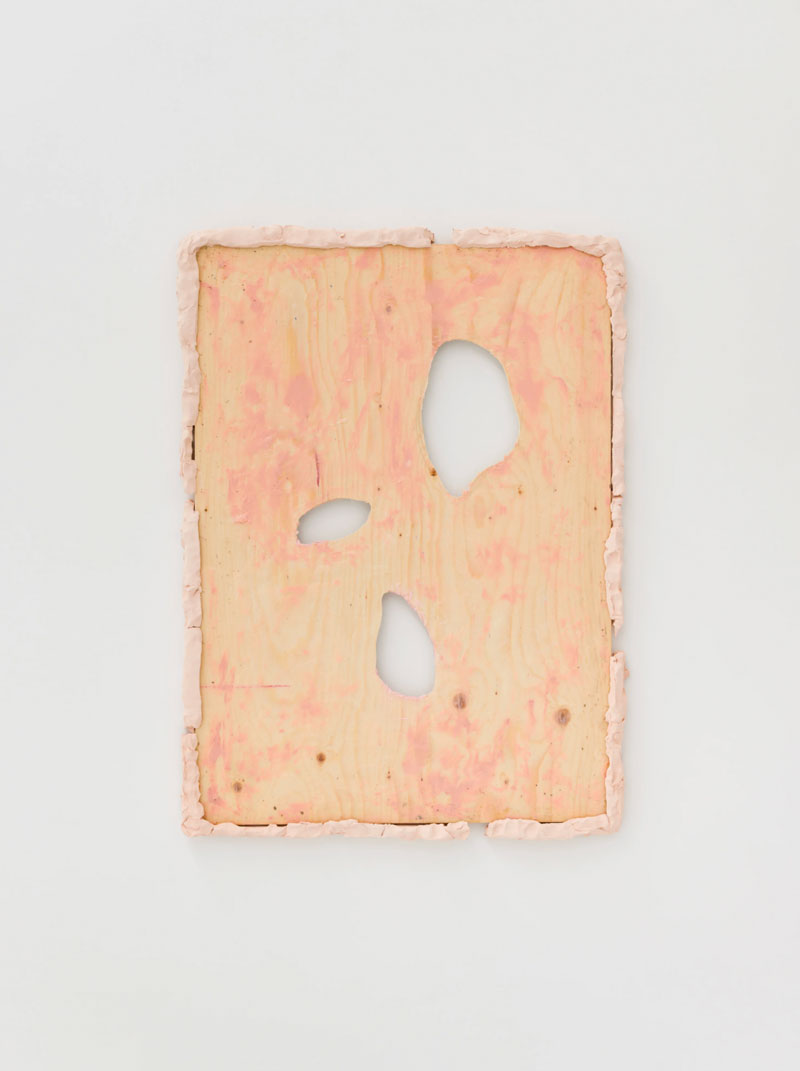 Jens Kothe, Grenzflächen II, 2026, BARBÉ
The title, Grenzflächen, ‘boundary surfaces’, is therefore not just for show. Barbé describes it as the thresholds running throughout Kothe's work: between body and object, interior and exterior, organic and constructed. The clearest example hangs in the middle of the exhibition: a photograph in which, as you move from one edge to the other, the material shifts constantly from red to soft, from navel to skin. With Kothe, boundaries are not barriers, but where things start getting interesting.
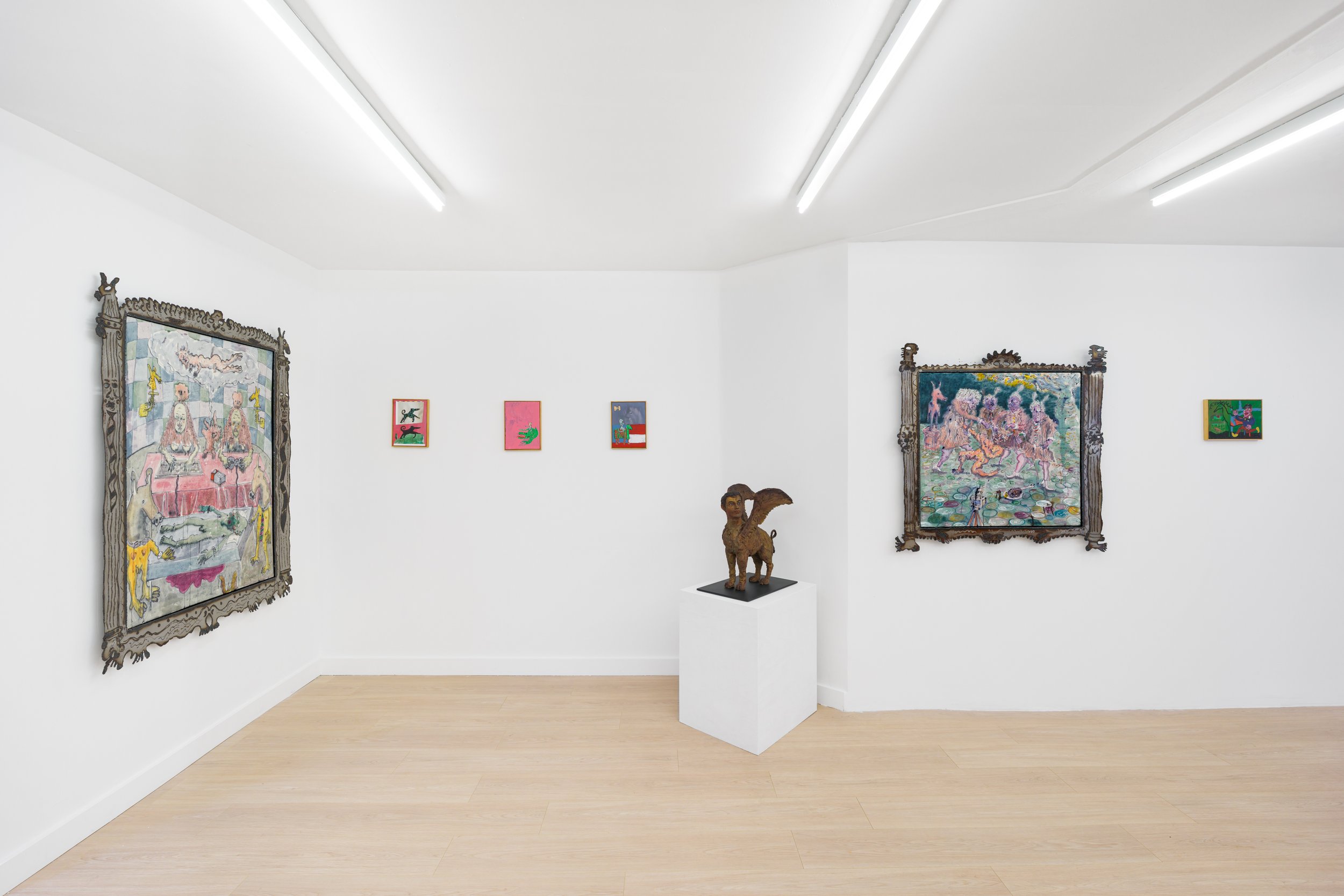 Arcana Animi, BARBÉ
Arcana Animi: cards that are not of your choosing
A few steps away on Baudelostraat, the register shifts from skin to character. Arcana Animi – literally the secrets of the soul – brings Stephan Balkenhol, Clément Jacques-Vossen and William Ludwig Lutgens together around a simple question: who are you when all roles are eliminated? And do those roles actually exist separately from you?
The comparison that is presented is a pack of cards. Everyone has the same personality, but you play different cards depending on who is sitting opposite you. You play a different card with a colleague than with your child, yet you remain the same player. In the exhibition, those cards are given names: the wanderer, the jester, the captain. Archetypes you immediately recognise and which remain uncomfortable precisely because of that familiarity.
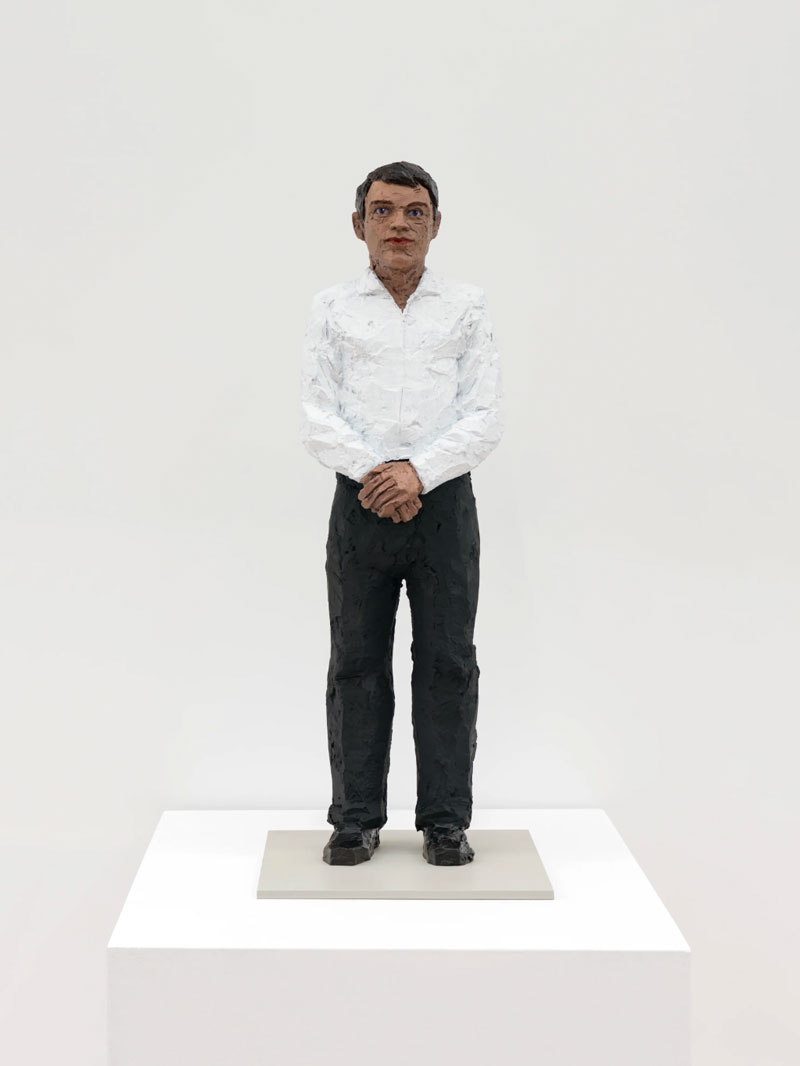 Stephan Balkenhol, Mann mit weissem Hemd und schwarzer Hose, 2026, BARBÉ
Balkenhol is the established name here, quite literally carved out of wood. Born in 1957 in Fritzlar, he studied at the Hochschule für Bildende Künste in Hamburg under, among others, Sigmar Polke, and has since exhibited at institutions like Deichtorhallen Hamburg and the Hirshhorn Museum in Washington. His figures carry the marks of their own making, cracks and all, and refuse to tell a story. They are no one in particular and therefore nearly everyone. Interestingly, he was criticised in the 1980s at the height of minimalism for returning to the human figure. Radical, says the gallery, and today young visitors look at those same figures and see something cute above all. And so, a scandal quietly slides into acceptance, which says as much about us as it does about Balkenhol.
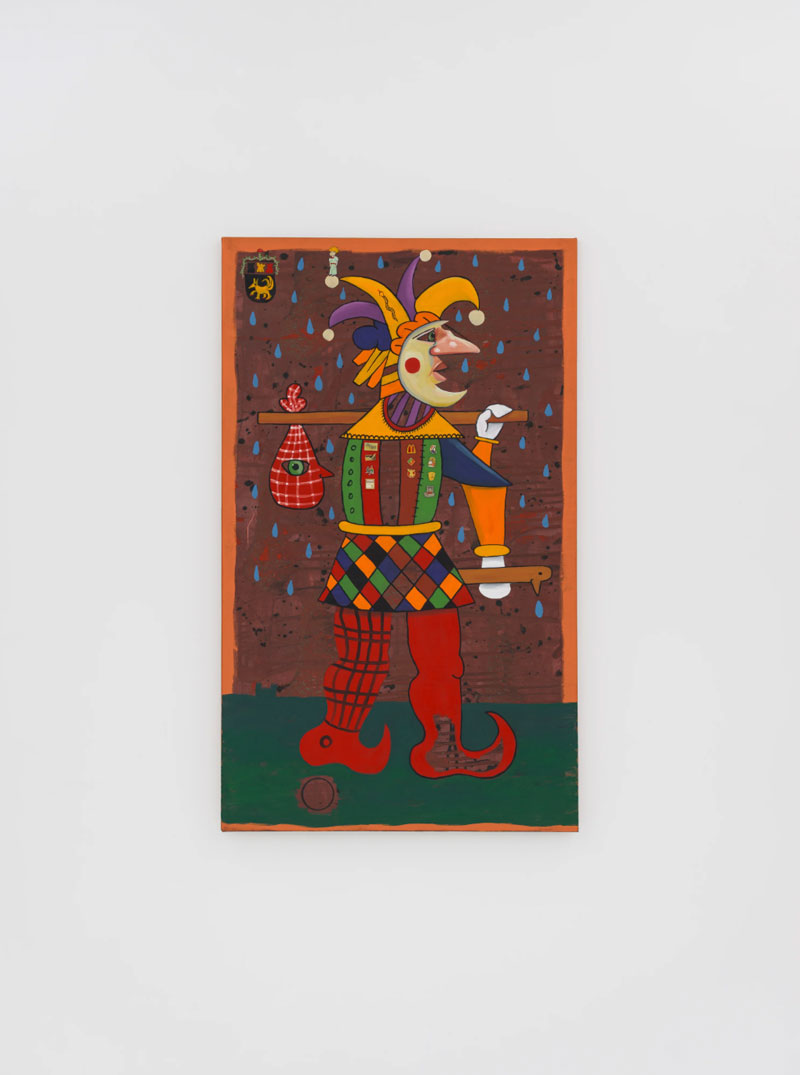 Clément Jacques-Vossen, Troubadour, 2026, BARBÉ
Clément Jacques-Vossen, born in 1996 in Brussels, deals with the other corner of the card: knights, fools, heraldry, self-portraits disguised in medieval symbolism. History as a dressing-up box, not as illustration. Where Balkenhol strips the figure of narrative altogether, Jacques-Vossen packs in as much narrative as the canvas can bear until it is almost bursting with references. Two opposing strategies for solving the same problem: how do you give a face an identity without giving it a name?
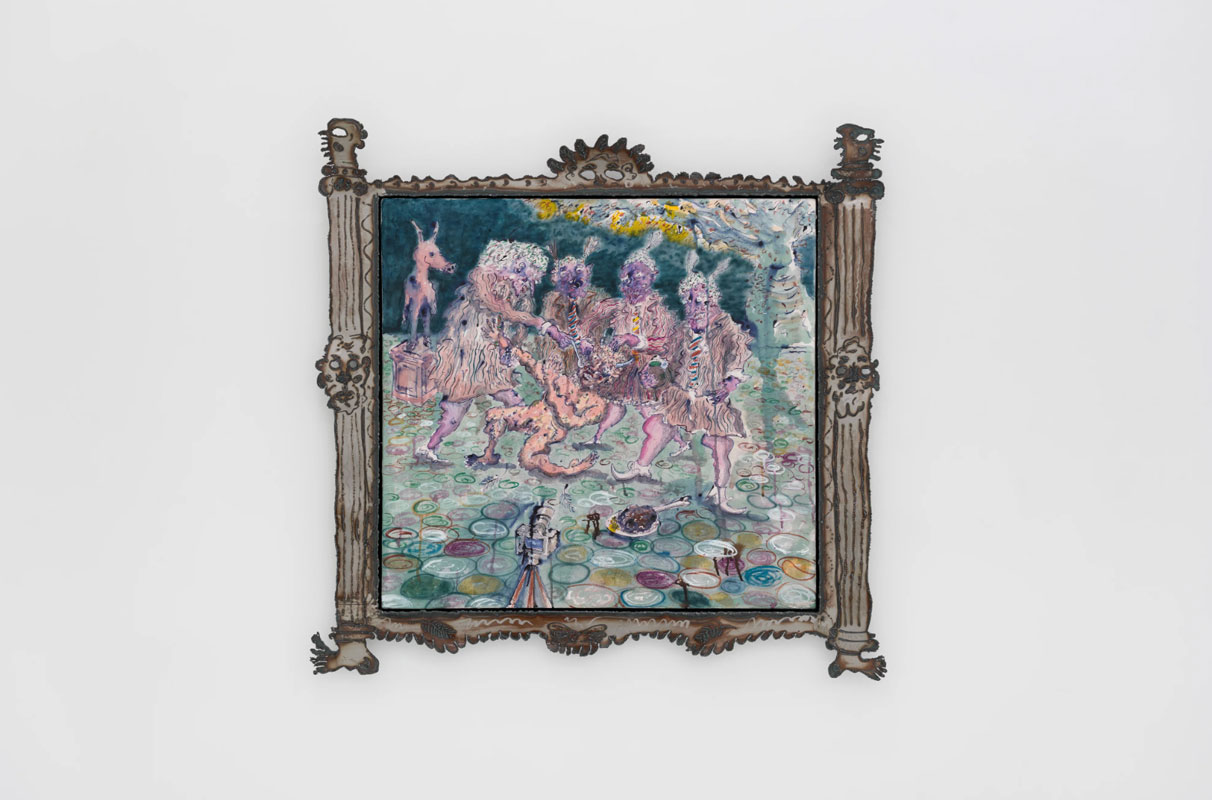 William Ludwig Lutgens, Peanut Butter Rebellion, 2026, BARBÉ
And then there is William Ludwig Lutgens, born in 1991 in Turnhout. This artist does not simply bring folklore into the picture, but the entire apparatus of the late-capitalist society that lies behind it. Lutgens works with different media – painting, drawing, sculpture, performance and film – and in each of these, the same character keeps appearing: a grotesque alter ego trapped in a system that is not obvious to it. Humour and horror constantly bleed into one another, attraction and repulsion become interchangeable, and this is precisely his commentary on labour, competition, artistic practice and authority.
His CV leaves little room for doubt: a post-graduate programme at HISK in Ghent, the Eeckman Art Prize at Bozar, the Brussels ArtContest Prize, residencies from Seoul to Lisbon to Barcelona, and in 2026 alone, a duo exhibition with Elen Braga at DMW Gallery, a duo exhibition with Alexandra Phillips at Fleur&Wouter, and participation in the joint Biennial of Painting at MUDEL Museum, the Raveelmuseum and Museum Dhondt-Dhaenens. Yet despite that impressive CV, the figure he creates remains exactly the same: someone who plays along with the system, while exposing it with merciless precision.
Two houses, one gaze
What connects the two exhibitions is not their subject matter, but their method: they show you something recognisable and then pull the rug out from under you. Kothe makes you think you are looking at skin, until you realise it is about desire. Balkenhol, Jacques-Vossen and Lutgens make you think you are looking at a portrait, until you realise you are looking at a card game in which you are a player.
Grenzflächen and Arcana Animi run until 4 October 2026 at Penitentenstraat 29 and Baudelostraat 23 in Ghent.
