17 september 2026, Flor Linckens
Reflection as experience: Zhuang Hong Yi and Pepe Valenti in SmithDavidson Gallery
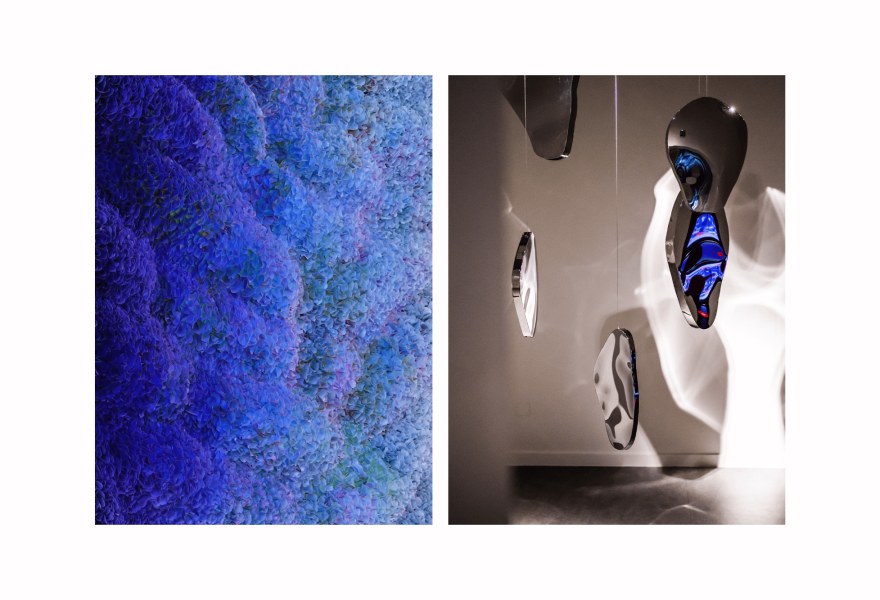
Until 8 November, SmithDavidson Gallery in Amsterdam presents ‘Reflections’, a duo exhibition featuring works by Zhuang Hong Yi and Pepe Valenti. At first glance, the artists have very different visual languages: Zhuang Hong Yi is known for his colourful, almost organic works made from painted rice paper, while Pepe Valenti works with cool and reflective metal surfaces. But the artists explore similar questions: what happens to an artwork when the light changes, when you move past it or when you look at it from a different angle? And to what extent is what we see ever truly fixed?
At SmithDavidson Gallery, this contrast in materials becomes immediately apparent. Zhuang Hong Yi’s works seem to extend from the wall into the surrounding space like fields of flowers, while Pepe Valenti’s metal sculptures appear to draw fragments of that space inwards, only to reflect them back again. None of the works on view can be fully experienced from a single position. As you move past them, colours change, shadows shift and reflections continuously take on new forms.
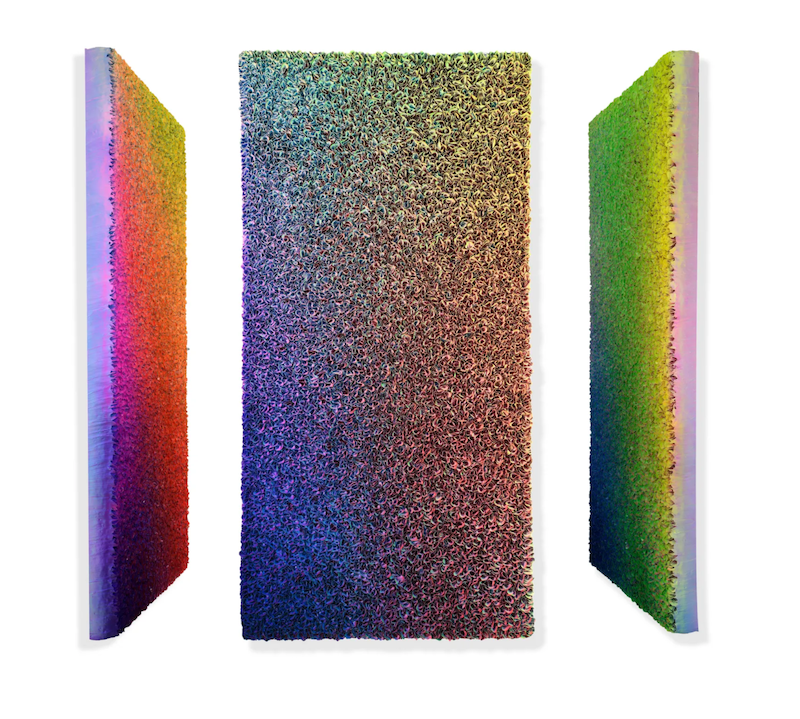
Nature, and flowers in particular, occupies a central place in Zhuang Hong Yi’s practice. The continuous cycle of nature runs like a thread through his work, providing a recurring source of inspiration. In China, flowers are associated with prosperity, elegance and transience. But they also carry a universal meaning, that the artist connects to the visual richness of the Dutch tulip fields that made such a profound impression on him. At the same time, the flower serves as a subtle protest against urbanisation, the depletion of natural resources and a wider ecological crisis. His work also has a poetic and philosophical dimension and reflects an ongoing search for meaning, with flowers functioning as a universal language capable of bridging differences.
Zhuang Hong Yi is best known for his three-dimensional "Flowerbed" series, in which he uses fragile, hand-folded and painted rice-paper petals in order to create sculptural compositions that appear to change colour depending on the light and the viewer’s position. The process is remarkably labour-intensive and physical, with some works comprising of hundreds of carefully shaped petals. Alongside these works, he creates landscapes inspired by the Impressionist paintings that he encountered at the Musée d’Orsay, as well as other Western artistic traditions. The artist works with colourful, expressive brushstrokes, dripping paint and paper elements. The resulting works have a meditative quality about them and touch on universal themes such as transformation, transience and connection. His practice plays with the tension between control and intuition, between abstraction and figuration. The artist also frequently works in triptychs.
Zhuang Hong Yi was born in 1962 in the Chinese province of Sichuan, where he studied at the Sichuan College of Fine Arts. In 1992, he moved to the Netherlands and continued his studies at the Minerva Art Academy in Groningen. Since then, his work has occupied a space between East and West, combining traditional Chinese materials with a more Western approach to colour and form. Today, the artist divides his time between Switzerland and China. His work was shown at the Groninger Museum, the Ulm Museum and the Powerlong Museum in Shanghai. He has also participated in the Venice Biennale and his work was presented at various art fairs, including TEFAF Maastricht, Art Miami and Zona Maco.
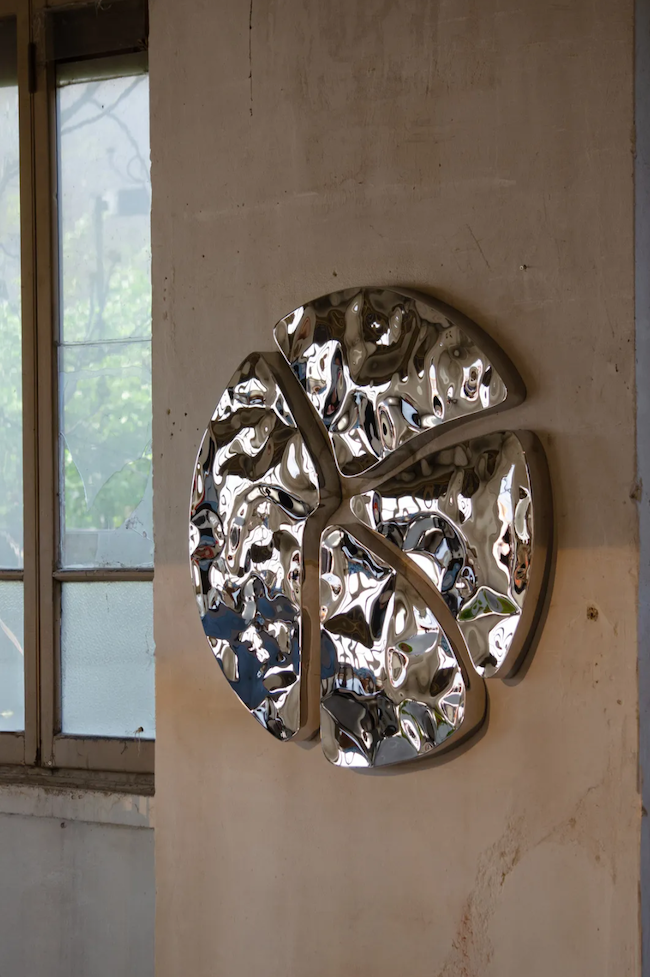
Pepe Valenti’s practice explores the porous boundaries between art and design and encompasses disciplines like sculpture, installation and collectible design. Material plays a central role in his work: during the production process, the artist discovers some of its possibilities through physical experimentation. How does a material bend, how does it respond to heat, how does it capture light and what traces does the production process leave behind? A certain degree of intuition and unpredictability is inherent to this approach. It also involves a distinctly physical working process in which thinking and making are often inseparable.
Visually, Valenti draws inspiration from geometric forms, the raw qualities of his materials and natural phenomena such as waves and sunlight on the sea. Rather than translating these phenomena into a representational image of the ocean, he uses materials that appear to behave in similar ways. For his "El Mar" series, for instance, he works with stainless steel coated in reflective chrome, which he shapes and folds by hand. The curves of the surface fragment the reflections and recall light moving across seawater. Valenti subsequently leaves room for viewers to bring their own associations and interpretations to what they see.
Pepe Valenti was born in Barcelona in 1999, but grew up in London from the age of twelve. Six years later, he moved to the Netherlands to study at the Design Academy Eindhoven. His work was shown at Z33 in Hasselt, Design Biennale Rotterdam, Object Rotterdam and Milan Design Week as well as at art fairs including Art Miami, Big Art, Collectible and PAN Amsterdam.
