04 september 2026, Wouter van den Eijkel
The studio of… Ricardo van Eyk
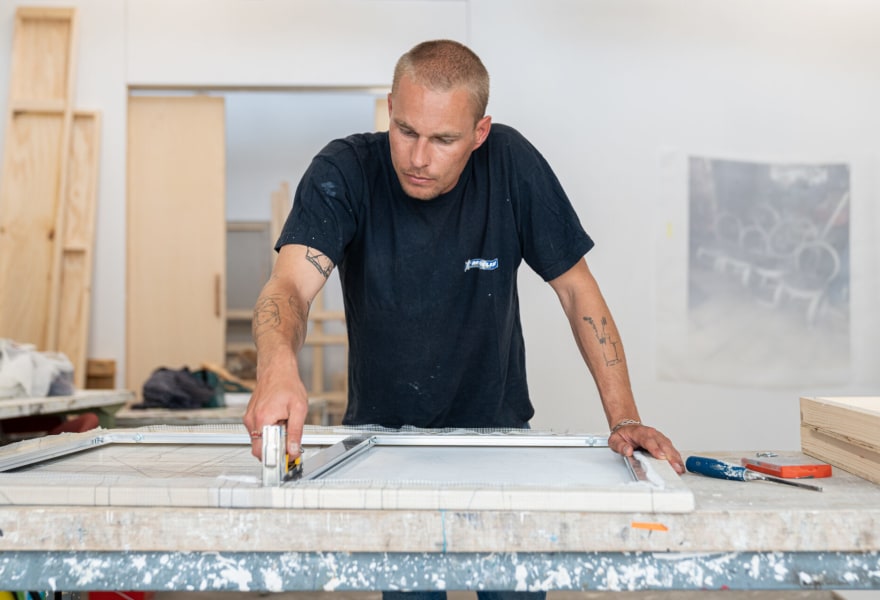
Van Eyk (1993) has a studio at a location that complements his practice. He has 125 m² at his disposal close to Schiphol Airport. Within this space, it's all about the process. The studio adapts to the requirements of the process, which may involve sketching, sculpting or working directly on the floor.
Interview is the first collaboration between Van Eyk and Han Schuil (1958) at tegenboschvanvreden. Years ago, Van Eyk saw Schuil's work at an art fair and was immediately taken by it, resulting in a conversation between two artists from different generations who both have little time for dogmatic hierarchies of good/bad or high/low motifs. Although their work looks completely different, they share a common point of departure: both are fascinated by something that presents itself and becomes useful when it refuses to let you go.
The last time we spoke, two years ago, you had just opened a new studio outside of Amsterdam beneath the flight path to Schiphol. Are you still working there?
Absolutely. Two years ago, the renovation was almost finished and the exhibition we talked about at the time featured the first work I made in my studio at Nieuw en Meer. Now, it truly feels like mine. There's room to grow and I can see myself working here for a very long time.
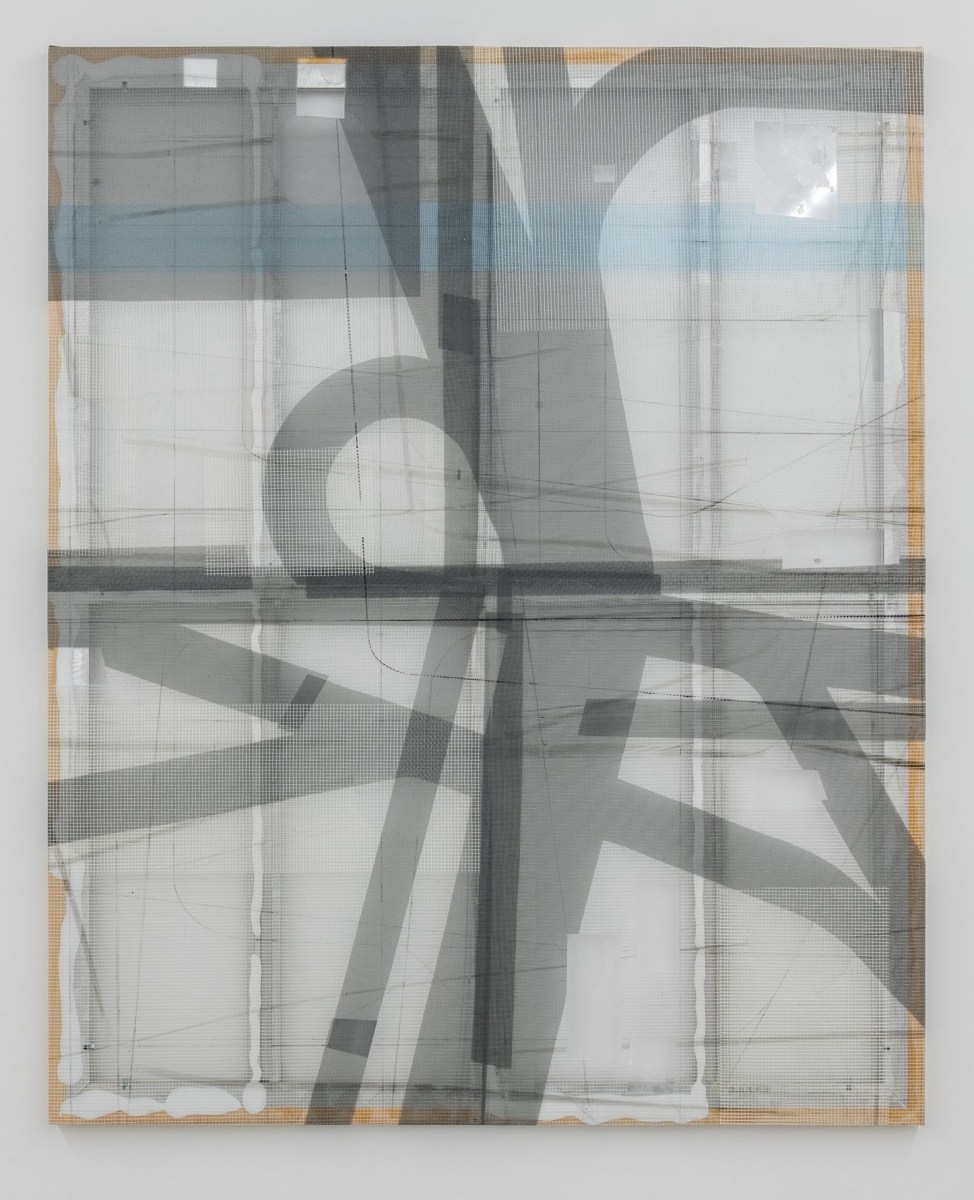 Ricardo van Eyk, OPERA (PLANE) II, 2024, tegenboschvanvreden
How would you describe your studio?
Right now, it's quite chaotic—covered in scraps of fabric, mesh and empty paint tins from the explosive working process of the past few months. The paintings resulting from that process will be on display at INTERVIEW, my exhibition with Han Schuil at tegenboschvanvreden.
The studio is 125 square metres in size, divided into a storage area, a heated office with a small kitchen and a dust room for sanding and working with chemical paints. The rest is one large open space that I can reconfigure with mobile worktables, depending on what I'm focusing on. That might be a drawing, sculpture or, as it has been recently, painting. I can work on the floor, on the tables or directly on the wall.
So, essentially, the studio adapts to whatever the process requires at that particular moment.
The studio is also on what's known as the 'gold coast'—the nickname for the spaces at the site facing south. Next to the French doors, I've created a small sitting area, with a pinboard for projects, a few plants and some creature comforts. It's a place where I can sit and think, reflect on work in progress, write applications or simply read a book.
You're a painter, but I imagine natural light is less important to you than it might be for someone working figuratively. What makes a good studio for you? What are your minimum requirements?
Light isn't particularly important for the work itself, but is important psychologically. My last studio in Utrecht had no natural daylight, for example, and I found that quite exhausting after a full day of work.
Space is probably the most important thing and ceiling height to a slightly lesser degree. What I really value about my current studio is the ability to transform it according to the demands of whatever I'm working on. My way of looking and the essence of my practice remain firmly rooted in painting, but apart from that, spatial work is becoming increasingly important. That requires a flexible studio.
One thing that has always attracted me to your work is how you avoid what you call 'easy strategies'—or things you become too good at. In other words, your work continues to surprise. Is there an approach you've recently abandoned because it had become too easy?
I'm quite wary of becoming too adept at a particular approach. The danger is that you start to get caught up in its visual appeal, without experiencing the initial sense of urgency that made you want to pursue it in the first place.
When we spoke two years ago for LEVEL, we talked mainly about the LASSO series—the mirror work that earned me the Royal Prize in 2023. I don't think it was necessarily too easy to continue with, which might sound a bit pretentious, but for me, the issue was simply that the sense of urgency was no longer there. Perhaps I'll return to it at some point and see new possibilities.
Something similar happened more recently with a process I'd been working with for years: building paintings out of thick layers of lacquer, then cutting and chipping away to reveal the layers underneath. The work century from 2024, for example, was shown at LEVEL and recently nominated for and exhibited as part of the Scheffer Prize at the Dordrechts Museum.
But right now, that process has made way for the one underlying the ACME series. The first discoveries within that process were shown at LEVEL and the new developments are part of the current duo exhibition with Han.
 Ricardo van Eyk, Lasso IV, 2021, tegenboschvanvreden
Speaking of Han Schuil, you're now exhibiting together even though he belongs to a different generation. That's quite unusual—you more often see artists of roughly the same generation exhibiting together. How did this collaboration come about?
I first discovered Han's work in art school, probably during my second year, when I was learning more about contemporary art and my own approach was slowly taking shape. At an art fair, I saw one or more work from his HEAT and BLAST series, based on infrared imagery and graphic depictions of explosions. I was immediately taken by it.
It's funny that you mention generations, because I couldn't place that work in any one period. I was actually surprised to discover that Han had been working since the late 1980s. His work felt so youthful and enthusiastic. I approached him and he was kind enough to invite me to chat. We hit it off and have stayed in touch ever since. Years later, that relationship led to our first collaboration, a joint exhibition in 2022 called ZOOM at Onrust, his gallery at the time.
What can we expect from this exhibition?
Hopefully, an interesting dialogue—an inter-view—between two artists, in which the similarities and differences in our underlying approaches and natural visual languages both reinforce and challenge one another. We feel we've succeeded at this and, of course, hope visitors will feel the same way.
 Ricardo van Eyk, Century, 2024, tegenboschvanvreden
What is it about Schuil's work that attracts you? Do you see similarities between your work?
It was his imagery that first drew me in. After that initial impact at the art fair during my second year at the academy, I naturally began to delve into his wider oeuvre. I recognised a particular way of looking: motifs such as painterly repaired asphalt roads, cartoon and manga eyes or the forms of farm buildings with compositions of corrugated sheets in different colours. But in the conversations we've had over the years, it's especially his freedom of approach that has taught me a great deal. He rejects dogmatic hierarchies of good and bad, high and low, and instead, allows himself to be fascinated by whatever happens to present itself—something that becomes useful simply because it won't let you go. That might be a temporary HERAS fence or a 1,500-year-old religious papyrus palimpsest. That way of thinking is very close to how I want to approach art. I also recognised something similar in the teachers at the academy, such as Lieven Hendriks. Together, those influences have become a driving force in my development as an artist.
Finally, if we were to talk again in five or ten years' time, what project would you hope to have carried out by then?
I don't have a specific long-term project waiting to happen. The work tends to lead me towards whatever I'm focused on at the time. Right now, for instance, I'm doing a lot of spatial work and that development is once again keeping me on my toes. It's generating new ways of thinking about how those ideas might be reformulated within painting, as with the ACME series in the current exhibition with Han.
Over the past ten years, since graduating from the academy in 2016, new experiences, fascinations and challenges have continually opened up new directions in my work. A good example is a sculptural commission for the Central Government Real Estate Agency, which I'm currently working on.
For that commission, I'm experimenting with aluminium casting. I've travelled to the Czech Republic with Maria Roosen to try glassblowing and I've also been teaching myself how to weld. Over the past few years, I've been working quite a lot with greenhouse-like structures in my installations and those ideas are now returning in a different form as part of this commission.
Perhaps that's the project I'd like to carry out in the next five years: the opportunity, through an institution such as a museum or project space, to create a major solo exhibition in which all these divergent elements of my current practice can come together in a single installation. I'd like to see—and feel—what kind of 'world of its own' might emerge from that. That would be a dream challenge. And perhaps, with new influences and further refinements along the way, that exhibition could eventually be shown, within the next ten years, at a prestigious international museum.
 Ricardo van Eyk, ACME IV (papillon I), 2025, tegenboschvanvreden