13 august 2026, Yves Joris
Summer images behind glass
Eight names in a row
The page loads and displays a list of eight names: Ronny Delrue, Ewerdt Hilgemann, Hans Lemmen, Les Deux Garçons, Riki Mijling, Theo Niermeijer, Adriaan Rees and Robert Schad. Normally, I would be introduced to their work in a completely different way, namely, by walking around it, looking at it from behind, measuring with my own eyes the shadow it casts on the gravel. Now, I am viewing the works of art as a sequence, an inventory. Eight names, arranged as if in a catalogue, waiting to be clicked.
What suddenly catches my attention is a sentence further down the page: most of the sculptures cannot be viewed in the gallery itself, but are located in the artists' studios or in public spaces. The online exhibition therefore continually points away from itself. It is not a destination but a signpost, a threshold leading elsewhere, somewhere I will not reach today. I am looking at an index of absences, neatly photographed.
Normally, an exhibition visit begins for me with a threshold that I need to physically cross: a door, a gravel path, a gallery attendant who perhaps knows me by name. Here, the threshold is a scrollbar. No brief hesitation before stepping inside.
Oddly enough, that absence of resistance feels heavier than a real threshold ever would. While a gallery door gives me a moment to settle into the role of viewer, the screen throws me straight into eight oeuvres at once – without transition, without decompression.
I scroll through the names a second time, more slowly this time. Not to see the work better, because there is too little to see for that, but to force myself to treat each name as a separate world, rather than a line in a list. Eight studios, eight mornings on which someone, somewhere, made a decision in steel, plaster, ceramics or wood that is ultimately reduced on this screen to a width of 500 pixels.
 Atelier les deux garçons, Le grand protecteur, Coppejans Gallery
A garden without wind
The exhibition text describes it most aptly: the power of an outdoor sculpture is determined by its relationship to its surroundings: the light, the seasons and the people who walk past it. A sculpture in the open air changes over time. And that is precisely what makes today's paradox so acute for me. On the screen, each sculpture is reduced to a single frozen moment, chosen by a photographer who left long ago. I do not see the sculpture in the wind, but on a day without any wind at a time chosen by someone else.
I think about what distinguishes an outdoor sculpture from a painting hanging on a wall: it has no fixed lighting or fixed angle, no definitive angle at which it is viewed. A JPEG, by contrast, is the exact opposite: a definitive view enlarged into a representation of a whole that, by definition, cannot be captured in a single image. So, strictly speaking, what I am looking at is never the sculpture itself, but a 'claim' about the sculpture, a promise I must accept in good faith.
And yet I notice that this promise refuses to be clicked into place. Between the rows of thumbnails, something of an intention occasionally slips through, stirring my curiosity rather than satisfying it. The screen does not show a sculpture, but a desire for one.
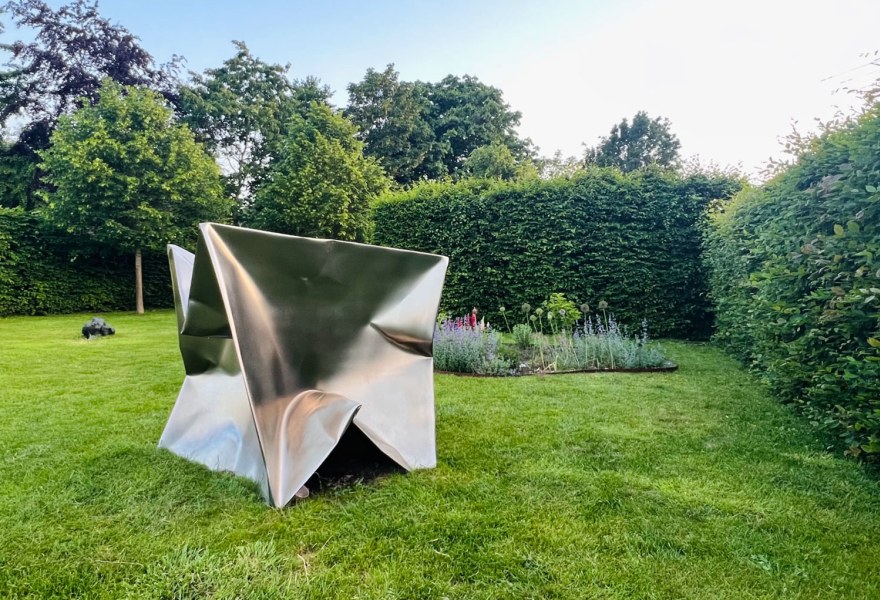
 Riki Mijling, Two Pieces, 2016, Coppejans Gallery
Choosing without touching
Under the works of art themselves is a series of tips, intended for those considering a sculpture for their own garden or terrace. Do not choose decoration, but interaction. Use a sculpture to create a destination. Think beyond today's garden, because trees grow and sightlines shift. Consider all seasons, because while flowers come and go, a sculpture remains. Dare to think bigger than the first small format.
I read this advice in a way I have never read purchasing advice before: as a text in its own right, detached from any actual perspective of a garden. I have no patio against which to weigh a bowl, no lawn on which I might mark out a sightline. I am reading about a sculpture that only gains meaning as it is lived with, while at this moment, I am doing the exact opposite: observing eight sculptures in a few minutes of scrolling without ever living with a single one of them.
There is something poignant about that contradiction. The text promises a slow, repeated encounter, day after day, season after season. The screen offers the opposite: a fast, one-off view, overtaken by the next tab, the next message. And yet it is precisely that contrast that makes me want to look more closely. What I lack in immediacy, I try to compensate for with attention to what is visible: a posture, a choice of material, a name I resolve to look up as soon as I am outside again.
 Robert Schad, DERGEL, 2016, Coppejans Gallery
A screen-defined edge
In my own writing, I keep returning to the tension between edge and core, between the frame that surrounds a work and the core that lies within. Usually, I look for that core beyond the museum room, beyond the press release, beyond the boundary an institution draws around a work. Today, for the first time, the edge is total: the screen is no longer a frame through which to look, but the entire space of the encounter. There is no possibility to walk beyond the frame or to step to the side to reach the core.
Perhaps that is the most honest way to read this impression: not as a review of eight sculptures – because I have never stood in front of a single one of them – but as a review of looking itself, of experiencing an art season through pixels rather than pollen and stone, of sculptures that, despite the glass between us, still whisper something to me about presence, about waiting for the wind and light that have yet to find it.
Less than a week ago, I was standing among sculptures that only have an effect in the full, changing openness of the outdoors, among Turrell's sky windows and Eliasson's rainbows, and I knew how much those works would elude me the moment I might try to reduce them to a photograph. Today, I experience the opposite: no in-person viewing, only the photograph, and yet something of the same elusiveness. Perhaps that is the lesson the screen teaches me today: that an outdoor sculpture can never be fully captured, regardless of whether you are standing on the gravel or sitting at a computer. The only difference is the degree of illusion you allow.
I close the tab. Somewhere in Antwerp or elsewhere, Delrue, Hilgemann, Lemmen, Les Deux Garçons, Mijling, Niermeijer, Rees and Schad have already been standing outdoors for weeks, untouched by this visit, unaware of the gaze that passed over them today. I make a note of their names, promising myself that I will visit a garden as soon as my schedule allows, and realise that this is the only honest conclusion a screen can offer me. Not an encounter, but at most a scheduled appointment. And this, I think to myself, is ultimately also a form of loyalty to a sculpture waiting for you, even if it does not know that it is waiting.
 Adriaan Rees, Strange Fruit, 2011, Coppejans Gallery