21 july 2026, Martine Bontjes
The studio of... Raquel Maulwurf
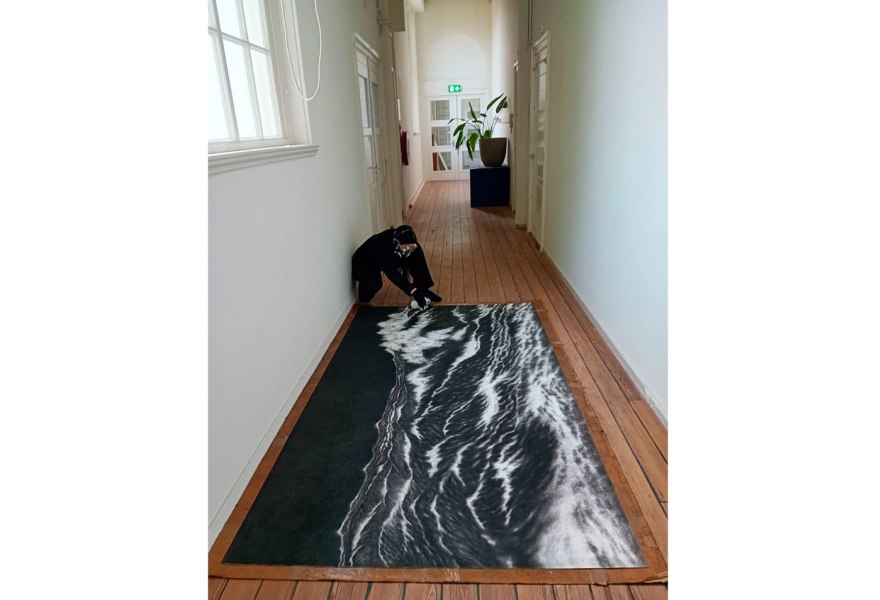
For months, millions litres of crude oil flowed into the Gulf of Mexico after the Deepwater Horizon drilling rig exploded in 2010. It was the ultimate doomsday scenario: oil-drenched, black oceans. This environmental catastrophe prompted Raquel Maulwurf to start a new series of charcoal drawings. Her monumental drawings depict the traces of ecocide, war and humanity's urge for destruction. By capturing historical events, Maulwurf intends to prevent them from being forgotten. Beauty and devastation coexist throughout her practice: “Those conflicting emotions encourage the viewer to move beyond simply looking and to start truly seeing.” Her work is on view in the anniversary group exhibition ‘HOLDING BACK THE YEARS - celebrating 35 years Livingstone Gallery’ in The Hague until 22 August.
Maulwurf is also a passionate advocate for contemporary (monumental) drawing. Last year, she made her debut as a guest curator with the exhibition ‘Size Matters | Monumental Drawing Now’ at Museum MORE. She advocates for greater recognition of the medium and believes drawing deserves its own prestigious national prize in the Netherlands.
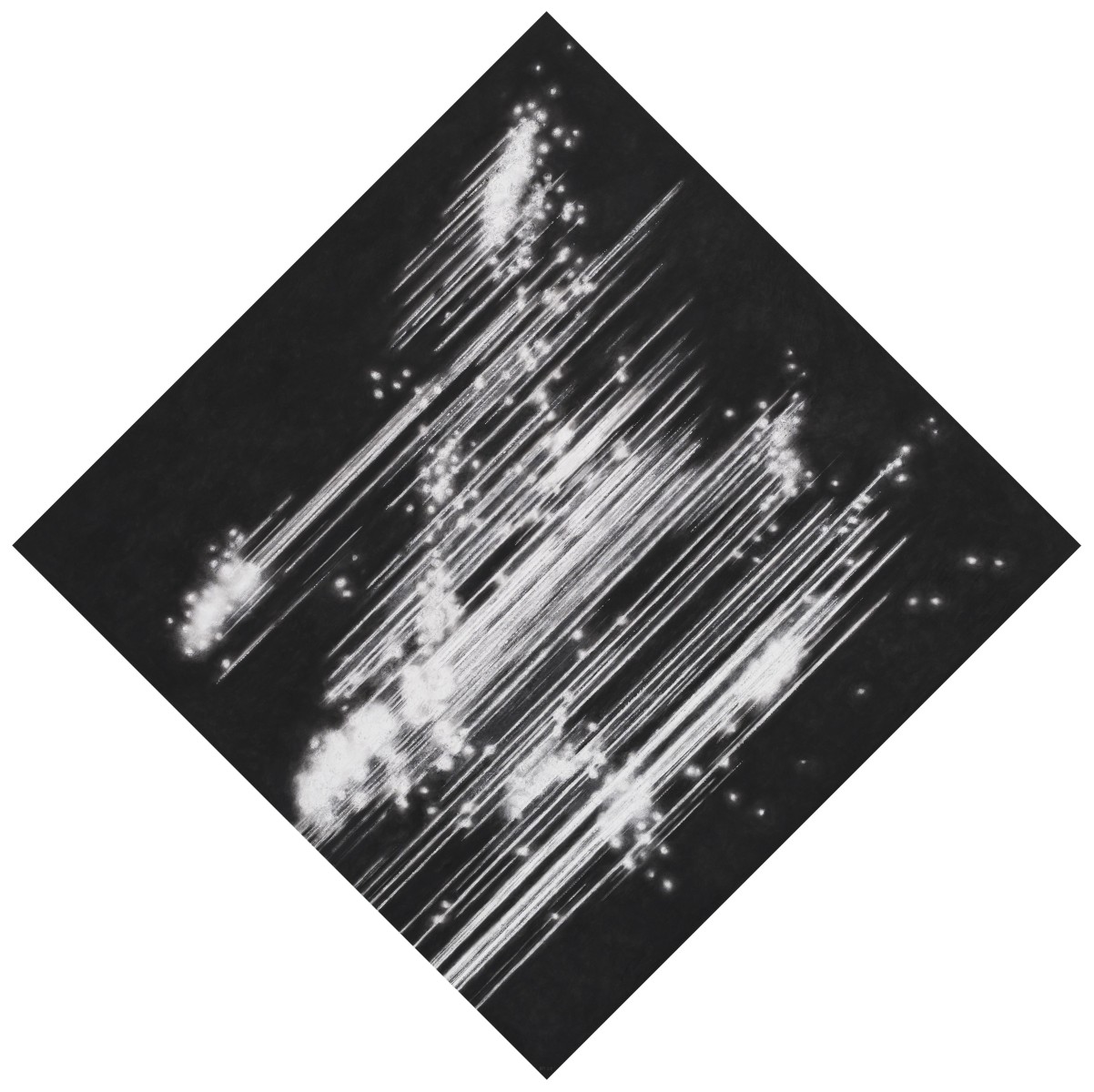 Raquel Maulwurf, Leuchtmarkierungen III, 2025, Livingstone Gallery. Photo: Peter Cox
Where is your studio and how would you describe this place?
It is located in a former school building in Amsterdam. After twenty years of moving from one temporary studio to another, sometimes as often as three times a year, I finally have a permanent workspace. I enjoy working at night when everything is quiet; it becomes much easier to detach myself from the practical concerns of everyday life. After many hours of continuous work, often until well into the morning, I enter a state of intense concentration in which only the drawing continues to exist. After hours of continuous work, usually until well into the morning, I enter a state of intense concentration in which only the drawing continues to exist.
Your works are sometimes several metres long. What practical solutions have you developed to create drawings on such a scale in your studio?
My current studio is spacious and high enough, but when I was an artist in residence at the International Studio & Curatorial Program ISCP in New York my studio measured just 3.5 by 4 metres. I constantly had to step out into the corridor to gain enough distance from my large drawings to see what I was doing. When I am drawing, all I can see close up are amorphous patches and scratches. Only from a distance do they turn into concrete forms and a picture emerges… it's an almost magical experience.
You create charcoal drawings, wall drawings and site specific installations using materials including coal and browncoal briquettes. What makes these materials so appealing to work with?
I draw with charcoal, one of the oldest art materials. Using charcoal, charred (destroyed) wood, I can bring entire worlds to life: creation from destruction. Reduction to black and white strips the image of any unnecessary frills. By tearing open the surface of the museum board I work on with a Stanley knife, the paper pulp spills out so that the violence of the depicted subject, as it were, forces its way into the drawing, materializing destruction in both subject and process.
The large format arose from my desire to immerse myself entirely in my drawings. The physical effort it takes to draw on that scale and to cut open the cardboard with a knife, leads me into a kind of trance. My compulsive urge to draw neatly disappears.
Large installations such as The Carbon War Room (7.5 by 4 by 4 metres and consisting of 2,500 kilograms of coal), which I created for my solo exhibition at the Kunstmuseum in The Hague in 2017, arose from my desire to physically create the depth that is evoked in my charcoal drawings in three dimensions. By working on a very large scale and creating wall drawings across multiple walls I had previously captured the feeling that one could enter the drawing itself, so this was the next logical step.
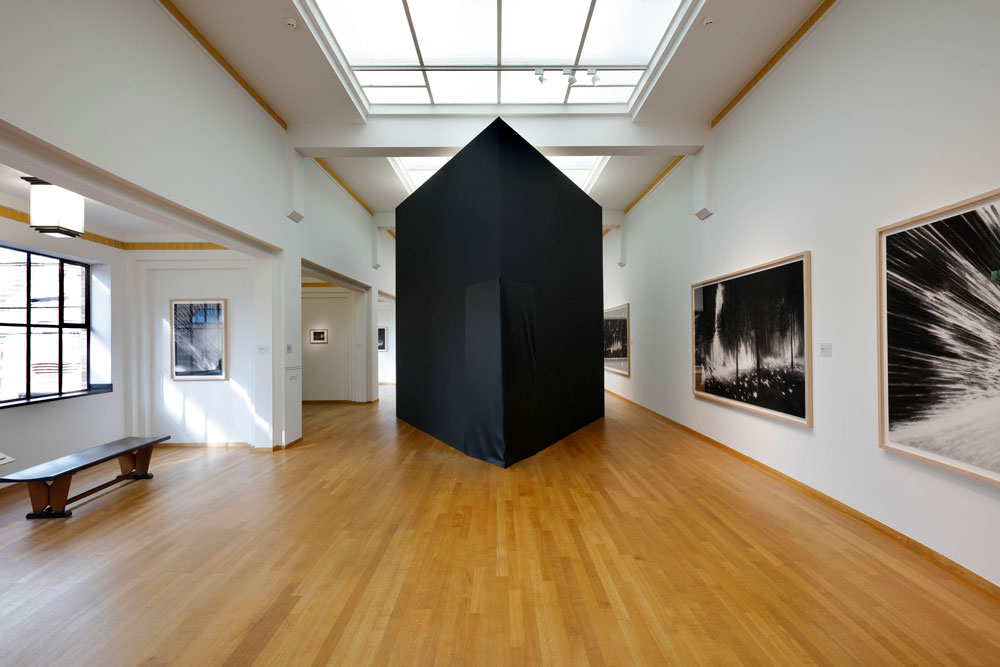 Raquel Maulwurf, The Carbon War Room, Kunstmuseum The Hague. Photo: Jan Zweerts
Earlier in your career, your work focused on the violence of war. Your recent work turns to the violence of nature. Do you see these as separate subjects, or are they connected?
My drawings, wall drawings and site specific installations all spring from my fascination with humanity's urge for destruction: the devastation of our own living environment through war and ecocide. Another recurring theme is the insignificance of man against the forces of nature. The nature series emerged later, yet both the nature and war series continue to develop alongside one another and at times they intertwine. It all began with the series Black Sea, created in response to the Deepwater Horizon oil spill disaster in the Gulf of Mexico in 2010. Over the course of three months, 800 million litres of crude oil flowed into the sea. It seemed impossible to plug the leak. Black Sea depicts the ultimate doomsday scenario: oil drenched, black oceans.
In the drawing Agent Orange, war and ecocide converge. The title refers to the defoliant that was widely used during the Vietnam War. The chemical took its name from the orange band around the barrels. The abstract pattern of seemingly random streaks and spots in the drawing is based on satellite images of the flight-paths of the aircraft formations that sprayed Agent Orange. By spraying in a carefully coordinated weave pattern, not a single area was left untouched. In my drawings I like to explore the boundary between figuration and abstraction. What seems at first glance to be an entirely abstract image, turns out to visualize a charged history.
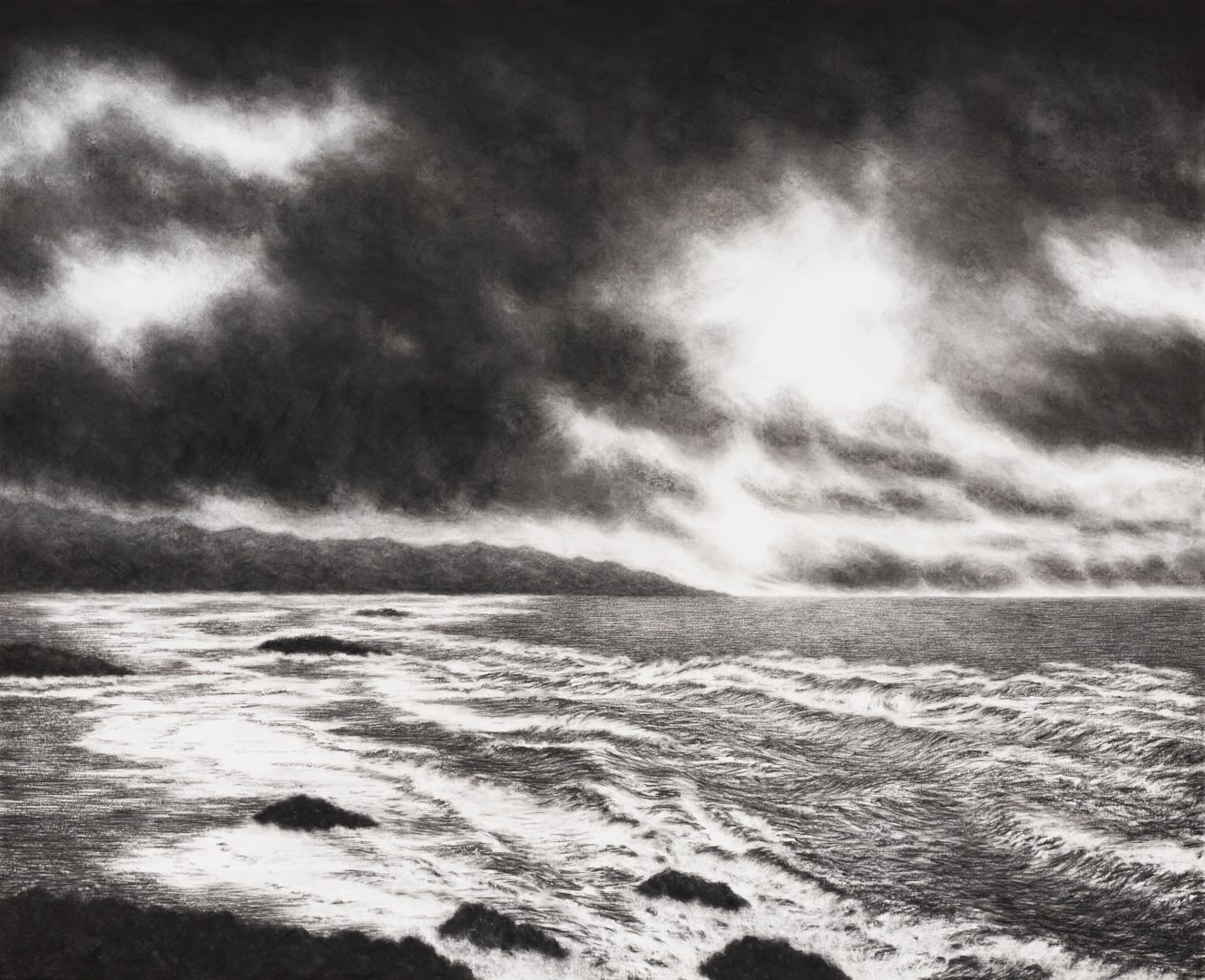 Raquel Maulwurf, Undertow VI, 2026, Livingstone Gallery. Photo: Peter Cox
Do you visit the locations you depict or do you work mainly from archival images and photographs? Where do you find your source material?
For my drawings I have travelled to several (war) archives across Europe, but nowadays much more material is available online, from historical images to events that unfolded only five minutes ago. I highlight major historical events that permanently altered our world as well as those we would rather forget. Through drawings and site specific installations I am creating my own ‘collective memory archive’ by making a personal selection from our shared history, all in the hope not to forget and avoid repeating past mistakes. Here, I also bring overlooked and almost forgotten events back to life, as a counterbalance to the well-known ‘grand narrative’ of history, written by the victors. In my drawings, I deliberately omit human figures; I show only the traces left behind by humanity.
 Raquel Maulwurf, Black sea XIX, 2025, Livingstone Gallery. Photo: Peter Cox
Your soft charcoal drawings almost make natural disasters appear beautiful. What exactly are you trying to convey?
We have become numb to images of suffering and destruction, because every day we are confronted with them in an endless stream of images through the internet, social media and television. Today's catastrophe quickly becomes yesterday's news. We move on and we forget. In my drawings I try to recover what we would rather forget and bring it back into view. I rework the images I find until only the essence of the event remains. This creates unsettling and paradoxical images in which beauty and destruction, attraction and repulsion exist side by side. Those conflicting emotions encourage the viewer to move beyond simply looking and to start truly seeing.
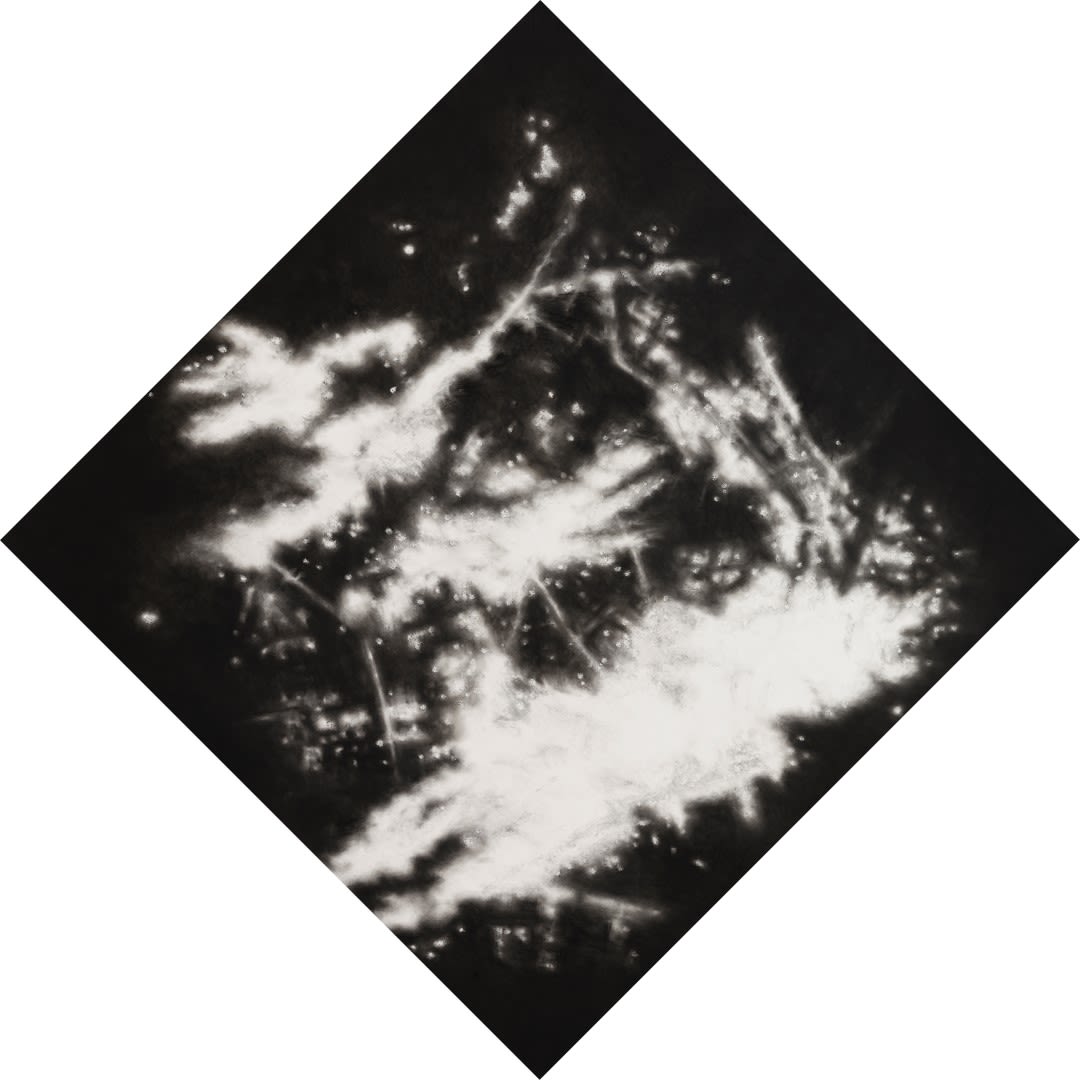 Raquel Maulwurf, Night raid on Tokyo 9 III '45, 2021, Livingstone Gallery. Photo: Peter Cox
Last year you were a guest curator at Museum MORE. What was it like to step into the role of curator and create an exhibition yourself?
Together with Museum MORE senior curator Marieke Jooren I curated the international exhibition ‘Size Matters | Monumental Drawing Now’. It fulfilled a long-cherished dream: to bring together in a single exhibition all the artists I had seen and admired at international art fairs over the years. The exhibition featured space-filling installations, virtual drawings, drawings made with magnetic iron filings, a ‘panopticon’ composed of twenty four drawn panels and a drawing measuring eleven metres in length. Yet ‘Size Matters’ was not just about impressive scale. It also revealed a rich spectrum of drawing techniques and addressed important current issues. Please take a look at https://www.museummore.nl/en/exhibition/size-matters/
Has looking at and curating the work of other artists influenced your own practice?
I found it deeply inspiring to exhibit alongside kindred spirits: fully dedicated artists who, without having been commissioned, work uncompromisingly for months on end on drawings several metres long – something that is physically and mentally very demanding. It's a huge investment of time that from a commercial perspective makes little sense, as such large drawings are very difficult to sell. It was a tremendous honour for me to create an exhibition with these twenty seven exceptional artists. I am so impressed by the extraordinarily high level of contemporary monumental drawing that it has strengthened my determination to continue working to bring (monumental) drawing to the attention of a wider audience. For that reason I also had the exhibition documented on film by Studio Roodenburch, allowing anyone, anywhere in the world, to visit the exhibition virtually at any time. See the exhibition film on: https://www.youtube.com/watch?v=wt0YAUtPL8s It would be lovely if there were to be a follow-up exhibition at another venue, perhaps abroad.
I want to keep championing (monumental) drawing because it is still shown far too little. It is rather remarkable when you consider that there are no fewer than five photography museums in the Netherlands, all of which are entirely devoted to a single medium. And whilst there are various prizes for every artistic discipline, why is there no major Dutch Prize for Drawing?
 Raquel Maulwurf, Burning XLIII, 2025, Livingstone Gallery. Photo: Peter Cox
What are you working on at the moment?
I am currently making new works for my presentation with Galerie Martin Mertens, Berlin at the Positions Art Fair in Berlin this September. At the same time I am working towards my solo exhibition at David Krut Art Space New York this fall. Following my solo presentation with Livingstone Gallery at Cape Town Art Fair 2026, curated by Céline Seror, I was invited by David Krut Projects Johannesburg/New York.
At David Krut Art Space New York I will present a floor installation titled The Carbon Cross, consisting of eleven acrylic boxes filled with charred wood and flanked by large charcoal drawings. Visitors will also be able to experience an immersive soundscape by composer Terra Ray, created especially for these works. In the second gallery space I will place my work in dialogue with that of the South African artist William Kentridge, renowned for his powerful charcoal drawings, stop-motion animated films and installations.
