07 july 2026, Yves Joris
The element of chance: Sculptural III and the risks of fire
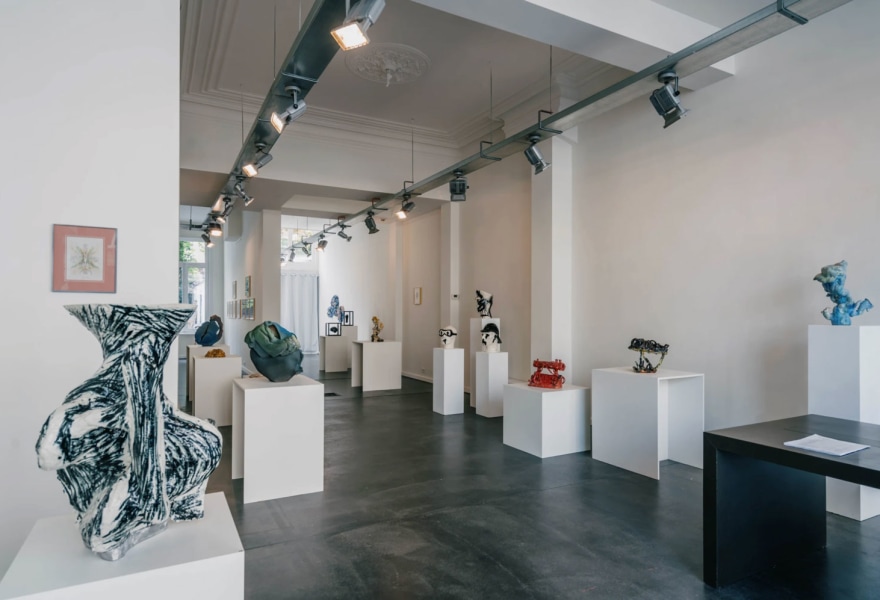
In 2015, A. S. Byatt wrote that there is always an element of chance in what happens inside the kiln. She was writing not as a ceramicist, but as a critic in The Spectator, reviewing Edmund de Waal's The White Road, his lyrical history of porcelain. De Waal had spent years travelling to the places where this white gold was first discovered and reinvented, and Byatt recognised in his book something that reached far beyond porcelain itself: the understanding that with this craft, there comes a moment when the maker must relinquish control. It is neither an aesthetic choice nor an artistic hesitation, but the instant the kiln door closes and the fire proceeds according to its own logic.
It is precisely that moment that is the very essence of Sculptural III, although no wall label at the NQ Gallery is likely to put it quite so plainly. Eleven artists—many of whom normally work with entirely different materials—have this year willingly surrendered themselves to a medium that refuses to negotiate.
Estrangement as method
Caspar Berger is not the first name that comes to mind when thinking about ceramics. Known for his background in bronze and his patient, almost obsessive approach, Berger devoted months to clay as though he had something to prove to himself, rather than to an audience. Among the results is a hand turned literally inside out, a gesture that would be a technical tour de force in bronze, yet becomes an existential gamble in clay. Clay neither forgives hesitation nor punishes overconfidence and an artist who has spent decades mastering a different material must start again as a novice.
The same is true of Stephan Balleux and Folkert de Jong, each of whom has established a distinctive visual language in either painting or sculpture. Faced with clay, both were compelled to rethink their artistic vocabulary in a material that refuses to be dictated. Joep van Lieshout presents a series of heads, of which—tellingly—only a selection have found their way to the exhibition, as though the series itself underwent a process of elimination beyond the artist's complete control. Joke Raes exhibits previously unseen work and that in itself is revealing: what has not been shown before may simply not have succeeded before or may have proven too fragile to share.
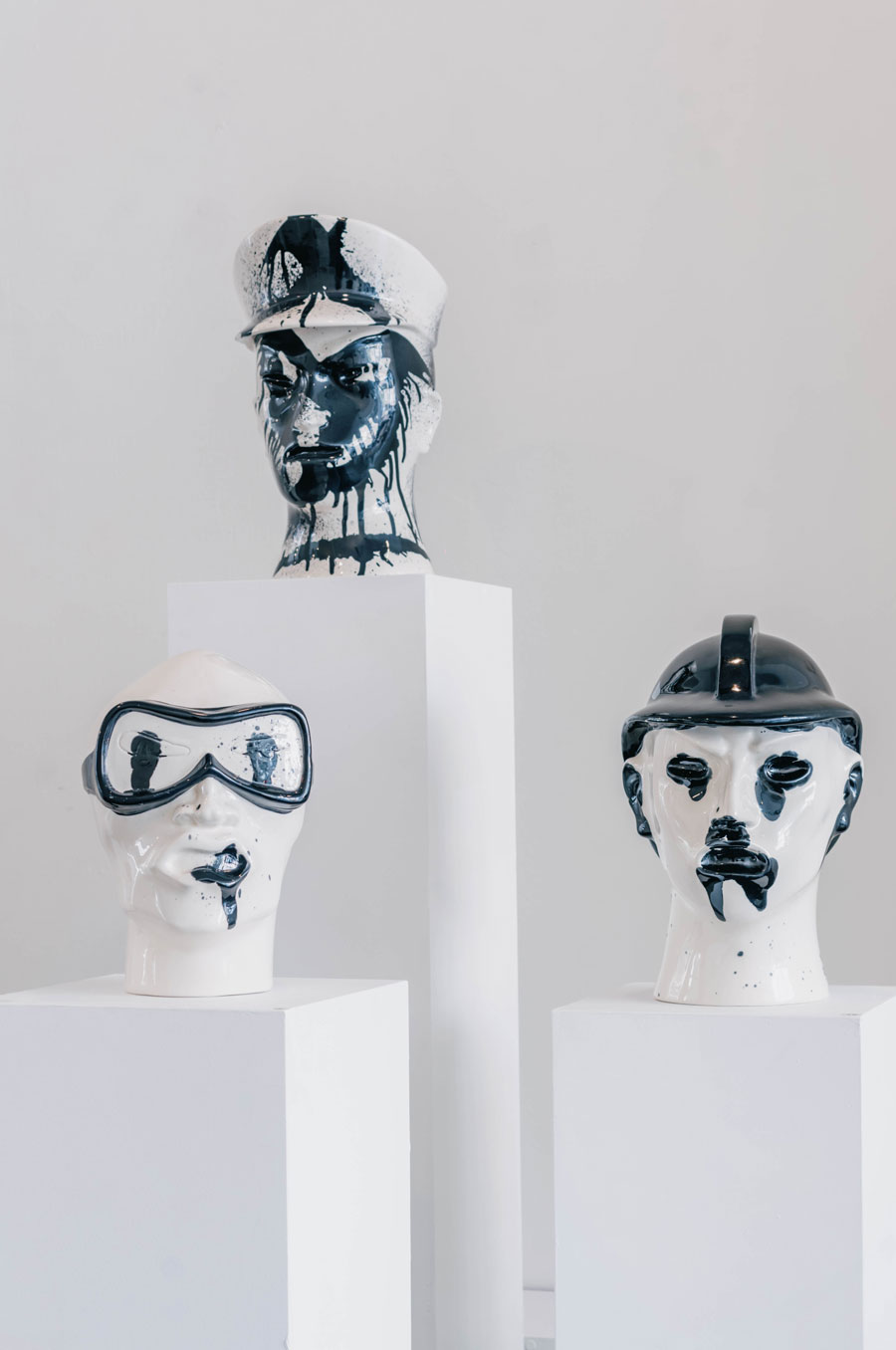 Joep van Lieshout, Sculptural III, NQ Gallery
This is the first layer of Sculptural III: not an exhibition about what artists are capable of, but about what they are prepared to risk when the material refuses to become an extension of their will.
The kiln decides
Anyone working with ceramics accepts a curious division of labour. The artist shapes, glazes and composes. This is followed by a phase in which nothing more can be done and the kiln takes over. Temperature, oxygen levels and the way glazes interact at nine hundred degrees are variables that reveal themselves only afterwards, never beforehand. A crack that appears unexpectedly, a glaze that fires differently from what was intended, a shape that collapses beneath its own weight are not accidents, but conditions of the material itself.
Byatt fully recognised this in her review of De Waal. What fascinated him in the history of porcelain was not the triumph of its inventors, but the long succession of failures that preceded success: centuries of artists and alchemists unable to discover the formula, kilns collapsing, entire firings lost. Chance is not incidental to the medium, but its defining characteristic.
Throughout Sculptural III, this logic is palpable, although never explicitly stated. Delphine Courtillot's alternating matt and glazed surfaces are the outcome of countless decisions whose consequences become visible only after firing. Anne Marie Laureys' compact, blue-hued forms bear the signature of decades of development, yet every new firing remains a repetition of the same attempt. What visitors perceive as a coherent body of work is, in reality, the product of years of negotiation with the fire, from which only the successful outcomes have reached the gallery walls.
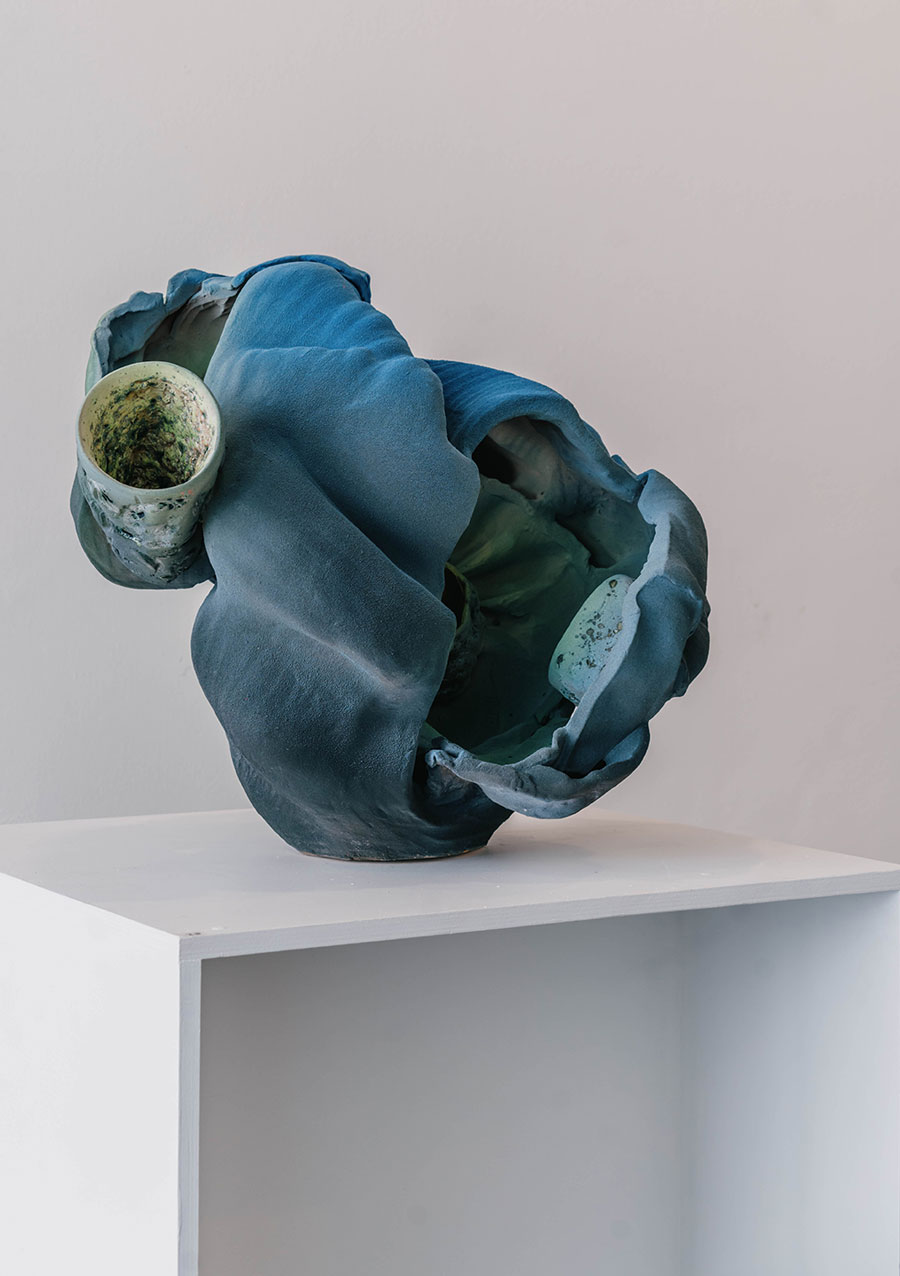 Anne Marie Laureys, NQ Gallery
Contrast as curatorial principle
Curating together for the first time, Niqui van Olphen and Nick Ervinck have deliberately structured the exhibition around contrasts: the organic against the figurative, the serene against the unsettling. Viewed through the lens of chance in the kiln, that decision acquires an additional layer of meaning. Tom Volkaert's black-and-red forms, charged with an ominous, almost Giger-esque energy, are not merely an iconographic choice, but also demonstrate what can happen when an artist actively seeks the unpredictable, rather than attempting to avoid it. Natasja Alers and Johannes Nagel, on the other hand, continually shift the viewer's perspective, encouraging uncertainty about what exactly is being observed.
Considering the context, the fact that gallery owner Niqui van Olphen and artist Nick Ervinck have curated the exhibition together is more than an organisational detail. An artist selecting fellow artists understands from experience what each work has had to endure before reaching the gallery. A gallerist views the works with a different kind of distance. Bringing those two perspectives together results in an exhibition attentive not only to what a work expresses, but also to what it has survived.
A canon in the making
The connection with Museum Beelden aan Zee underscores that Sculptural III does not exist in isolation. Many of the participating artists have previously exhibited here and once again, Dick van Broekhuizen, curator and head of museum collections, delivers the opening address for the third consecutive edition. With tentative plans to extend future editions across the German border, what the NQ Gallery is building is more than an annual exhibition. It is an informal, steadily evolving canon of Dutch and Belgian sculpture, enriched by artists willing to engage with the same unpredictable material.
This echoes what De Waal accomplished in The White Road: not an encyclopaedic history of porcelain, but a personal, fragmentary account of people captivated by a material that has never entirely submitted to them. Sculptural III achieves something similar on a more intimate scale. It is not a survey of contemporary ceramic art, but a collection of 11 iterations of the same risk, undertaken repeatedly.
Visitors stepping afterwards into the adjoining H.F. Room may very well experience a sense of relief. Throughout the summer, The Ordinary Luminous, Erwin Keustermans' series of drawings is displayed here: light-footed, almost sculptural in line, yet without kiln, without fire and without the element of chance to which Byatt referred. Precisely through its absence of risk, it serves as a counterpoint, emphasising what the artists in the main gallery have consciously embraced.
Conclusion: what fire does not forgive
Back to Byatt and back to the fire. What she observed in De Waal's work applies equally here: a work in clay never entirely belongs to the person who created it. There is always a moment when the maker has to let go—quite literally—and something older, more indifferent than artistic intention assumes the final authority. Sculptural III reveals what remains when 11 artists understand this, yet choose to continue all the same—not in spite of the risk, but by embracing it.
Sculptural III is on view at NQ Gallery through August 31.
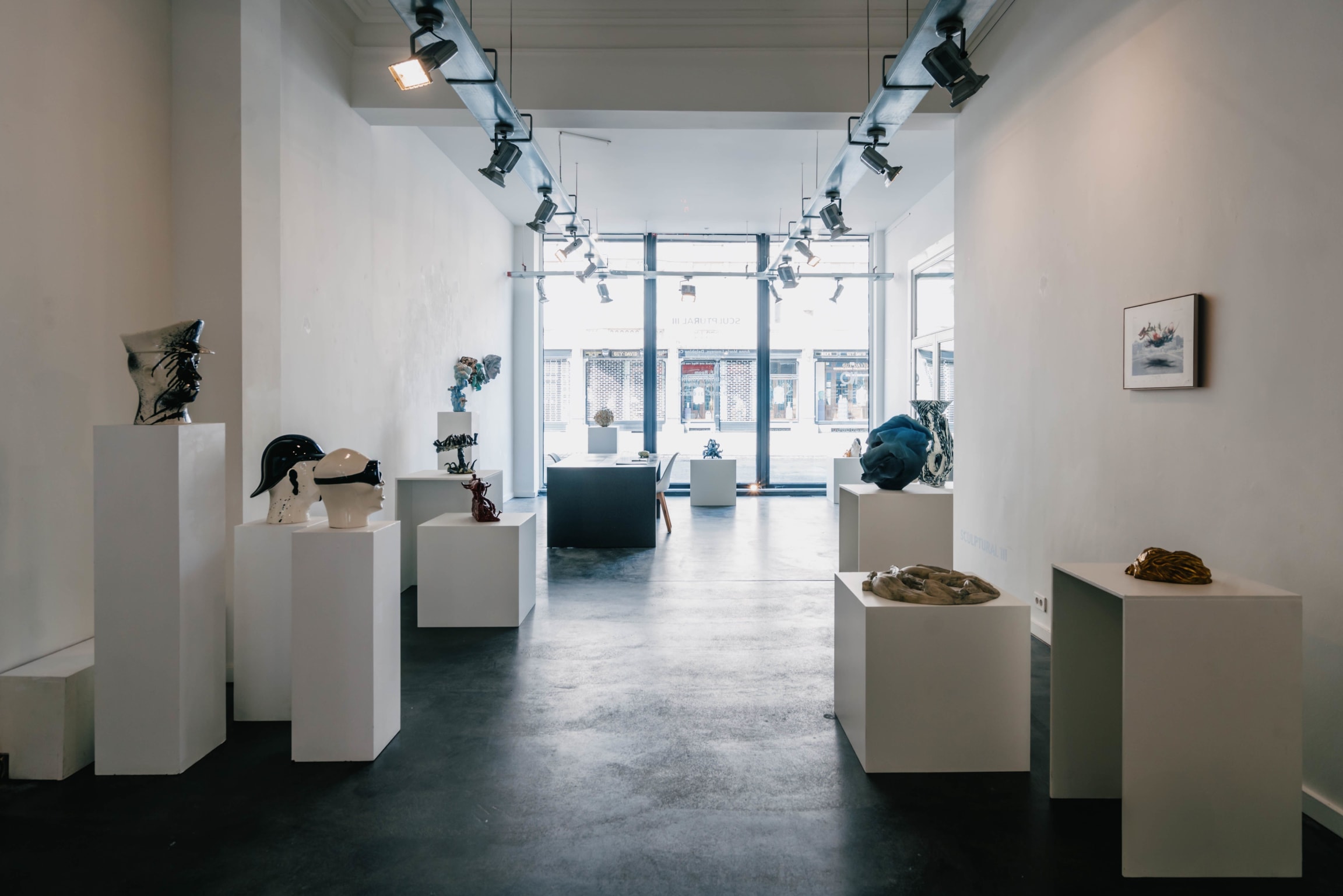 Sculptural III, NQ Gallery