29 june 2026, Martine Bontjes
The studio of... Fahrettin Örenli
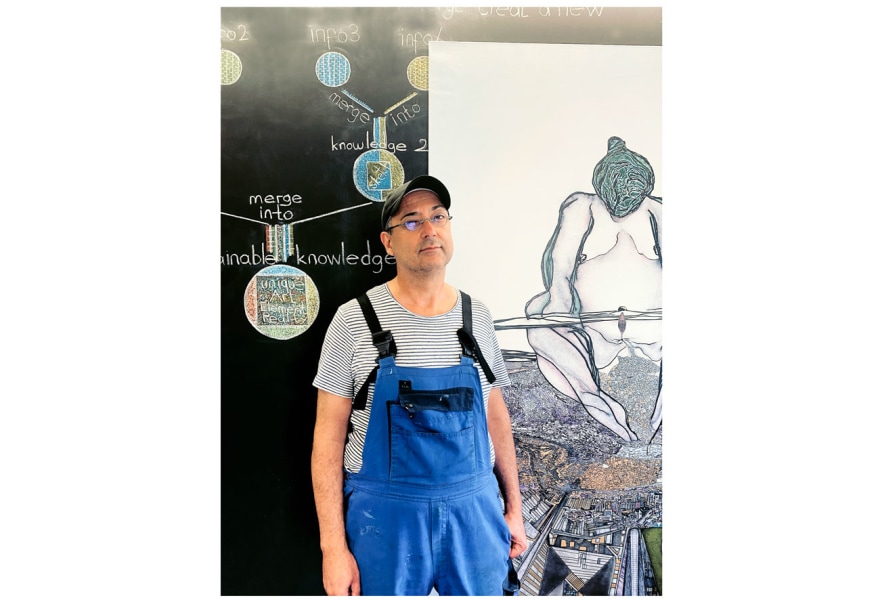
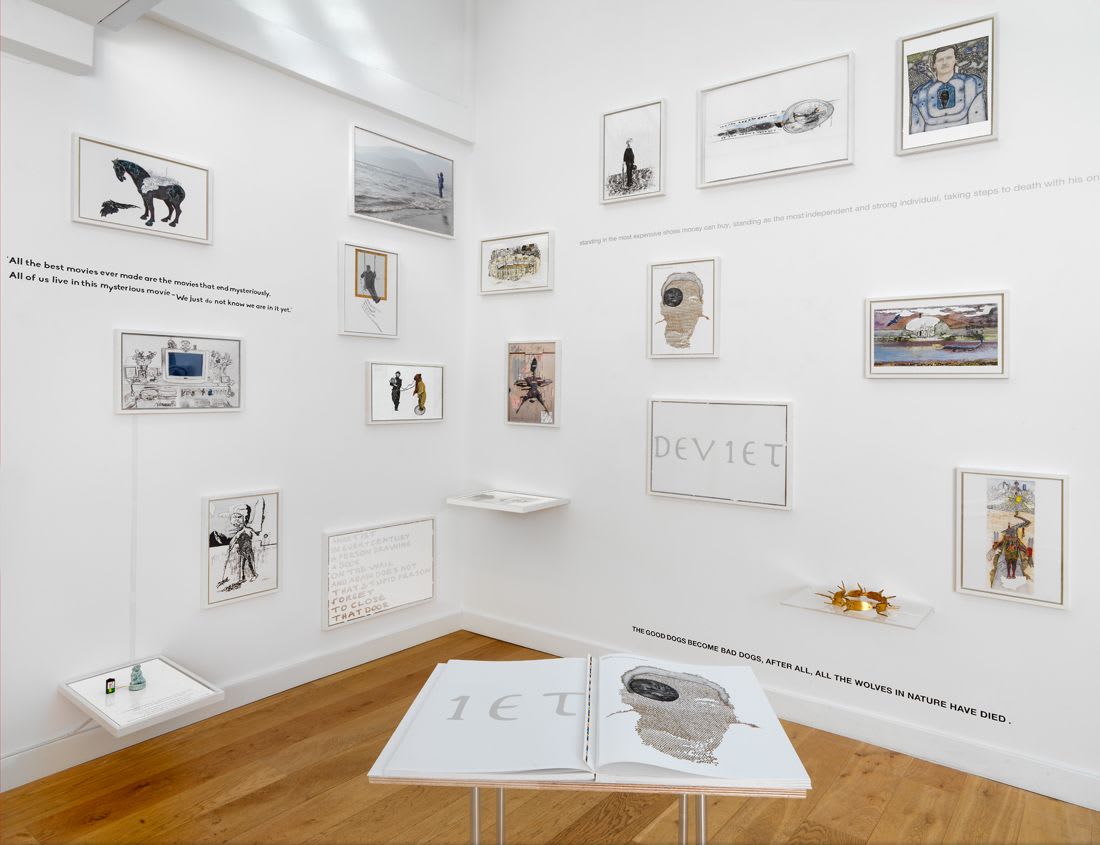
Over the past years, Fahrettin Örenli has lived and worked between Amsterdam, Istanbul, Seoul, and New York, cities that each produce power and knowledge in their own way. In the exhibition ‘Conspiracy Wall > ANARTIST’ at Bradwolff & Partners, these observations take the form of an expansive artist's book filled with drawings, poems, silkscreens, and text fragments, inviting visitors to make connections of their own. ‘Conspiracy Wall > ANARTIST’ remains on view at Bradwolff & Partners through 11 July.
Örenli spent ten years developing this project, immersing himself in subjects including geopolitics, migration, technology, and structures of economic power. His artist's book functions not only as an archive, but also as an invitation to let art and life merge into one single form. Pages can be detached from the book, rearranged, and reassembled into a personal installation or narrative.
You live and work in different cities around the world. What is the biggest difference between these workspaces?
I do not only live and work between Amsterdam and Istanbul. Since 2004 I have also lived in Seoul, and before that in New York. For decades, these four cities have been the main urban environments through which I examine contemporary life. Today, money has become one of the dominant measures through which value and knowledge are produced, and cities are the primary sites where this process unfolds. As cities continue to grow, the transformation of our value systems seems to accelerate as well.
Each city allows me to study a different condition. In Amsterdam, I focus on individualism and how economic activity shapes knowledge production. Istanbul interests me for its hybrid character. In Seoul, I examine continuous competition and urban restructuring. New York possesses an almost unconditional psychological power to absorb individuals into its systems and structures.
Your practice moves between visual art and poetry. Where does a work usually begin? With a text or poem, or with an image?
At the beginning of my career, realizing ideas visually took time. I could not keep pace with the speed at which ideas emerged, so I began writing them down. Over time, those notes evolved into poems, and writing became as important to my practice as visual art.
Today, a work can begin with either a text or an image. My process involves collecting, analysing, and recombining elements across different media to develop a distinct artistic language. By bringing together poetry, short stories, art-theoretical writing, and visual forms, I move continuously between literary and visual expression.
Your new exhibition is titled ‘Anartist’. What does that title refer to? Is it an identity?
Born in a beautiful mountain region close to nature, yet living under martial law, I witnessed extreme realities. People were killing each other and dying for nothing. I use the word ‘Anartist’ satirically. It relates to one of my central concerns: the function of art and the attitudes that shape the art world. Growing up, I saw how political and ethnic divisions could turn neighbors into enemies and constantly produce “the other.”
ANARTIST emerges from these experiences and from questions of belonging, identity, and the contradictions of contemporary life. There is no distinction between my life philosophy and my work. Millions of questions and a few humble answers. Perhaps the poem ANARTIST expresses it best:
ANARTIST
IN EVERY CENTURY
A PERSON DRAWING
A DOOR ON THE WALL
AND AGAIN, DOES NOT
THAT STUPID PERSON FORGET TO CLOSE THAT DOOR?

Fahrettin Örenli, Artist’s book: Conspiracy Wall > ANARTIST, 2015, Bradwolff & Partners
You first presented this book ten years ago. Why did you feel it was important to bring it back right now?
The project is the result of a decade-long process (2004–2014), during which I travelled across different parts of the world, from the United States and South Korea to China, Uyghur regions, Turkey, and the Middle East. In these different environments, I encountered issues ranging from pipeline politics and corporate power to the exploitation of natural resources. At the same time, I was investigating technological developments and asking whether art could still communicate with an audience in the vast and intangible realm of the World Wide Web.
I wanted to bring the book back because the questions it addressed remain highly relevant today. Many of the social, political, technological, and environmental issues it explored have become even more urgent. I believe art should be timeless, connecting the past, present, and future. This artist's book reflects those continuing realities while offering a historical perspective on them.
Should we see it as a historical document, or rather as a commentary on the present?
Yes, it can be seen as both. My artistic method has developed alongside my approach to research. I map social interconnections and political motivations to understand how human interventions shape daily life, urban environments, and new realities. My research is grounded in travel, observation, and direct encounters rather than a single environment. While the work contains historical material, it should also be read as a commentary on the present, as many of the issues it addresses continue to shape our systems of knowledge and understanding of the world.
In this exhibition, you combine prints with drawings and texts. The prints are attached with a perforated edge. What do you hope people will do with them?
To communicate my realities, I use a simple structure that represents “the realities of individuals” (folded) and “the realities of the masses” (unfolded). The artist book can exist as a book, but it can also unfold into an installation or exhibition.
‘Conspiracy Wall > ANARTIST’ is designed to transform within exhibition spaces as well as domestic environments. Through its perforated poems, prints, and silkscreens, I invite viewers to participate in this process. By rearranging its elements, they can create their own narrative structures and installations in private or public spaces. In that sense, the project carries both artistic and educational dimensions.
The work is also easy to transport. Does that relate in any way to your own life of moving between places?
Yes, certainly. My artist book reflects an autobiographical dimension of my practice. Born between different ethnic origins and having lived across several countries, I gradually became merged into a universal “ANARTIST.” The portability and transformability of the work relate directly to this condition of moving between places, realities, and systems of knowledge.
Ultimately, the project raises questions about belonging, transformation, and the possibility of merging life and art into a single form. It is about unfolding the darkness within one's own mind, communicating it to others, and searching for meaning through that process.
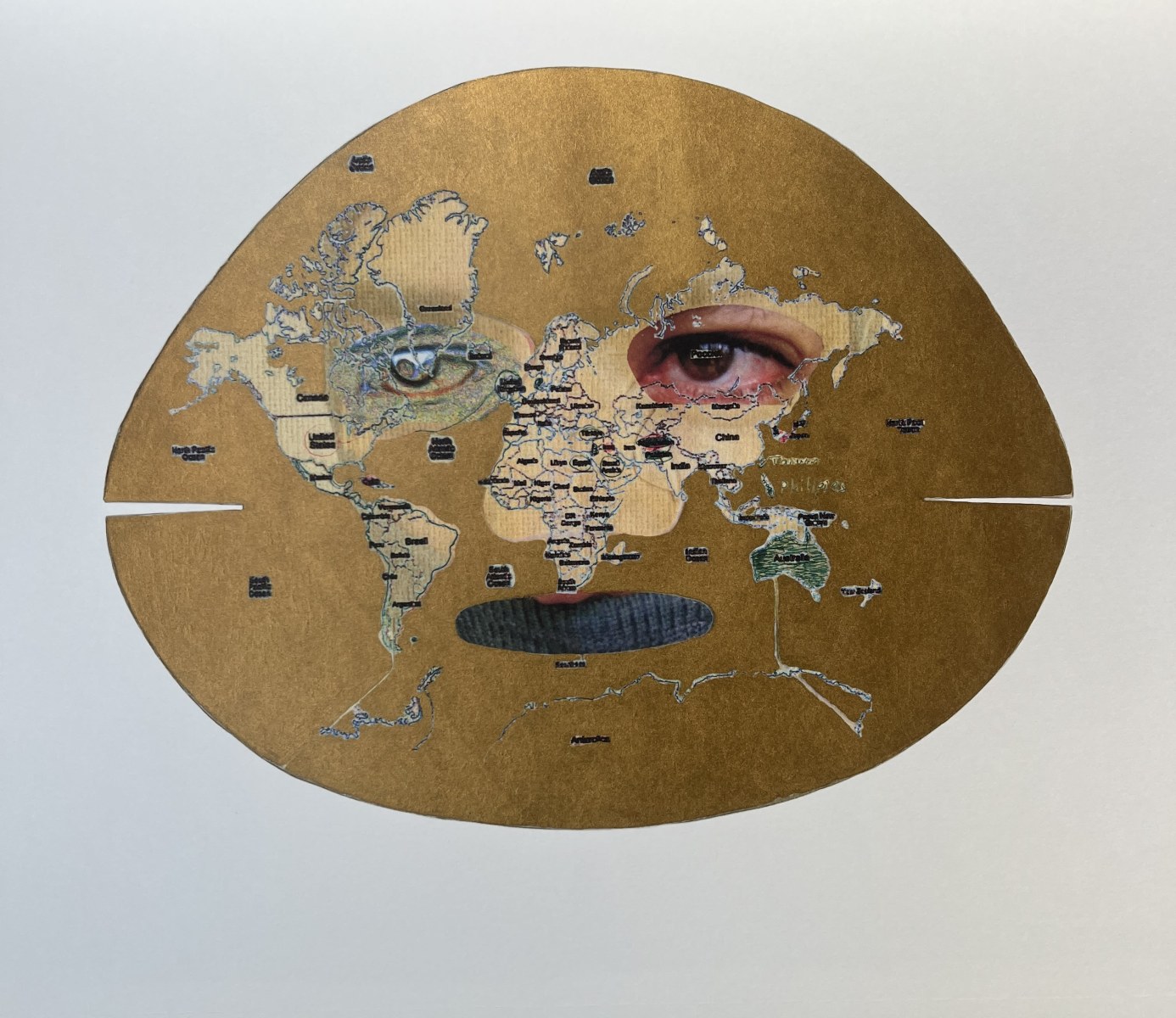
Fahrettin Örenli, Artist’s book: Conspiracy Wall > ANARTIST, 2015, Bradwolff & Partners
There are references to television news broadcasts surrounded by colourful embroidery. Why did you want to connect the harshness of current events with something light and decorative?
Yes, I am referring to the video work MIDDLE CLASS HOME TV within the installation. The videos are presented within drawn television sets that evoke an ordinary middle-class home. Viewers would not normally expect to encounter critical video art in such a familiar setting. The works address political, social, and historical realities, while the domestic environment brings them into everyday life.
Shadows of Dust III combines animation with sound recorded at a Workers' Party gathering discussing contemporary economic issues, including the dominance of the US Dollar. The Emotion of the Land, THE CUT by Post Cosmetic Surgery connects the division of Korea with the pressures of cosmetic surgery and modernization. I am interested in how seemingly unrelated realities intersect and generate new meanings.
I also noticed a map marked with routes. What do those routes refer to?
The map refers to the West-East Oil Pipeline and other existing or proposed energy routes connecting East and West. These routes link regions across Central Asia, the Middle East, China, and Europe. Through this work, I question the political and economic interests surrounding pipelines, natural resources, borders, and geopolitical power. In the case of the West-East Oil Pipeline, I was particularly interested in contradictions such as the petroleum resources already present in the Uyghur region and the implications of directing pipelines through areas such as Afghanistan.
My interest in maps comes from their ability to visualize invisible political and economic structures. The routes connect questions of oil, water, migration, borders, and power. While these references may appear specific, together they point to broader forces that shape everyday life across the world.
In the book, you seem to create an entirely new world, for example in 'New Amsterdam'. What do you reveal through that imagined world?
By combining different media and subjects, I explore the tension between nature and human self-interest, questioning whether what is lost to wealth, power, and political ambition can ever be recovered, and whether true freedom exists only when nature is allowed to follow its own course.
In New Amsterdam, these questions take a Dutch form. Referencing both the ship-shaped ING headquarters and the VOC ship Amsterdam (1748–1749), I examine the banking system and its structures of power. In many countries, ordinary people have become modern slaves to the private banking system. In the Netherlands, the contradiction is even more striking: some major banks have historically depended on significant government ownership or intervention, yet citizens continue to carry growing financial burdens and pay 21% VAT. Through New Amsterdam, I ask whether a system supported by public resources ultimately serves the public, or the structures of power behind it.
Are you currently working on any new projects?
Yes. I am continuing to develop my long-term research project, ‘Equation: The Evolution of Knowledge Within and Beyond the Human Mind’. The project combines visual art, poetry, literary writing, and theoretical research to explore how knowledge is formed, transformed, and transmitted within and beyond human consciousness.
My current work focuses on the relationship between natural and human-made systems, the impact of capital and urban structures on knowledge production, and the question of how consciousness and accumulated knowledge might persist beyond the physical body. Through new visual works, artist books, poems, and theoretical texts, I continue to expand this research.
Fahrettin Örenli, Conspiracy Wall > ANARTIST, Bradwolff & Partners
