19 june 2026, Martine Bontjes
The studio of... Kim van Norren
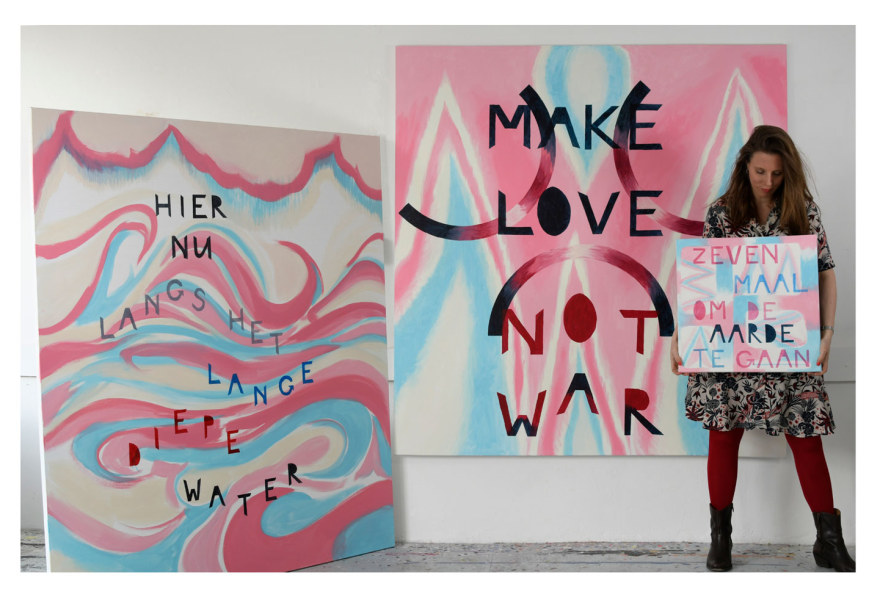
Every painting by Kim van Norren has its origins in either words or music. Song lyrics are usually the foundation of her colourful abstract canvases, but in her new work she also draws inspiration from poetry and sports commentary. In her studio in Kampen, after a difficult period, she picked up the thread again. By painting words, Van Norren once again created space for tenderness and connection. In her new exhibition ‘I Will Soften Every Edge’ at ROOF-A Van Norren explores how love, vulnerability and self-reflection can offer us something to hold on to in difficult times.
For her new exhibition, Van Norren drew, among other things, on the poetry of Walt Whitman. The line “I am large, I contain multitudes” is closely connected to her own creative process and the ongoing desire to keep reinventing ourselves. The exhibition runs all summer, through 30 August, at ROOF-A in Rotterdam.
Where is your studio and can you describe what it looks like?
My studio is in Kampen, in the former Graphic Workshop Kampen. I have a space at the back of the building. The best thing about this studio is the light.
What music was playing in your studio over the past month?
Elvis Presley, Bram Vermeulen, Maarten van Roozendaal, Lou Reed, Jules de Corte, Depeche Mode, Johnny Cash, and Lankum with the track Bear Creek on repeat. That's Irish folk music.
What's the first thing you do when you step into your studio? And how does the day usually end?
I put on music and look at which texts will come up that day. I take out a canvas and mix my colours. I always work with diluted paint. I prepare this in advance so it has the right viscosity. These days I also work with gouache paint, which I often use for painting my letters. Gouache has a very high pigment content, which makes the colours bright and rich. I then prefer to start by organising things, because I know I'm going to end up in chaos once I'm working. I don't want to trip over the mess I've made myself.
The day always ends with tidying up and cleaning. I always have to leave my studio the way I found it. Clean and tidy. I can't work in mess.

Kim van Norren, I contain multitudes-2026 Text: Derived from Walt Whitman, 2026, ROOF-A
Do you keep song lyrics, words and phrases in a specific place?
My 'archive' is in my head, I live daily with all the texts. Over time, it's also become a comfort to carry them with me. The texts are part of how I think and feel. Often they form a kind of subtitle to what I experience, and then I'm grateful that I can reflect on the things that happen to me in a poetic way. If something isn't going well, it helps to hear Bram Vermeulen somewhere in the background saying: 'It's a contest no one can win'. When happiness overtakes me, I think of Maarten van Roozendaal with his 'It's so beautiful it makes you cry'. As far as I'm concerned, Maarten van Roozendaal is the absolute master of the Dutch language. The following line from Dal (2001) can get me crying: 'As if you normally live in squares too, I cry with you in clear lines'.
Do you always choose pop music as a source of inspiration? Or do other texts inspire you too?
My inspiration comes first and foremost from language and, more broadly, from popular culture. I draw on poems by, among others, Leopold, Neeltje Maria Min, Walt Whitman, Robert Frost and Leonard Cohen, but also classical music and lyrics by Henry Purcell and Bach. Sometimes also soundbites from sports commentary, interviews and conversations. As for pop music, I mostly listen to covered songs, songs that have been interpreted by many. I love, for instance, every version of I am a poor wayfaring stranger. I'm also very fond of spirituals and traditionals that found their way from around 1800 to now, I am building me a home (Davis Coen) is a favourite. The collective quality that music and poetry carry within them appeals to me. In art, making work seems solitary, but your work is never shown or experienced in isolation. We're part of a whole, even as an artist. And I'm glad that at my new gallery, ROOF-A Gallery, I also get to collaborate from that same value.
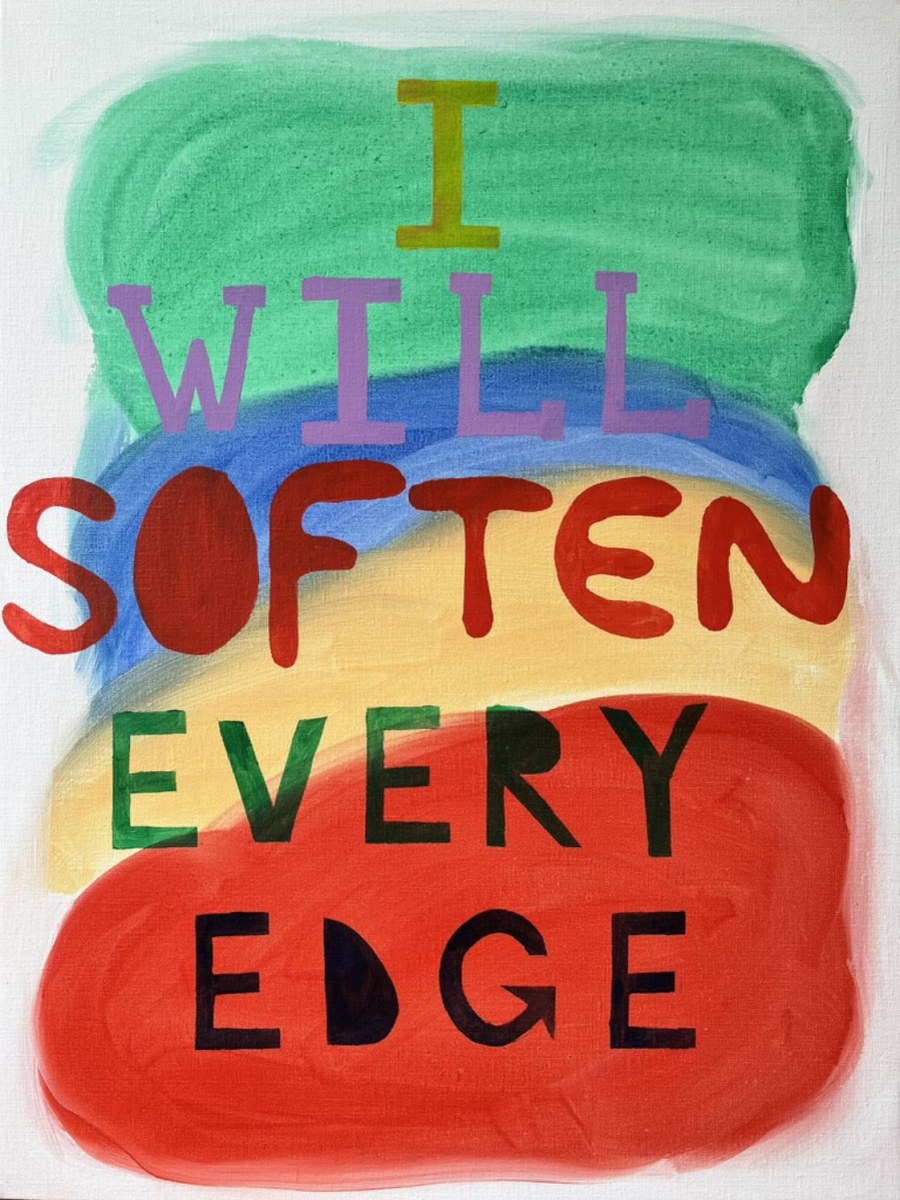
Kim van Norren, I Will Soften Every Edge Text: Light, Sleeping at last, 2026, ROOF-A
What music is the new series of works in the exhibition ‘I Will Soften Every Edge’ based on?
In this exhibition hang paintings with texts that come from music, but also from poetry. Some works have a very personal origin, others are lighter and more reflective. In my choice of music, poetry and texts, 'love' is the guiding thread of this exhibition. I've just come through a dark period. Music always lifts me back up out of difficult periods. This time too, music helped me feel again, and come back to myself. Everything in this life can feel so rough and harsh. The text I will soften every edge comes from the song Light by Sleeping at Last. To me, the song is about how showing love lets you be good to the people around you. By painting this text this way, I was able to give shape again to some softness for myself.
Applying a text to canvas is always, at first, driven by a personal motivation. But once it's on canvas, it becomes separate from me. We all feel the same spectrum of emotions, just in different areas and on different subjects. We all have to deal with pain and grief. My greatest hope as an artist is that my paintings, with their carefully chosen texts, may be a support to others in what they have to carry. There are also works in this exhibition with text from Walt Whitman from his poem Song of myself (1881). That's not music, but it moved me nonetheless. There's a passage in that poem where the poet asks himself:
“Do I contradict myself?
Very well then I contradict myself,
(I am large, I contain multitudes).”
Walt Whitman, section 51, Leaves of Grass, 1881
That's powerful, this self-reflection. We're not one person, we're always allowed to reinvent ourselves. For me that coincides with the creative process of making a work. The two works that came out of this are also the last works I made for this exhibition: I contradict myself for fun and I contain multitudes.

Kim van Norren, I contradict myself for fun-2026 Text: derived from Walt Whitman, 2026, ROOF-A
Your new work is mainly abstract, with here and there a few figurative elements from nature. Was that a conscious choice?
Definitely a conscious choice. I don't need to see physical reality reflected back in a painting of mine. In We are heading for a fall I painted a plant form. We could analyse that in Freudian terms, but that would lead at most to a flat observation that doesn't really help anyone looking at this painting. I prefer to work with geometric forms that give direction within a painting. If it becomes too organic, a canvas starts to 'swim'. In that sense, this painting is an exception to my rule.
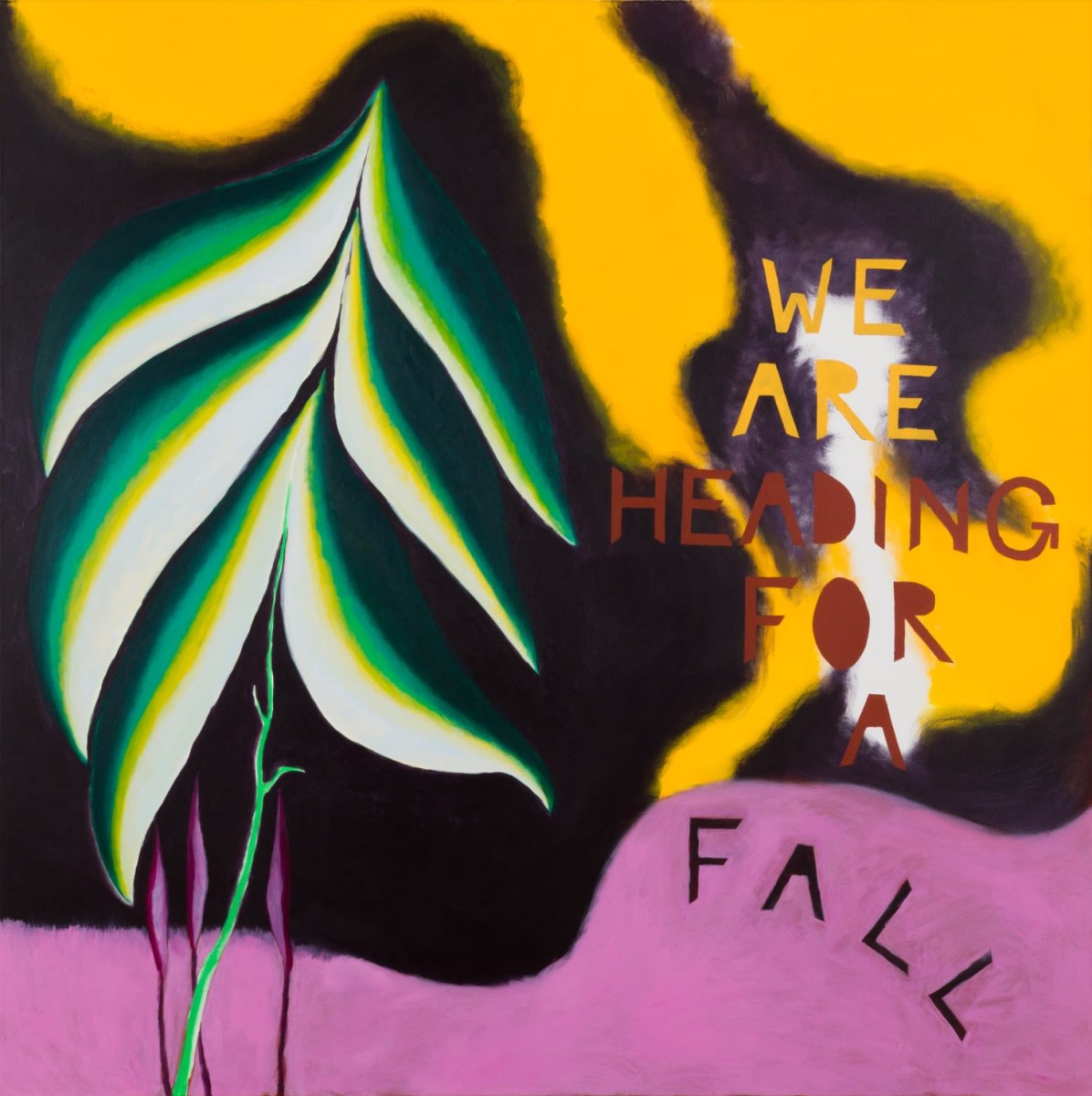
Kim van Norren, We are heading for a fall, 2023, ROOF-A
What role do colour and composition play in translating a sentence into a painting?
Colour is functional, it makes a text come forward or recede into the background. Warm colours come forward, cool colours recede. Contrasts create unrest, mixing with white makes things matte. Colour is the core of my work. Composition is about precision. How do I place colour, form and text? That's the main question when I'm painting.
Your work often starts from a personal association. When do you know a subject can also be recognisable to others?
I painted a canvas with the text Be naïve, be humble, be human. When I finished this work I felt very strongly: This is what we need right now, as an individual and as a society. We need to be human, gentle, humble, and we need to want to contribute to a better world. Then I already know, while painting, that the reach of this text is bigger than my personal longing. The canvas Make love not war also arrives, I think, at a good moment. Hopefully this painting works as a beacon to remind people that things can also be different.
What are you working on now?
I'm now working on a series of paintings in which I want to relate to what it means to be human. What are the limits of humanity? Why are people sometimes so cruel and how can we become gentler and more human?

Kim van Norren, Be naïve, be humble, be human, 2023, ROOF-A
