05 june 2026, Wouter van den Eijkel
Jan Banning: Bureaucratics at Galerie Fontana
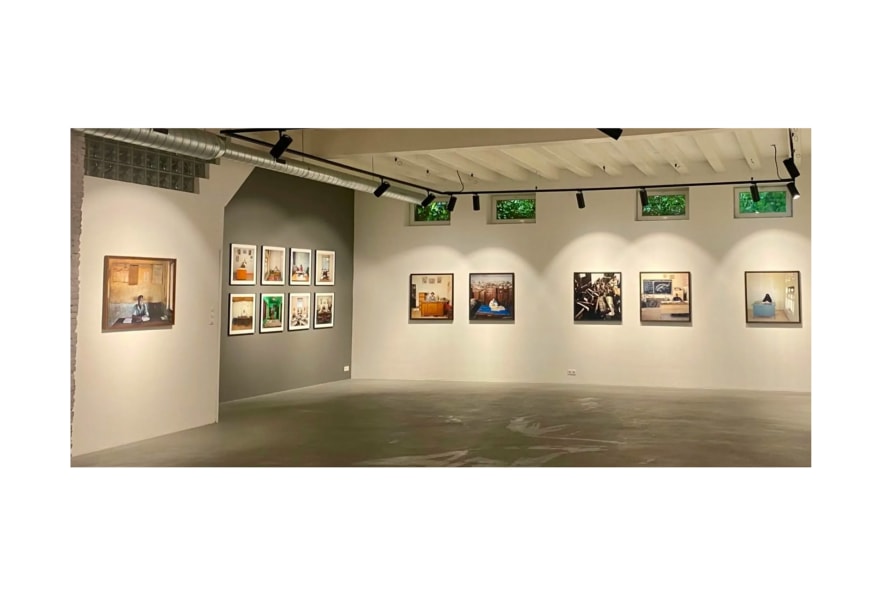
How many artists get the chance to reflect on their own work 20 years down the line? When that opportunity arose, photographer Jan Banning seized it with both hands. He republished his best-known book, Bureaucratics (2008) — this time entirely on his own terms — and expanded it with bureaucrats from four additional countries. A selection from the series is on view at the Amsterdam branch of Galerie Fontana until the 27th.
In Bureaucratics, photographer Jan Banning and journalist-writer Will Tinnemans (1959–2014) take viewers on a journey through the offices of civil servants in a wide range of countries, from Yemen to the United States and from France to India. Each photograph creates the impression that you've stepped inside an official's office, allowing you to inspect exactly what is lying on their desk. Banning's deadpan approach does the rest and with some images, it is difficult to suppress a smile.
At the same time, Bureaucratics reads and unfolds as an index of bureaucracy across different countries, the sort of photography that had long since fallen out of favour. Yet it is precisely the repetition of essentially the same image in different settings that makes the work so accessible and highly entertaining. 'It is a strange theatre that is being performed.'
Bureaucratics was first published exactly 20 years ago by American publisher Nazraeli Press as part of a series curated by Martin Parr. Both the book and photographic series were a resounding success. The book went through no fewer than four print runs, while the exhibition travelled around the world. The series was shown in 45 museums, art institutions and government offices — including at the tax authorities in a southern German federal state — across 18 countries on five continents. We spoke to Jan Banning about Bureaucratics, why the time had come for a new edition and how he ended up in Texas, Picardy and Shandong.
How did the idea of republishing Bureaucratics come about?
I had never really been satisfied with how the book was produced. I didn't think it was printed particularly well. I put up with that through four print runs. At one point, someone pointed out to me that copies from the first edition were selling online for between $350 and $2,000. So, I emailed the publisher and asked whether I could buy the remaining 150 copies. I then sold them through my website for a fraction of those prices.
Once they had all sold and enquiries kept coming in, I thought, this is the perfect opportunity to publish the book how I want it and to reflect on it. How often do you get the chance to look back on your own work? So much had happened with it. It had been widely exhibited and has inspired countless others.
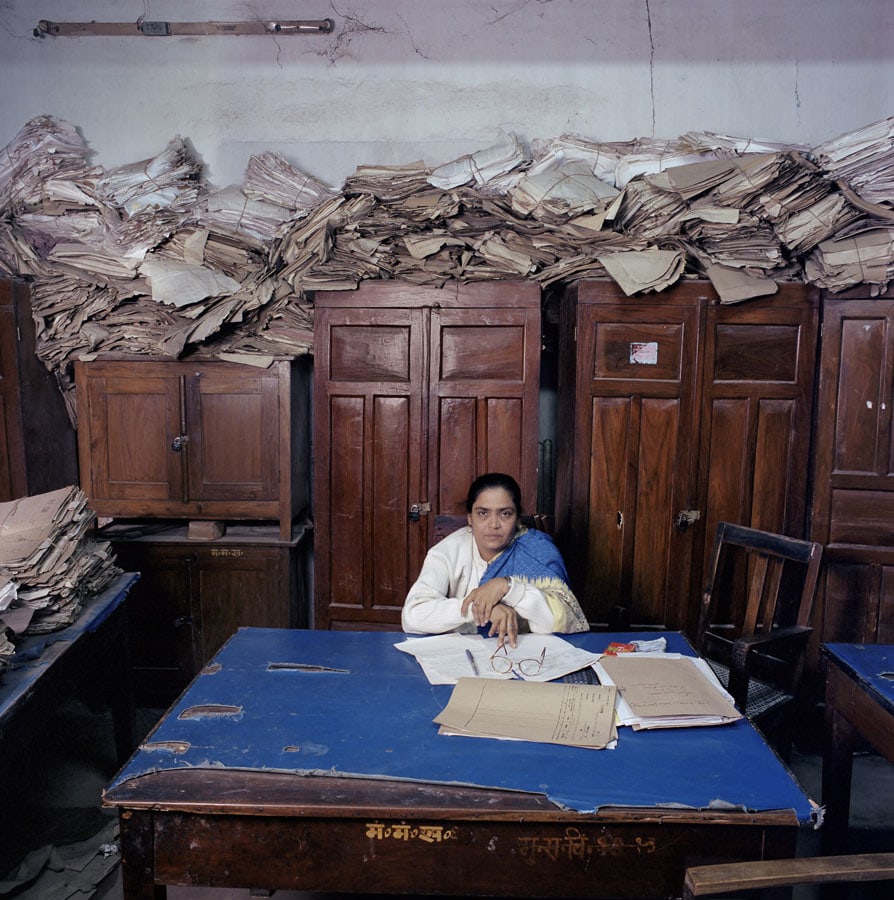
Jan Banning, India 17, 2003, Galerie Fontana
The first series that became part of Bureaucratics was made in Mozambique in black and white. You have added this chapter, along with three other series, to the new edition. When did you realise you had stumbled onto something much larger?
I had accepted an impossible assignment: to produce photographs for a story about Dutch development aid in Mozambique, more specifically the decentralisation of the country's administration. I decided to photograph civil servants in their offices.
Almost immediately after Mozambique, I realised how unusual and absurd it was. All my projects have a political dimension and I realised that bureaucracy is an expression of a political system. It is the state presenting itself to its citizens.
'Let's not stop here,' I thought, so I approached Will Tinnemans and asked whether we could create a chapter together. That became the chapter on India.
Why India?
We chose India because, formally speaking, it is the world's largest democracy. Each chapter had to represent something bigger than itself.
And that led you to the state of Bihar?
Yes, Bihar has roughly the same population as Germany, yet lacks a significant economy. As a result, government jobs are highly sought after. They carry status. We ended up in the office of a civil servant who had a computer on his desk, but could not operate it himself. Someone else was responsible for that.

Jan Banning, USA 11, 2007, Galerie Fontana
You also took pictures in Texas. What did Texas represent?
If you want to photograph the United States, you cannot choose New York or California because they are the exceptions. We wanted a large state with a substantial economy, so we settled on Texas.
I assume you didn't simply board a plane as soon as you decided to photograph there. How did you go about organising something like that?
Nowadays, everything can be arranged online, but back then, we first contacted someone who knew Texas well. Once you have a sense of what might be interesting, you start sending out emails — usually without receiving any replies. You then start making phone calls. The people who answer often have no idea what you're talking about, despite the emails. You ask whether you can explain, only to be interrupted halfway through with 'Just send an email!'
So much of the work happened before you even arrived. That must have been time-consuming. Returning to Texas, how did you eventually gain access to this sheriff?
In most places, a senior official approves our request and grants permission for us to take photographs. But in the United States, everyone decides for themselves. That sheriff determined personally whether he wanted to be photographed.

Jan Banning, France 05, 2006, Galerie Fontana
In the essay accompanying the new edition, you say that France was the only country where people immediately understood the value of the project and where permission was quickly granted by the prefect. Yet photographing there proved challenging because it resembled the Netherlands so closely, making it harder to appreciate the visual qualities of the spaces. Looking back, which would you have preferred: endless preparation or the French approach?
The preparation can drive you mad and it is wonderful when you encounter a prefect who simply instructs a press officer to cooperate. In France, access was not the issue. We photographed in Picardy, among other places, a region experiencing gradual depopulation. Every village has its own town hall, but they are not open all the time. In fact, the civil servant in question travelled from village to village, meaning that in the next village, you might encounter the same municipal secretary again — and I wasn't going to photograph the same person twice.
If I'm not mistaken, most of the people you photographed were street-level bureaucrats rather than senior officials?
That's not entirely true. In Yemen, for example, we photographed the head of a district. He sits in a room lined with empty cabinets — he simply is; he doesn't need to do anything.
Sometimes it isn't immediately obvious what position someone holds. There are lower-ranking officials in the book, but also people from the middle and upper-middle ranks of the bureaucracy.
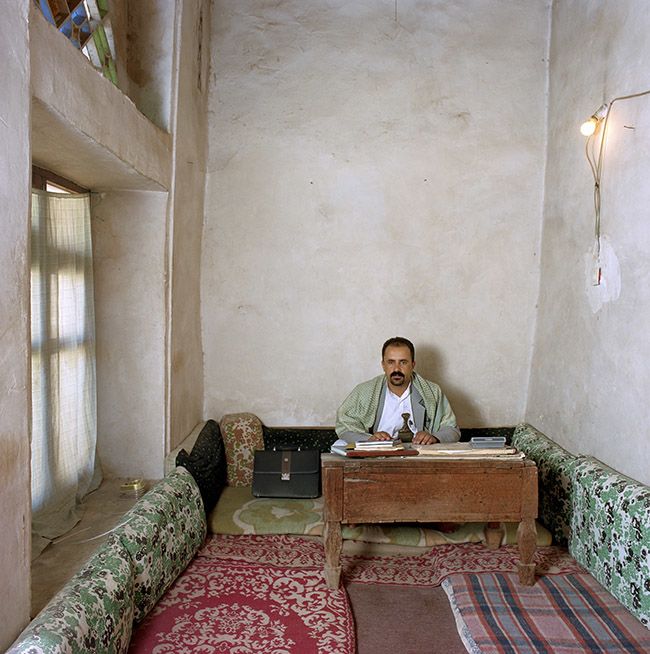
Jan Banning, Yemen, 30, 2006, Galerie Fontana
Which country and location were the most challenging? You might assume that a Western art project would not be welcomed with open arms in Yemen, though I may be mistaken.
No, Yemen was difficult at first. But once we had obtained permission and found a guide, and people realised we were not Americans, we were warmly welcomed. Photographing in Shandong, a province of China, was a different matter altogether. It was hell. There was no possibility to wander around freely within the Communist bureaucracy. Nothing was left to chance. The offices were spotless — it looked as though no work was ever done there. Officials seemed primarily concerned with presenting us with a positive image of China. Photographing there became a constant struggle. I had to shake off chaperones and guards. Sometimes I succeeded.
Finally, you describe yourself in the essay as someone with anarchist leanings who views governments with a fair degree of suspicion. Did that change over the course of the project?
No, that attitude hasn't changed dramatically. What has changed is the depth of my understanding. I was generally seen as a harmless eccentric. That was very useful, because after spending countless hours in town halls and government offices, I developed a much better sense of the dilemma faced by bureaucracies.
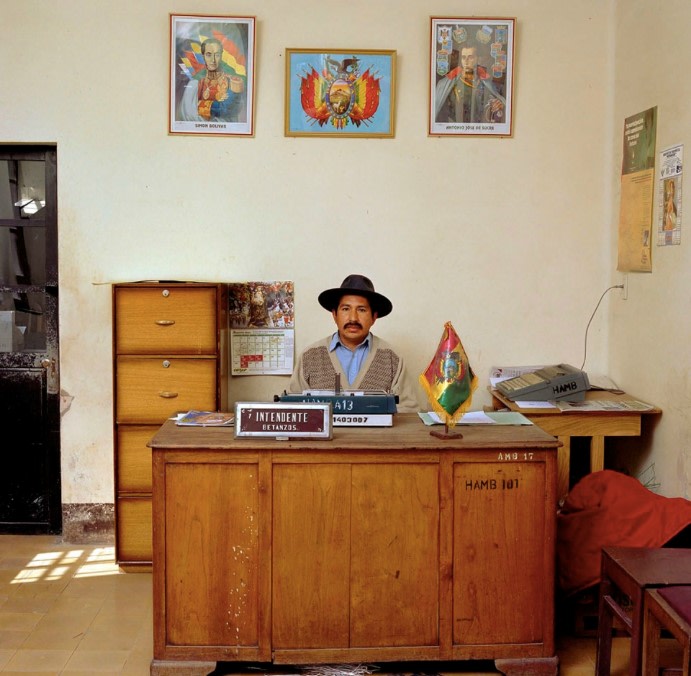
Jan Banning, Bolivia 13, 2005, Galerie Fontana
And what is that dilemma?
Civil servants are expected to act impartially, without regard for the individual. In that sense they appear fair. Yet by doing so, they risk losing sight of personal circumstances and individual needs. The rules apply to everyone, but not everyone is equal. I have gained a greater appreciation of that dilemma.
What are you working on at the moment?
I have just returned from Portugal after a short exploratory trip. In 1982 and 1986, I took pictures of agricultural cooperatives there. At the time, only women worked in the fields. What is the situation now? How do agriculture, immigration and politics intersect in a country where the far right gained a foothold relatively late? Can I make a link to photographs I made 40 years ago and would that be interesting?
