26 may 2026, Martine Bontjes
The studio of... Anna Aagaard Jensen
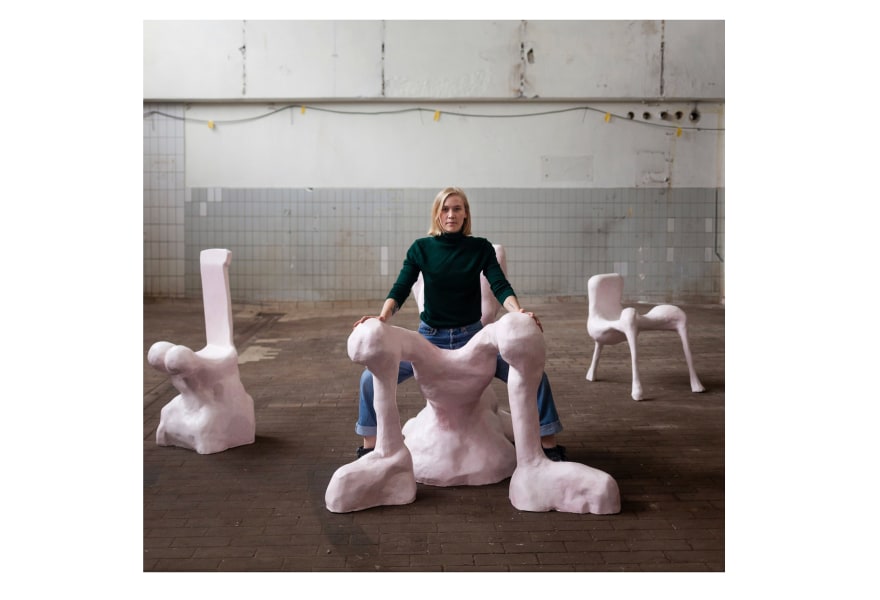
During her studies in furniture making in Denmark, Anna Aagaard Jensen began to realise that the objects she was asked to create seemed largely shaped by a male gaze. "I couldn't see myself reflected in the objects around me. The experiences I had as a woman didn't seem to exist within the narratives that these objects carried, so for whom was I actually making?", she wondered. Think of chairs in which women can barely move comfortably, or tables that are simply too high. Jensen decided to create her own sculptures through which she reveals how social structures shape the way we move, sit and occupy space. This becomes visible in works such as Dining with Daisy Table and womenspreading chairs like Boss Lady and Grand Lady, through which she exposes the invisible social codes that shape ideas of gender and behaviour. Jensen's work remains on view at KERSGALLERY in Amsterdam until 31 May.
Through her sculptures, Jensen hopes to contribute to a society in which more people feel free to be present, visible and heard regardless of gender or sexuality. She believes terms such as "girlish art" ultimately diminish her work: "We don't use the term 'boyish design'. And on a more personal note: I am a woman, not a girl."
Where is your studio and how would you describe this place?
My studio is in Schiedam, inside a former glass factory. The space is divided into two parts: a clean office and a workshop, which I think of as my "dirty" space. The workshop is my favourite place. It's a space for experimentation and intuition, a place where I can make mistakes, try things out without judgement, and allow ideas to develop freely.
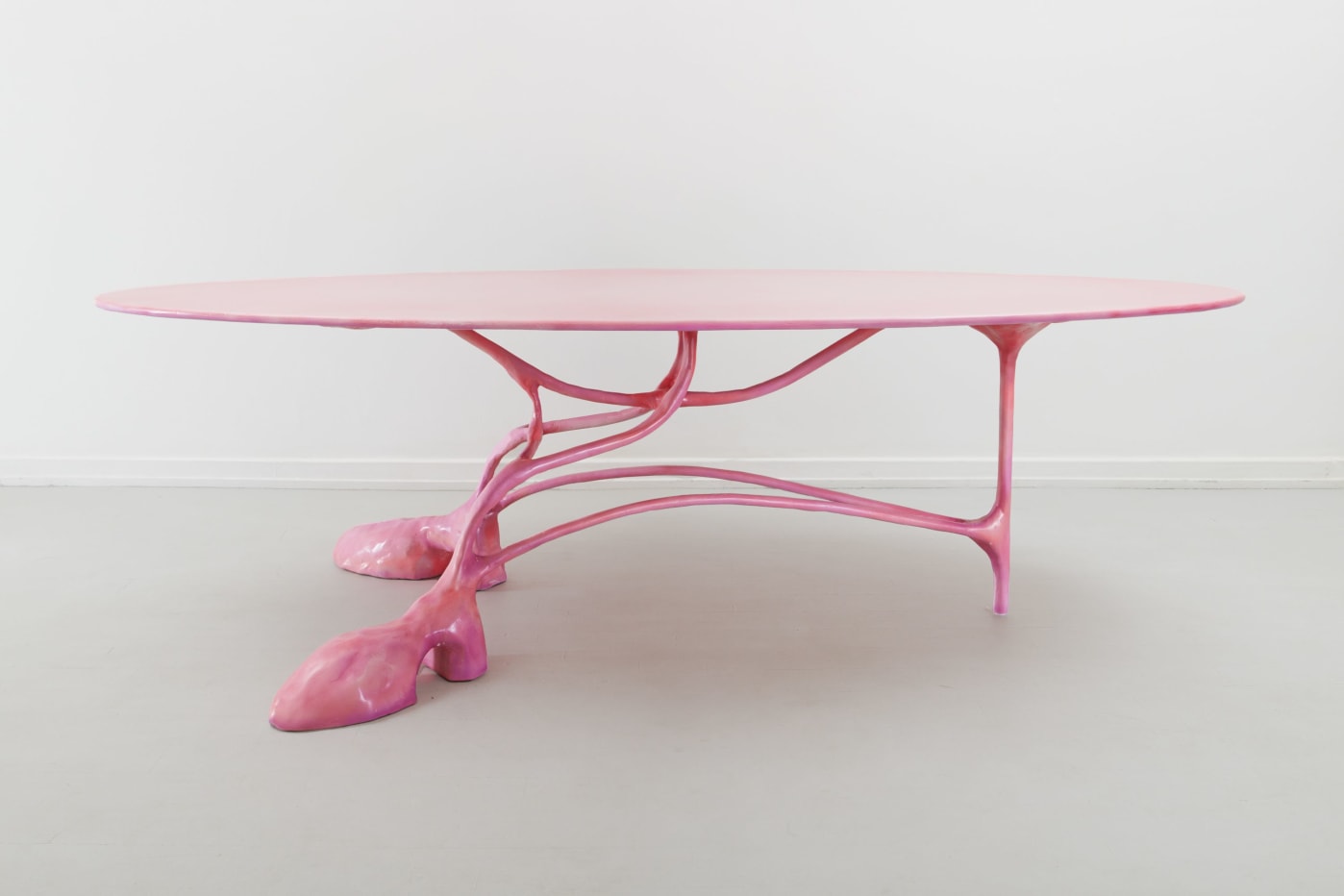
Anna Agaard Jenssen, Dining with Daisy Table #1, 2026, KERSGALLERY
Do you have a favourite tool you can't work without?
I find it hard to choose… but if I had to I would say a simple hobby knife. This is the tool I use for sculpting and I think without this, my objects might be a little too polished or predictable.
You have a background in furniture making. When did you begin to see furniture not only as functional objects, but also as a form of self-expression?
I believe that shift began during my studies in Denmark. I was puzzled by the emphasis on repeating the work(s) of old masters and 'solving problems' that had already been solved. To me, that felt repetitive and somewhat redundant. More importantly, I couldn't see myself reflected in the objects around me. The experiences I had as a woman didn't seem to exist within the narratives that these objects carried, so for whom was I actually making?
I have come to see furniture and everyday objects as catalysts for stories about how we live, both positive and negative. Rather than asking objects to perform perfectly or solve everything for us, I use them as a way to reflect behaviours, expectations and conditions within society. After all, design is something we all recognise, when you disrupt that, you are bound to get a reaction.

Anna Agaard Jenssen, daisy chair, 2026, KERSGALLERY
Flowers play a prominent role in your work, such as in the Daisy Chair. What meaning does the flower hold for you?
The flower entered my practice during a period of grief. I was struck by how many flowers arrived at our house as gestures of care and love. What fascinated me was that these symbols of comfort were also inherently temporary as the flowers were already in decay. I found myself longing for that beauty to persist rather than die. Flowers, at this moment, embody two opposites for me: beauty and brutality. The beauty in their colour, form and symbolism. The brutality in the act of control. We cut flowers, arrange them and determine how they exist and this started to filter into my practice.
Flowers are often used as symbols of femininity, delicacy and fragility, and these same qualities are frequently projected onto women. Yet women are not inherently fragile; they are incredibly resilient. Throughout history, women have continually adapted, endured and resisted despite the limitations imposed on them. I believe that strength and vulnerability can coexist. We often try to define people through a single characteristic, but we are much more layered than that. We can be resilient and fragile, powerful and vulnerable, soft and strong all at once. The flower allows me to explore cultural contradictions. It carries cultural ideas about beauty, femininity and fragility, but it can also embody resistance, persistence and transformation. In that sense, the flower becomes a way of talking about the complexity of women and the many truths that can exist within a single person at the same time.
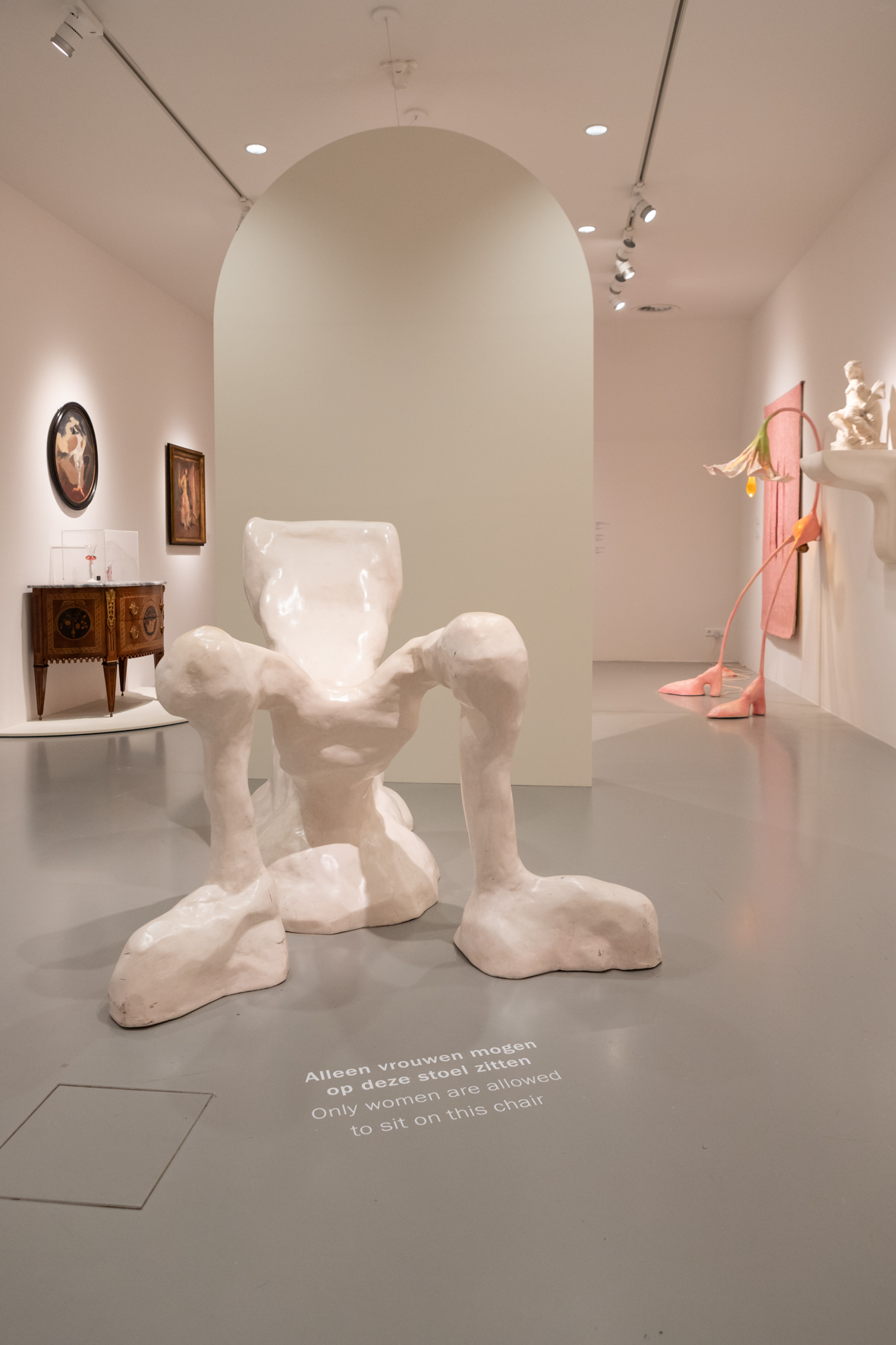
Anna Aagaard Jensen in Centraal Museum Utrecht, photo by Billie-Jo Krul
Recently, your womenspreading chairs such as Boss Lady and Grand Lady were exhibited at Centraal Museum in Utrecht. It turned out to be an ideal selfie spot. Visitors are usually discouraged from touching artworks. Why do you choose to make your sculptures touchable?
Without women interacting with it, the work simply doesn't function. In that sense, using furniture as a medium is also a great advantage, it allows people and visitors to become part of the story. I like that I can share or provide these moments for others.
For your womenspreading chairs, you drew inspiration from 'The Tonight Show' by Jimmy Fallon. What caught your attention?
I noticed that the women occupied the minimum amount of space in the chairs they sat in, while the men used all the space available to them. It was a very visual demonstration of how differently we are taught to occupy space and position ourselves in the world. Of course, there are many factors involved, from clothing to being in the public eye, but at its core it reflects the social expectations that shape our behaviour. We learn from an early age how much space we are allowed to take up, both physically and metaphorically. Those expectations influence how we sit, move and present ourselves.
How did you come up with the idea of creating a series of chaise longues?
The objects conceptually developed with the historical association between chaise longues and "fainting couches" for women. I found both the phenomenon and the proposed solution fascinating. Women often fainted because of restrictive corsets and because they couldn't easily go to the toilet. Instead of addressing those underlying conditions, society designed furniture to accommodate the symptoms. I found that logic both bizarre and revealing.

Anna Aagaard Jensen, madonna, 2026, KERSGALLERY
Your work is sometimes described as 'girlish design'. How do you feel about that terminology?
I think the term is derogatory. It is rarely intended to celebrate or elevate the work; more often it serves to dismiss it. We don't use the term 'boyish design'. And on a more personal note: I am a woman, not a girl.
Through your work, you encourage women to literally take up more space. What society do you dream of?
Ultimately, it comes down to confidence and believing that you are worthy of occupying space, and I don't mean that only for women, I believe everyone deserves the freedom to take up space, regardless of gender and sexuality. The goal is not to dominate or diminish others, but to create a society where everyone feels equally entitled to be present, visible and heard.
Are you currently working on any new projects that you're already excited about?
Yes. As I am going through a period of change in my own life, and my work is evolving through this. I still focus on female narratives and the female body, but just as my previous works emerged from lived experiences, the new work follows the changes and experiences I am navigating now.
