22 may 2026, Flor Linckens
Maya Watanabe in Venice: video art at the Complesso dell’Ospedaletto
The 61st edition of the Venice Biennale has just opened and, as every two years, an exciting programme unfolds beyond the Giardini and the Arsenale, the Biennale’s two main venues. During these months, the city becomes a treasure map of palazzi and churches — often free to enter and normally inaccessible — that temporarily house contemporary art. At the Complesso dell’Ospedaletto, a sixteenth-century church with an adjoining complex that over the centuries served as a pharmacy, concert hall and hospital for the sick, orphans and pilgrims, Fondazione In Between Art Film presents its third large-scale exhibition dedicated to video art. ArtReview recently selected the exhibition as one of the six unmissable off-site highlights of this year’s Biennale.
‘CANICULA’ brings together eight new site-specific video works specially commissioned and produced by Fondazione In Between Art Film. The participating artists are Lawrence Abu Hamdan, Massimo D’Anolfi & Martina Parenti, Roman Khimei & Yarema Malashchuk, Janis Rafa, P. Staff, Wang Tuo, Yuyan Wang and Maya Watanabe. The latter is represented by tegenboschvanvreden.
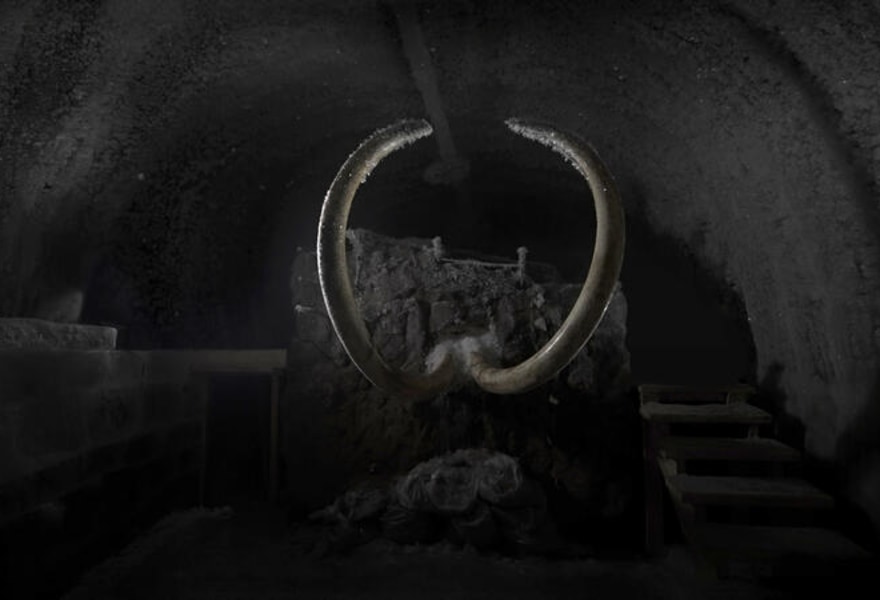
Within this context, Watanabe presents her new video work "Jarkov" (20 min, single channel). For this project, she travelled to northern Siberia, where mammoth remains are stored in tunnels beneath the permafrost, which is currently shrinking by approximately one metre each year. The video centres on the exceptionally well-preserved woolly mammoth Jarkov, who died more than twenty thousand years ago (nearly impossible to comprehend) and still remains largely intact inside the ice. The animal is embedded in a gigantic 23-ton block of dark ice and sediment, with only two enormous tusks protruding from it. Watanabe filmed inside the underground tunnel system, where the temperature permanently remains at minus twelve degrees Celsius, slowly moving through the corridors, the visible fragments of Jarkov and other mammoth remains.
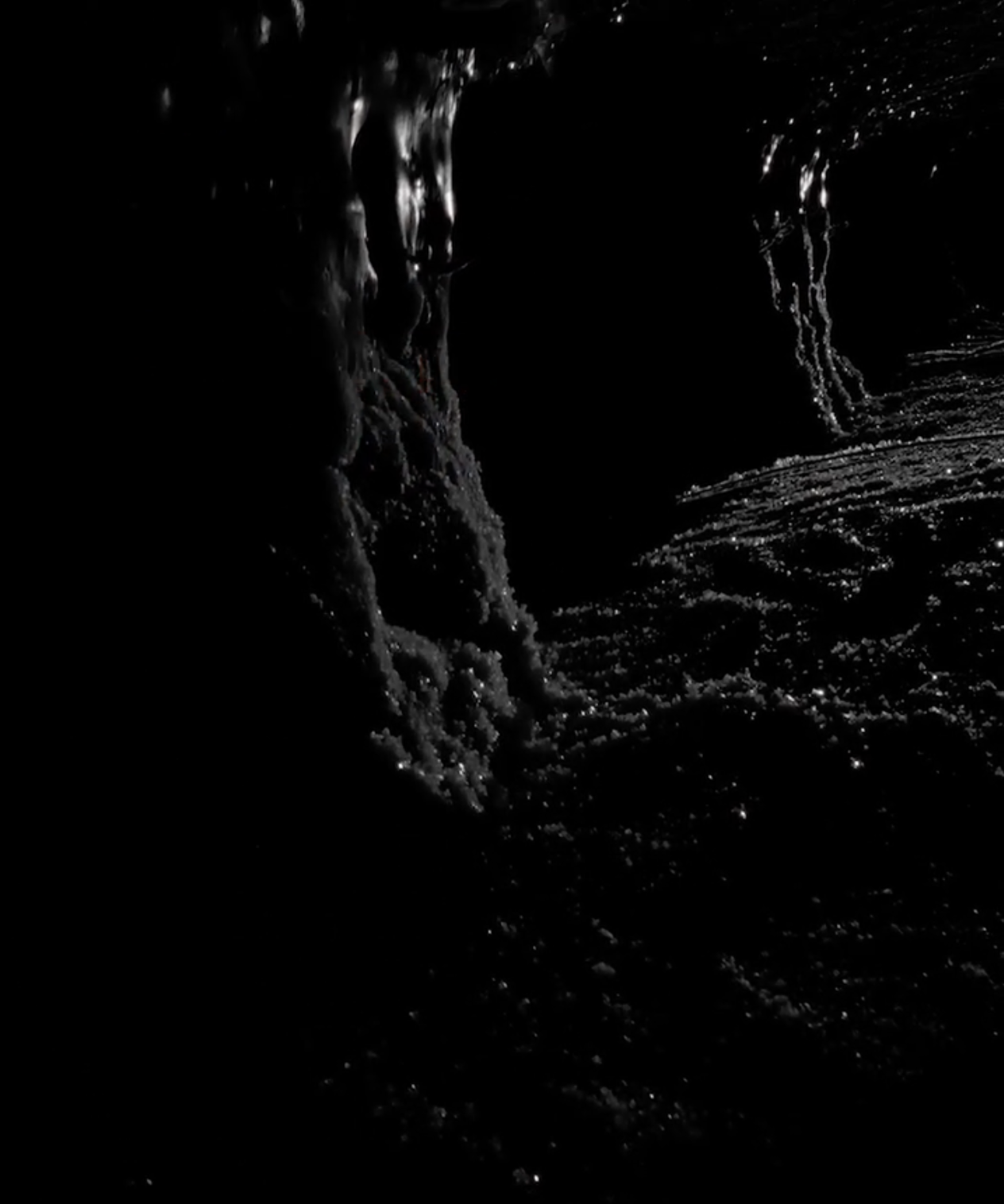
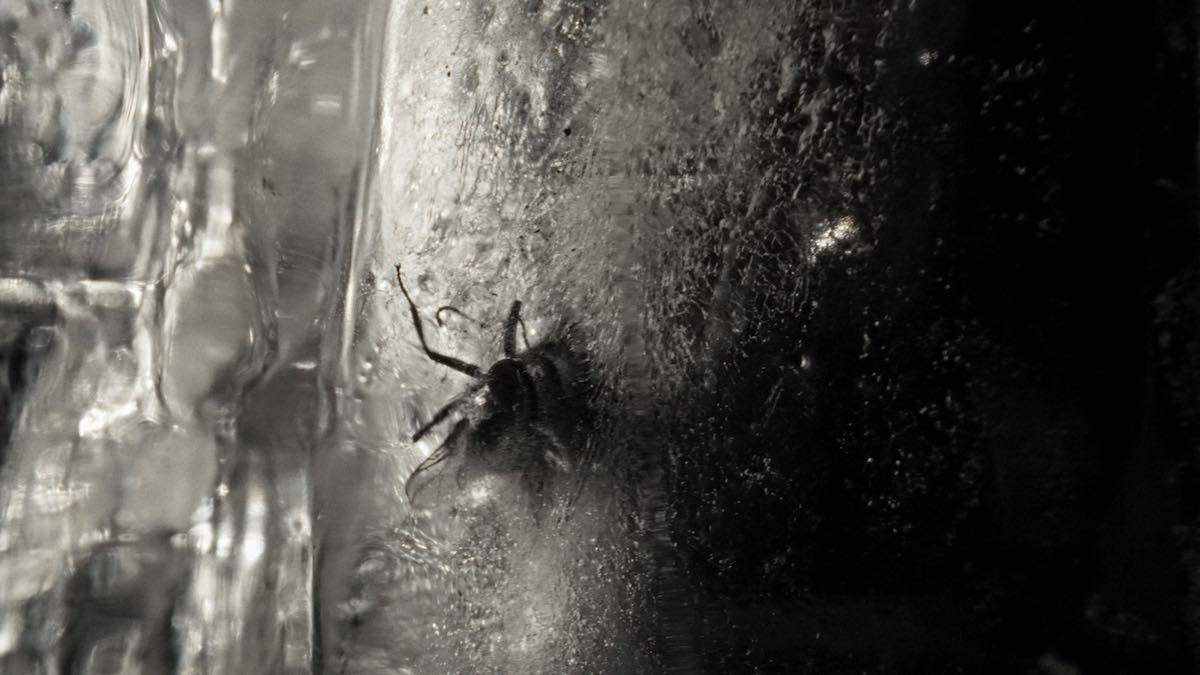
Yet Watanabe never presents the animal as an archaeological spectacle or museum curiosity. On the contrary, her camera sometimes moves so close to the bones, ice, hair or rock surfaces that the viewer briefly loses all sense of orientation and no longer fully understands what they are looking at. The images are ambiguous and fragmented, and lack a clear narrative structure. This tension between recognisability and abstraction appears throughout Watanabe’s work. She slows images down to the point where they become elusive and impossible to grasp at a glance. As a result, the viewer never fully gains control over the image, yet its emotional and physical impact remain tangible.
That approach was also present in Watanabe’s earlier work "Liminal", shown at Museum De Pont in 2021. For that work, she followed investigations into two mass graves from the Peruvian civil war, slowly gliding the camera across soil, textiles and human remains. By filming at extremely close range, she transformed these images into almost abstract landscapes. In her earlier video work "Stasis", she filmed a fish in a biostatic condition, suspended between life and death under controlled preservation. This fascination with bodies existing outside ordinary experiences of time returns in "Jarkov", although the scale shifts here from human history towards a much deeper geological timeframe. At the same time, the work also touches on questions surrounding climate change and extraction.
Sound also plays a crucial role in "Jarkov". Watanabe collaborated with composer Robin Rimbaud, better known as Scanner, who developed a disorienting low-frequency soundtrack that seems to reverberate throughout the space. Combined with the rotating camera movements and the black, tilted projection room, the result is a truly immersive experience.
Maya Watanabe was born in Lima in 1983 and grew up during the Peruvian civil war (1980-2000). During this conflict, between fifty and seventy thousand people lost their lives, thousands disappeared and Indigenous communities were particularly heavily affected. This history continues to resonate throughout her practice, in which she investigates the relationship between images and reality while questioning the reliability of perception itself. In earlier installations, she explored mass graves, disappeared bodies and forensic investigations into victims of the conflict. Her work rarely revolves around explicit representations of violence. Instead, it focuses on what remains behind: traces, absences, uncertainty, gaps in memory and unresolved forms of mourning, but also more broadly on the ways history embeds itself within landscapes, bodies and objects, and how representation and image-making function as political instruments. Watanabe is particularly interested in moments when moving images (ultimately always interpretations of reality) fail to fully grasp their subject, revealing instead the limitations of human perception and the boundaries of visibility itself.
Watanabe studied fine art at the Universidad Europea de Madrid, followed by a master’s degree at the Dutch Art Institute (ArtEZ University of the Arts) and PhD research at Goldsmiths in London. She also completed residencies at the Kyoto Art Center and the Cité Internationale des Arts in Paris. Her work has previously been shown at Palais de Tokyo, MAXXI, Museum De Pont, the Mori Art Museum in Tokyo, Kyoto Art Center, the Sharjah Art Foundation, Foam Fotografiemuseum, the Kadist Art Foundation, Museo de Arte Contemporáneo de Lima, and during Manifesta 15 in Barcelona and the biennials of Havana and Beijing. The artist currently lives and works in Amsterdam, where she also teaches at the Gerrit Rietveld Academie.
