19 may 2026, Martine Bontjes
The studio of... Eva Spierenburg
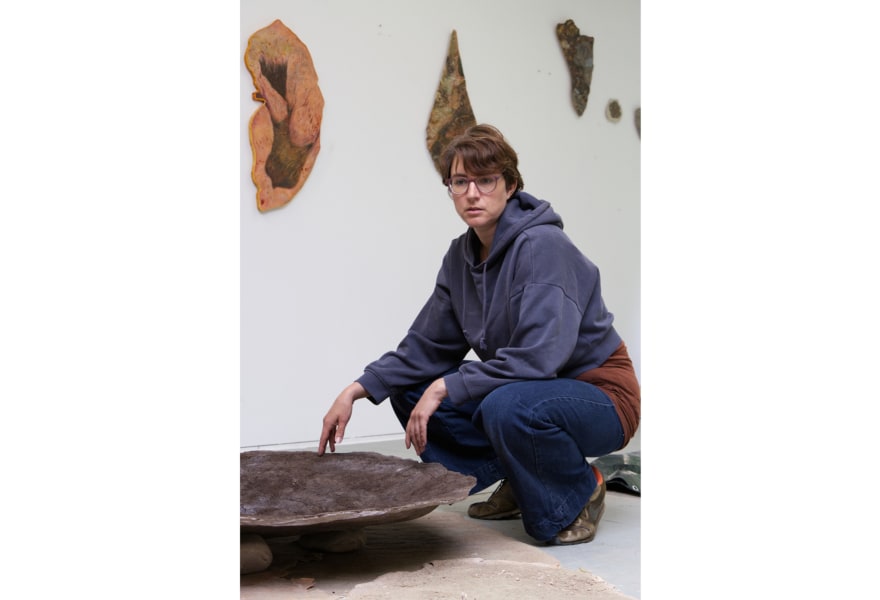
During a residency in Iceland Eva Spierenburg began to see body and landscape no longer as separate worlds. In patches of melting snow and branching streams of water she recognised a living organism that, much like the human body, is constantly moving and transforming. This approach became the point of departure for the exhibition 'Moving as a Mountain' at Bradwolff & Partners. In Spierenburg's work cracks appear in ceramics while ink and graphite slide across one another like dark masses. We also encounter textile, skin-like surfaces that blur the boundary between body and landscape. "Seams and openings reveal an intermediate state," Spierenburg explains, "a stage in which the earth reveals itself as something alive."
After an intensive period of residencies Spierenburg is now once again working from her studio in Utrecht. During her recent residency in Zeeland she continued investigating the parallels between landscape and body. She uses the term "sand hunger" to describe the disappearance of sandbanks caused by human intervention. According to Spierenburg the landscape itself possesses human qualities: the land hungers for sand just as our bodies hunger for food or touch.
You work across different media. You make works on paper but also work with textiles and ceramics. How do you combine these in your studio?
My studio is located in a kind of warehouse on the green outskirts of Utrecht. Over the past few years the studio has gradually filled with an ever-growing collection of media, tools and large-scale works, so it has become quite crowded. One section is used for storage, there is a kind of office space where I make the smaller works on paper and work with the sewing machine, and there is an open area that I have arranged to be as flexible as possible. It contains a few permanent tables and cabinets with materials and tools, a stockpile of wood and two mobile worktables that can be used for all kinds of purposes. For example, I use them to cast the sculptural paintings made from acrylic resin.
I have only recently begun working with ceramics. At the end of January I completed a residency at EKWC. All the ceramics currently shown in the exhibition were made there. I do not have my own ceramic kiln but I can have a future series fired elsewhere.

Eva Spierenburg, moving as a mountain (leaking), 2024, Bradwolff & Partners
You do not always work independently. Could you describe what a collaboration with other artists looks like, such as the one with a voice artist?
I find collaboration quite challenging. I struggle to share my intuitive working process with someone else and to find the right words for what I want when I am still searching myself. Yet sometimes I have an idea that I simply cannot realise on my own and then I look for someone who possesses the qualities the work requires. A few months ago I developed the desire to create a sound work, because I had experienced several installations using sound that made a deep impression on me. The idea evolved into wanting to create an echo of a landscape through the body, for which I needed someone who works with voice in relation to environment. Eventually I approached Janneke van der Putten and we had several conversations about my points of departure and expectations for the work. I asked her to help me listen to the landscape so that we could make choices for the recordings from that perspective. In the end we spent several days together in the dunes of Schouwen-Duiveland doing listening exercises, experiments and recordings in order to arrive at a sound composition.

Eva Spierenburg, moving as a mountain (flow), 2025, Bradwolff & Partners
You have just completed a residency in Ellemeet in Zeeland. Could you tell us what you did there?
I was there at the invitation of the Bewaerschole in Burgh-Haamstede where I will have an exhibition in June. Their programme focuses on the relationship between human beings and landscape with particular attention to the local environment. In that context it was enormously valuable to be able to work on site for a period of time. Alongside the sound work I developed there with Janneke, I also attempted to capture the shifting skin of young sand dunes by casting them in an environmentally friendly moulding material. When sand dunes are still small and largely untouched by vegetation or footsteps they possess a beautifully fragile surface that is constantly changing and strongly reminiscent of human skin. The exhibition will be titled 'Zandhonger', a term used to describe the disappearance of sandbanks along the Dutch coast caused by human intervention in water management. I find it beautiful that the term immediately transforms the landscape into a body: the land hungers for sand just as our bodies hunger for food or touch.
In the exhibition 'Moving as a Mountain' at Bradwolff & Partners body and landscape seem to merge into one another. When did you first begin to see a connection between the two?
The connection between body and landscape gradually entered my work several years ago, although at that time the landscape functioned more as a representation of the body than as something inseparable. During a residency in Iceland in 2024 I began for the first time to look at the landscape as a moving, living body. I stayed in a small village in a fjord surrounded by mountains and sea. On a mountain where I regularly walked the different layers of earth were clearly visible, making it possible to sense how the landscape had shifted in order to take on its present form. The weather changed constantly so the mountains seemed perpetually transformed by light, mist or by patches of snow melting into branching streams that resembled veins. The landscape and the presence of time itself were so overwhelming that my own transient body felt like a small part of a much larger and more complex whole that is constantly in motion. It was a classically romantic notion that set a shift in my work into motion. Whereas I once saw the body and its surroundings as separate yet connected, they now flow into one another. The body is not merely a vessel for an individual but also a mutable composition of matter, and the landscape is not only matter but also a living entity.

Eva Spierenburg, sense of sediment (63), 2024, Bradwolff & Partners
In this exhibition you present, among other works, a series of drawings made during your residency in Iceland. How did these come about?
I travelled to Iceland with an open-ended plan to investigate the relationship between landscape and body. Once there the landscape was so overwhelmingly present that while I was drawing, the body dissolved into the landscape and I began to approach the earth itself as a living body: leaking, digesting, moving and breathing on a different timescale from our own.
Since then this series of drawings under the title sense of sediment has continued to expand. At first I developed photographs I took in Iceland, later I was also able to recognise the same principles within the cultivated landscapes of Belgium and the Netherlands. Back in the Netherlands I investigated how to translate the visual language and ideas from the drawings into larger works and other media. From this emerged several textile works in which I effectively draw with the sewing machine, two of which are included in the exhibition. In the ceramic works I attempted to use engobe glazes in such a way that they flow into one another while also seeming to belong to the surface of the clay itself.
You describe your work as a field in which earth and skin rewrite one another. Could you explain what you mean by that?
It stems from the way I approach matter: as elementary particles clustering together into the temporary form of a mountain, organ, river or body. When we die the matter of our bodies is absorbed back into the landscape but even during life we carry fragments of landscape within us. Our bodies consist largely of the same substances as the earth's crust, which could itself be seen as the skin of the earth. A drop of water inside our cells once flowed through a river and gathered minerals from the stones it encountered, minerals that now nourish our bodies. In this way earth and skin are not fixed or separate concepts but forms of matter that are mutable and interconnected.

Eva Spierenburg, sense of sediment (dissolve), 2024, Bradwolff & Partners
In several works seams, fractures and openings are visible. What interests you about this unfinished surface?
Seams and openings reveal a sense of process or an intermediate state. In doing so they show both that the work has been made by an acting body and that it suggests a transition. An opening between inside and outside, a passage between past and present or a stage in which the earth reveals itself as something alive.
Do you already have another residency planned or will you be staying in your studio in Utrecht for now?
For now I am staying in Utrecht. During the residencies of the past two years I gathered a wealth of new ideas, images and insights that will continue to shape my work for quite some time. I am looking forward to taking the time in my own studio to process everything.
