19 may 2026, Yves Joris
Noah Latif Lamp: Chemtrails at Tommy Simoens Gallery Antwerp
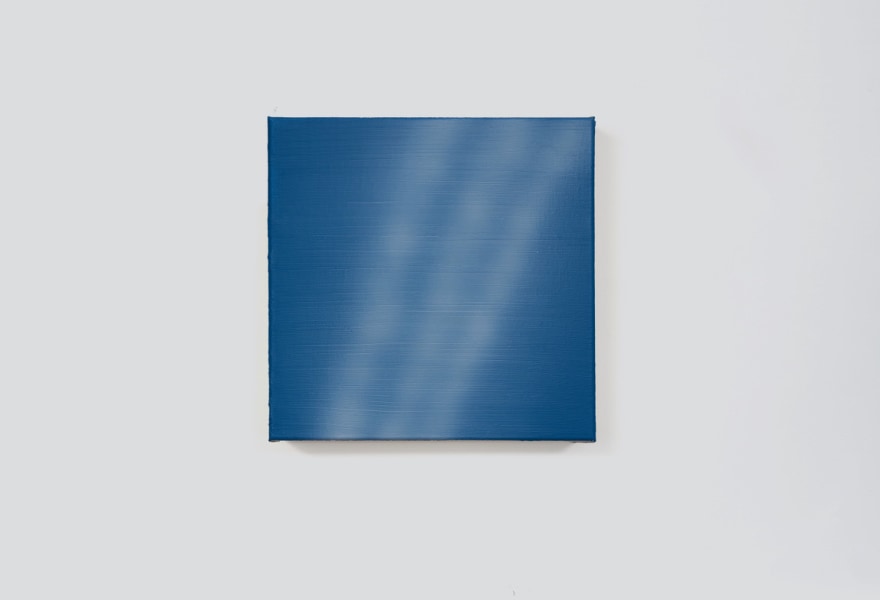
This is not a conspiracy theory. This is painting.
Somewhere in the 1990s, the sky acquired a second meaning and there was no official announcement. At some point—no one can say exactly when—the air ceased to be neutral. You suddenly see it: a white streak drawn sharply across the blue, slowly unfolding, feathering out and thickening into something that looks like a cloud, but is not. A condensation trail. A chemtrail. And something inside you begins to wonder: what is that?
The question seems innocent. It no longer is.
That is precisely the moment Noah Latif Lamp waits for—not the paranoia itself, but that fracture point before interpretation, the split second in which the eye sees something but the mind has not yet decided what exactly. That split second is his true subject. The unease that follows is not a by-product of the work. It is the work.
Small canvases, heavy load
What he paints are streaks across a sky: white on blue, sometimes white against an almost nocturnal darkness. The canvases are small—rarely larger than 50x50 centimetres—and restrained. At first glance, they do not appear to be saying very much. And yet you stand before them longer than expected, as though something within them remains unresolved, or worse: something that is just a little too complete, too precise in its awareness of what it is doing.
Lamp's paintings do not overwhelm. They invite you to come closer. And in that proximity, you begin to notice how carefully the paint surface has been layered, how the sky behind it forms a painterly space that feels both familiar and indeterminate. You have seen this before. Outdoors, every day. And yet here, on this canvas, something feels wrong. Or perhaps too right.
His works were created during a stay between the former Gulf of Mexico and the Caribbean Sea. That displacement is not merely biographical—because Lamp is someone for whom movement and work are one and the same. Born in Amsterdam in 1991, third generation in a family of artists, he left art school early: not out of laziness, but impatience. He is drawn towards places where something seems on the verge of happening. The Caribbean was one such place—where the boundary between documentary and evidence, between registration and accusation, is constantly shifting.
 Noah Latif Lamp Chemtrail, 2026 Oil on canvas 50 x 40 cm, Tommy Simoens
The theory that does not need to be believed
The chemtrail theory claims that the condensation trails behind aircraft are not water vapour, but chemicals, deliberately dispersed by governments in order to control and spy on people. It is documented and debunked—yet repeatedly survives that contradiction.
The chemtrail believer and the sceptic both look at the same exact thing, yet see something radically different. This is not a matter of information, but the framework through which the viewer views. And that framework cannot simply be corrected through reason because it is precisely what determines what counts as rational in the first place.
Lamp paints that framework—not the theory, not the paranoia, but the condition under which both become inevitable. You do not need to read the streak as a chemtrail to feel this. It is enough to know that the word exists, that there are people who look upwards every morning and see something else. That knowledge is now in the air, irreversible, like dye diffused through water. It cannot be extracted again.
 James Turell Skyroom at Muhka, Antwerp, Late December 2025
photo: Yuka Keino
James Turell Skyroom at Muhka, Antwerp, Late December 2025
photo: Yuka KeinoTurrell and the promise of a purified sky
There is another way of looking at the sky. James Turrell built it: Skyspaces, chambers with openings in the ceiling in which the blue of the sky becomes pure colour, freed from all context. Beauty as escape velocity. Blue as liberation. A beautiful idea.
Lamp works in precisely the opposite direction. His blues are not purified, but loaded. The streak he paints is not an ornament, but a sign, and the problem with signs in an age of permanent emergency is that it is no longer possible to be certain about what they mean.
Agamben in the sky
There is a theory by Giorgio Agamben that I cannot shake while looking at these works of art: the state of exception that lasts so long it ceases to feel exceptional. The emergency measure that becomes so familiar it simply turns into reality, without anyone ever declaring 'this is now the new normal'. It happens quietly, like a condensation trail spreading until it resembles a cloud.
Lamp paints what that does to the eye, the moment when the background ceases to remain background. When the sky—once the most neutral surface imaginable, the only thing shared by everyone without being claimed by anyone—begins to participate in something it was never meant to be part of. A vapour trail is no longer simply vapour. Visibility itself has become something that must be explained and defended.
In False Flags, Lamp burned 195 national flags—without audience, without hierarchy—exposing how symbols lose their meaning until they become combustible. Little Brother introduced a mobile phone jammer: interference not as solution, but as condition. The signal is already compromised, not because of the device, but because the device exists at all. The chemtrail paintings are the atmospheric version of that same insight: what lingers in the air once fear has been normalised and looking has lost its innocence.
 Noah Latif Lamp Chemtrail, 2026 Oil on canvas 50 x 50 cm, Tommy Simoens
Painting as the only slow movement
Lamp paints this. I cannot stop thinking about that. At a time when everyone lifts a phone the moment something appears worth seeing, he chooses oil paint. A medium that dries. That waits. That does not have an 'undo' function. A layer of paint dries more slowly than an image goes viral—and that is not a nostalgic observation, but a hard reality.
The chemtrail on his canvas is not captured but constructed, layer upon layer, until it becomes something you cannot simply walk past. In 2026, that is a radical gesture. Even if it does not look like one.
I left the gallery on Falconplein and looked up. No blue, no chemtrails, only a thick blanket of cloud. Yet I found myself wondering whether, even though I cannot see them, they might still be there. But that is another philosophical question altogether.
 Noah Latif Lamp Chemtrail, 2026 Oil on canvas 40 x 30 cm, Tommy Simoens