14 may 2026, Wouter van den Eijkel
Little Ghetto Boy: Mounir Eddib at Galerie Ron Mandos
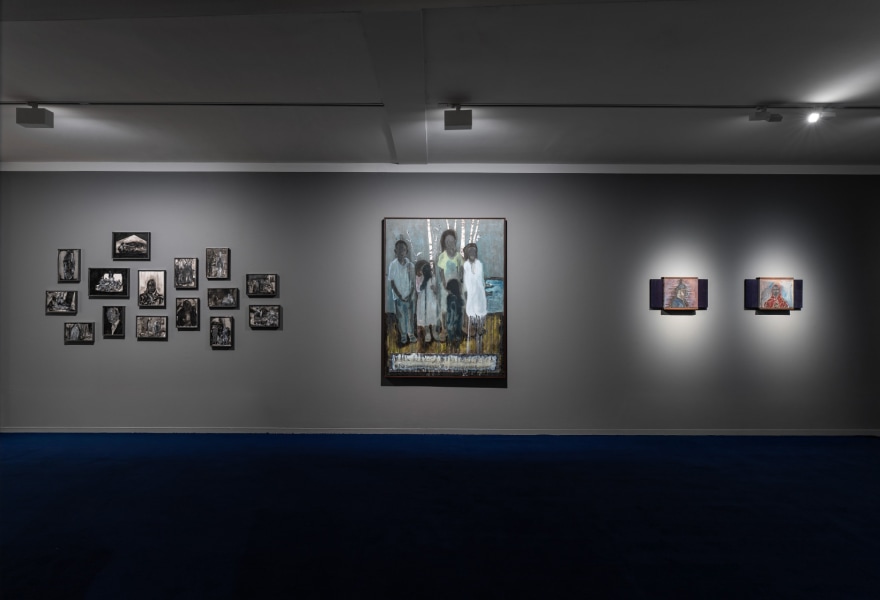
In Little Ghetto Boy, Mounir Eddib portrays his own childhood in a working-class neighbourhood in Genk. In the former mining region of Belgian Limburg, opportunities are few and far between. In Little Ghetto Boy, Eddib moves beyond the stigma and shows that there is far more here than hardship alone.
Eddib borrowed the title from the song of the same name by American soul legend Donny Hathaway. In a highly poignant way, Hathaway describes what it means to grow up in a ghetto: a deprived neighbourhood surrounded by stigma, where minority communities are concentrated, often as a result of broader social issues. With Little Ghetto Boy, Eddib does much the same as Hathaway: he brings the stories of a marginalised community to the fore, moving them from the margins to the centre.
In his work, Eddib places the humanity, dignity and resilience of these often misrepresented communities at the centre, without losing sight of their vulnerability. Through fragments of seemingly ordinary domestic scenes and street imagery, he brings to the foreground those who live on the margins of society.
Eddib presents his paintings and drawings in a muted palette, incorporating tin and lead, within a darkened space. This helps the nuanced narrative he seeks to convey in Little Ghetto Boy resonate powerfully—and linger long afterwards.
Little Ghetto Boy by Mounir Eddib can be seen at Galerie Ron Mandos until 24 May.
I read that you only began attending art school at the age of 24. Most students have just graduated at that age. Why did you apply at such a late age?
I would say mektab. It was written. Fate. Before starting Fine Art in Maastricht, I had enrolled in Hasselt (Belgian Limburg). I was accepted there, but apparently, they did not think I was good enough for the painting degree I wanted to pursue. I stopped after a while because I did not feel at home there.
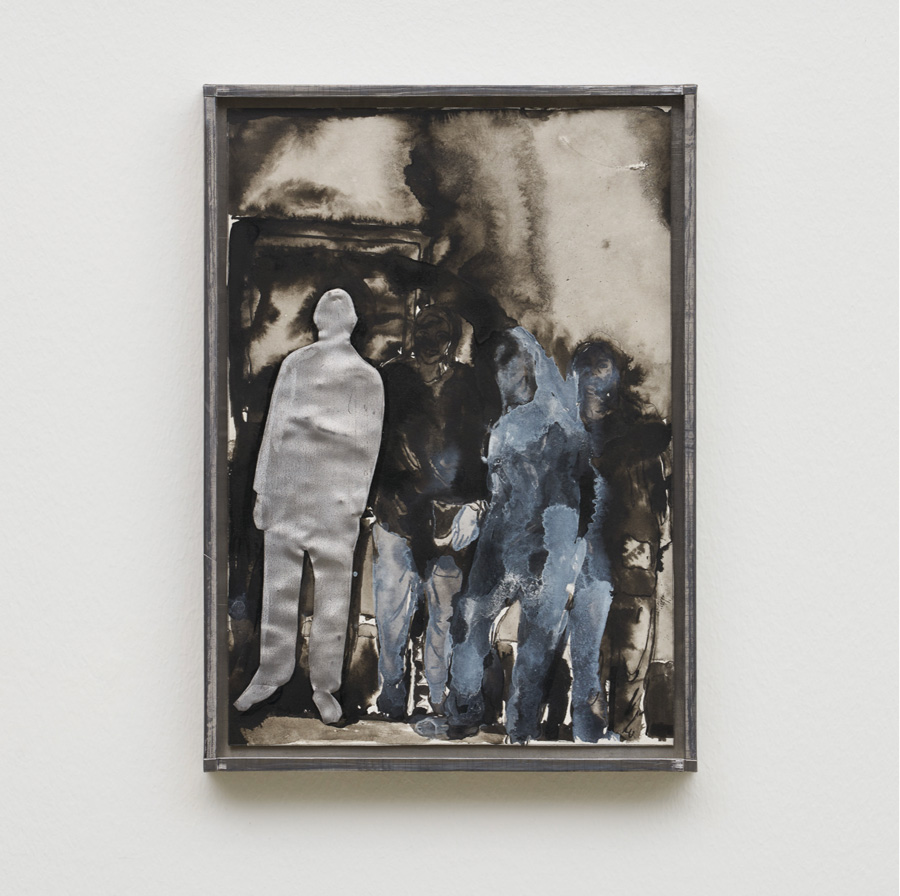 Mounir Eddib, Dream kin 13, 2026, Galerie Ron Mandos. Photo: Jonathan de Waart
Was that a big step to take at the time?
No, that notion mainly emerged in retrospect, when a story had to be constructed around it. People around me saw what I was making and encouraged me to do something with it. That meant a great deal. Making art is a passion and in that sense, it feels entirely natural to me.
Did your education change how you viewed your immediate surroundings?
My studies gave me a fundamental awareness of art history. Through subjects like art history and critical thinking, I began to view my surroundings differently—no longer as a self-evident backdrop, but as a layered field of meanings. It is there that I encountered thinkers like bell hooks and Sara Ahmed, whose ideas have helped shape my artistic discourse. That theoretical framework functions as a compass today, helping me situate and position my work within broader social and historical contexts.
Nowadays, you have a studio and founded a non-profit organization in Genk, in the former mining region of Belgian Limburg where poverty levels remain relatively high. What do you hope to achieve with The Building?
The Building is a multidisciplinary art workspace in which diversity and inclusion are not secondary conditions, but points of departure. It is about creating a space where both younger and older local makers, people of colour and people with a migrant background can feel at home. A place for experimentation, development and claiming one's own position within the field. At the same time, I wanted to avoid allowing that space to be reduced to a single, fixed profile: it is a biotope, a launch platform, a collective that encourages cross-pollination and solidarity.
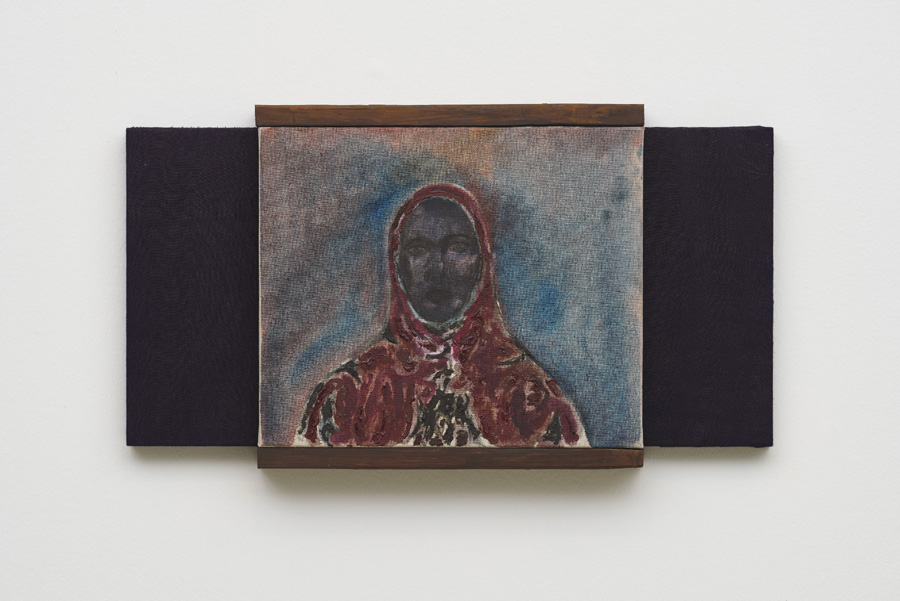 Mounir Eddib, The Mother, 2026, Galerie Ron Mandos. Photo: Jonathan de Waart
Your exhibition at Galerie Ron Mandos is titled Little Ghetto Boy, a reference to the song by Donny Hathaway. Hathaway sings about a youth marked by suffering and deprivation, a situation in which change is only possible if you believe in yourself. No one else will do it for you. In your view, has the hardship of Belgian Limburg and the migrant workers who settled there in the '60s and '70s been forgotten?
Within this exhibition, I actually try to avoid that heavy narrative. Not by denying it, but by transforming it into something else: mysticism, magic, a form of free imagination that responds to the complexity of being human. What interests me is not repeating a singular narrative of misery, but opening it up. That history is present, but it is not monolithic. It equally encompasses moments of beauty, imagination and resilience.
I therefore read the reference to Hathaway as a space in which that ambiguity can exist: between heaviness and lightness, between limitation and possibility. The Little Ghetto Boy exhibition is not about 'guest workers' themselves, but about the social aftershocks of mining history. Life moves on, but the past has left traces in contemporary society and in the landscape itself.
We should, of course, talk about your use of materials and symbolism in your work. You not only work in Genk, but your work is also about the Limburg landscape and past. Several works depict slag heaps and you work with tin, tar and lead. When did the idea to create work about your region first emerge?
My work always departs from my immediate surroundings. I grew up in Genk and it is inseparable from my practice. I go on walks and collect materials from the industrial landscape—slag and stone waste—remnants of the mining industry. That landscape carries within it a history of labour. The slag heaps, for example, were formed from what was extracted from the earth: the higher the hill, the deeper the intervention.
That insight led me to reflect on what lies beneath the surface—literally and figuratively. From that sense of connection, the work developed organically. The landscape never functions merely as a backdrop, but as an active bearer of stories and histories. Both urban and rural settings recur, showing how people relate to their environment. At the same time, they create an ambiguity of time and place: it often remains unclear where or when exactly we are. That tension allows the images to be read as both specific and universal.
 Mounir Eddib, Rest, Floor, Home, 2026, Galerie Ron Mandos. Photo: Jonathan de Waart
Your work also has a mysterious, mystical quality that stems from Moroccan mystical thought. I imagine not everyone knows much about that. Could you elaborate on that and explain how it manifests in your work?
That mystical dimension is rooted in my background. As a child, I saw my mother use lead in protective rituals: it would be melted and poured into water, creating shapes that then had to be interpreted. That combination of transformation and unpredictability has always fascinated me.
That tension is incorporated into my work. Lead is both protective and toxic—an ambivalence that interests me deeply. My process is largely intuitive: I start with an image, a memory or a feeling, but during the creation process, these elements shift and transform. I am not interested in representation in the strict sense, but in conveying an experience, a sensation.
That attitude also translates visually. I work with restricted colour palettes, usually four or five shades, and consciously seek contrast. This produces images that are both seductive and slightly unsettling, a world that feels both familiar and estranged, as though it is simultaneously disenchanted and animated.
The exhibition at Galerie Ron Mandos is sparsely lit and the walls are grey. Is that also connected to the mystical aspect of your work?
The walls are grey and the floor is dark blue. And yes, that is an extension of the colour palette in my work. Blue tones recur in different ways, including in the traditional indigo cloth I incorporate into sculptures. I seek a certain atmosphere in which darkness creates a sense of shelter. A more intimate experience than the white cube, one that leaves room for symbolically and ritually charged materials such as lead and tin. These metals possess their own sheen, which is able to emerge more fully in this setting.
Finally, if I were to speak with you again in five years' time, what would you hope to have achieved by then?
I have no idea. I live in the present—that is difficult enough as it is. I dream of having my own home with a studio, that freedom and independence. And perhaps a part-time job in education or something similar. It is stressful surviving solely as a self-employed artist.
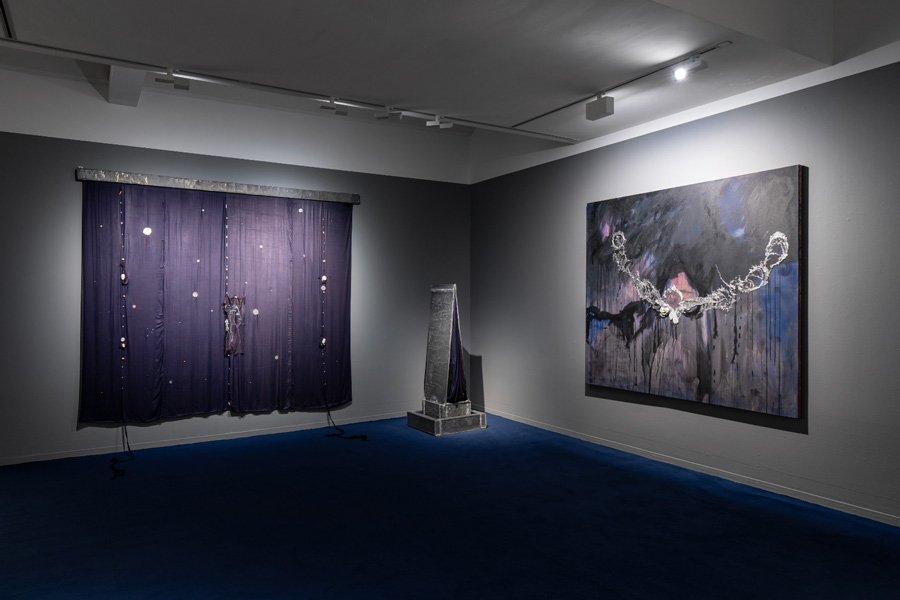 Mounir Eddib, Little Ghetto Boy, Galerie Ron Mandos. Photo: Jonathan de Waart