08 may 2026, Martine Bontjes
The studio of... Haru K
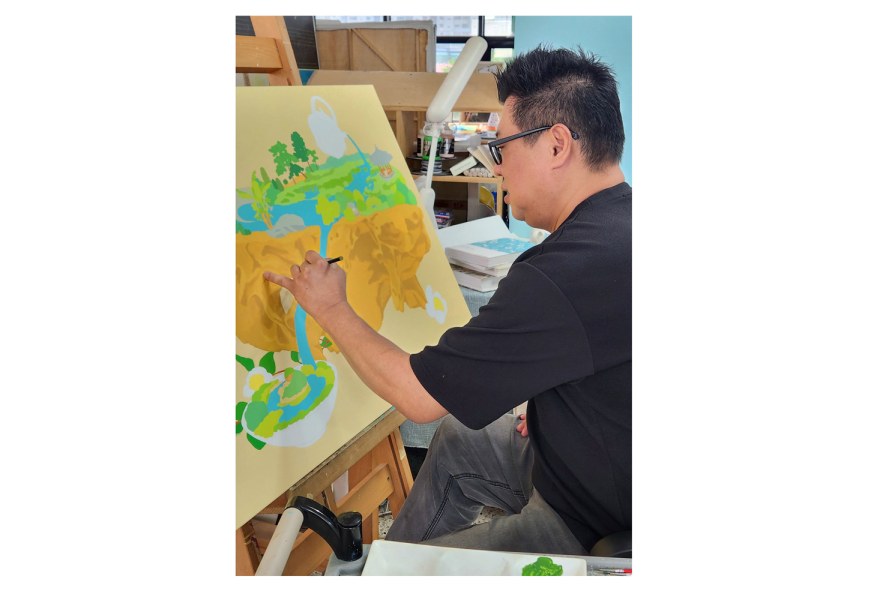
In the vibrant paintings of Haru K, we encounter a tranquil world from an bird's-eye view, shaped by stillness, attention and slowness. Working within the tradition of East Asian painting, the Korean artist employs an elevated perspective to bring together landscapes, architecture, and everyday gestures into layered, fluid compositions. His figures wander, rest, or share meals, not driven by productivity or destination, but by an attentive mode of being present. Haru K shares a studio with his wife, artist Lim Hyun-chae, in Gwangju in South Korea.
A recurring element in Haru K's work is the food that drifts weightlessly through the pictorial space. For the artist, food is more than an everyday necessity; it carries traces of geography, culture, and humanity's relationship to nature. As he reflects: "If life itself can be understood as a journey, then I wonder what it would mean to live it by looking around more attentively, appreciating nature, and enjoying simple pleasures such as food." Haru K's work is on view until 13 June as part of the group exhibition Suchness: Already Within at Namuso Gallery in The Hague.
Where is your studio and how would you describe this place?
My studio is located in Gwangju, South Korea. Gwangju is not only my hometown, but also a city deeply embedded in modern Korean history as a symbol of democracy and collective memory. At the same time, it is a major center of contemporary art, internationally known for the Gwangju Biennale, one of Asia's most important biennales, where historical consciousness and artistic experimentation continually intersect. I was born here, studied in Seoul, and eventually returned to Gwangju to continue my practice. This return was not only geographical, but also a way of re-grounding my work in a place that shapes my sensibility.
The studio is on the third floor of a modest office building, shared with my wife who is also a painter. We divide the space with a long bookshelf, creating a clear but quiet separation between our working areas. Within this space, I work across painting and sculptural practices. It is a simple, functional studio, but one that carries a focused and concentrated atmosphere for making work.
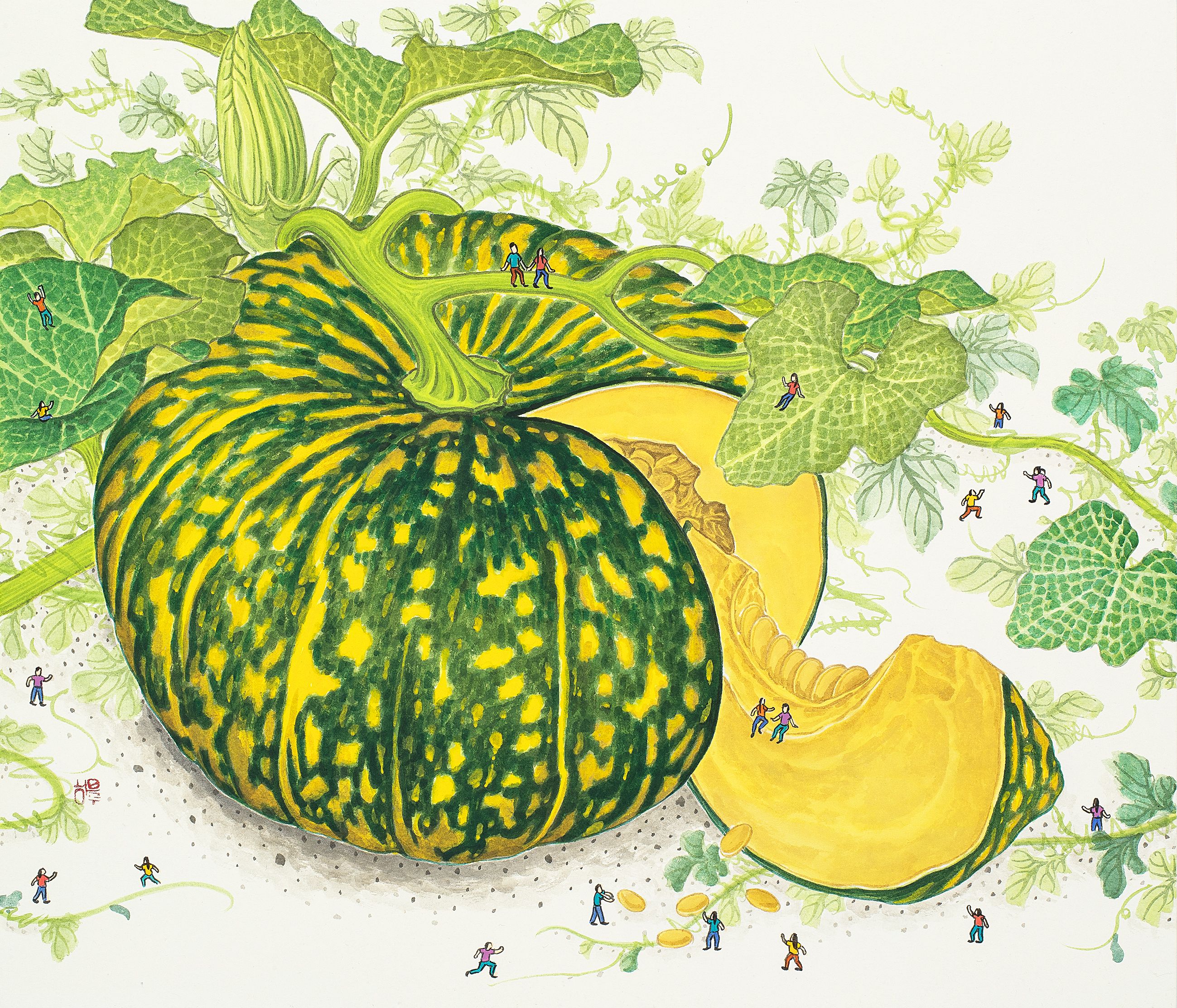
Haru K, Pumpkin Seeds, 2026, Namuso Gallery
What material can we find on your worktable? Do you have a favourite tool you can't work without?
I don't really have a single tool that I would call indispensable. Instead, I tend to choose materials depending on the needs of each work and its purpose. On my worktable, you can find a wide range of materials - from traditional Korean painting supplies, to acrylics for canvas, materials suitable for ceramics, and even a 3D printer. Each medium offers a different way of thinking and producing images, so I select and combine them according to the concept of each project or the context of an exhibition. In that sense, my studio is less a fixed workspace with a defined set of tools, and more an experimental environment where different possibilities coexist. I move between materials quite freely, choosing whatever best serves the idea I am trying to express at that moment.
Let's say I spent a day as your intern. What would a typical day in your studio be like?
If someone were to spend a day as my intern in the studio, it would likely follow a relatively structured yet slow and reflective rhythm. I usually arrive at the studio around 9 a.m. I start by cleaning the palettes and dishes left from the previous day, washing off the remaining paint. Then I have a cup of coffee and take some time to think about what I will focus on for the day. Once the direction of the work becomes clearer, I begin painting while listening to YouTube videos related to politics, culture, or current affairs in the background. I prefer not to work in complete silence; instead, I like having a flow of external information and narratives surrounding me while I work. Around noon, I have a simple lunch, usually a packed meal from home. After that, I take a short walk or a nap to reset both my body and mind before continuing with the afternoon session of work. I typically finish working around 6 p.m. After that, I often attend exhibition openings or dinner meetings. These moments are also part of my creative process, as conversations over food frequently become a source of inspiration for my next works.
If I had an intern, I would probably ask them to help me with research and organizing reference materials, especially images related to food and nature. Since I do not currently work with interns, gathering and structuring visual references is an important part of my own workflow.
Food plays a central role in your work. Why did you choose food as a motif through which to explore existential themes?
I believe that in thinking about how human beings should live, the balance between mind and body is essential. A well-balanced life requires both mental well-being and physical satisfaction to coexist. Mental well-being, in my view, is formed through contemplation of nature or through art— through philosophical thinking that expands one's awareness. On the other hand, physical fulfillment is closely related to everyday needs such as sleep, relational satisfaction, and eating well. The degree to which these basic desires are harmonized in daily life is equally important. My work brings these two dimensions, the mental and the physical, into a single pictorial space, creating both visual harmony and a certain sense of tension. Within this framework, nature and food function as symbolic visual elements that help express these ideas.
Nature represents the mental foundation of human existence: the way we observe the world, understand its principles, and expand our thinking through reflection. Food, meanwhile, is a fundamentally material element that sustains the body and enables survival. At the same time, it carries a dual nature - it can also harm the body when consumed in excess or imbalance. In this sense, food is a particularly meaningful subject because it embodies the material, physical side of human existence so clearly. By placing nature and food within the same visual space, I aim to suggest an image of an ideal human life - one in which the mental and physical are in harmony.
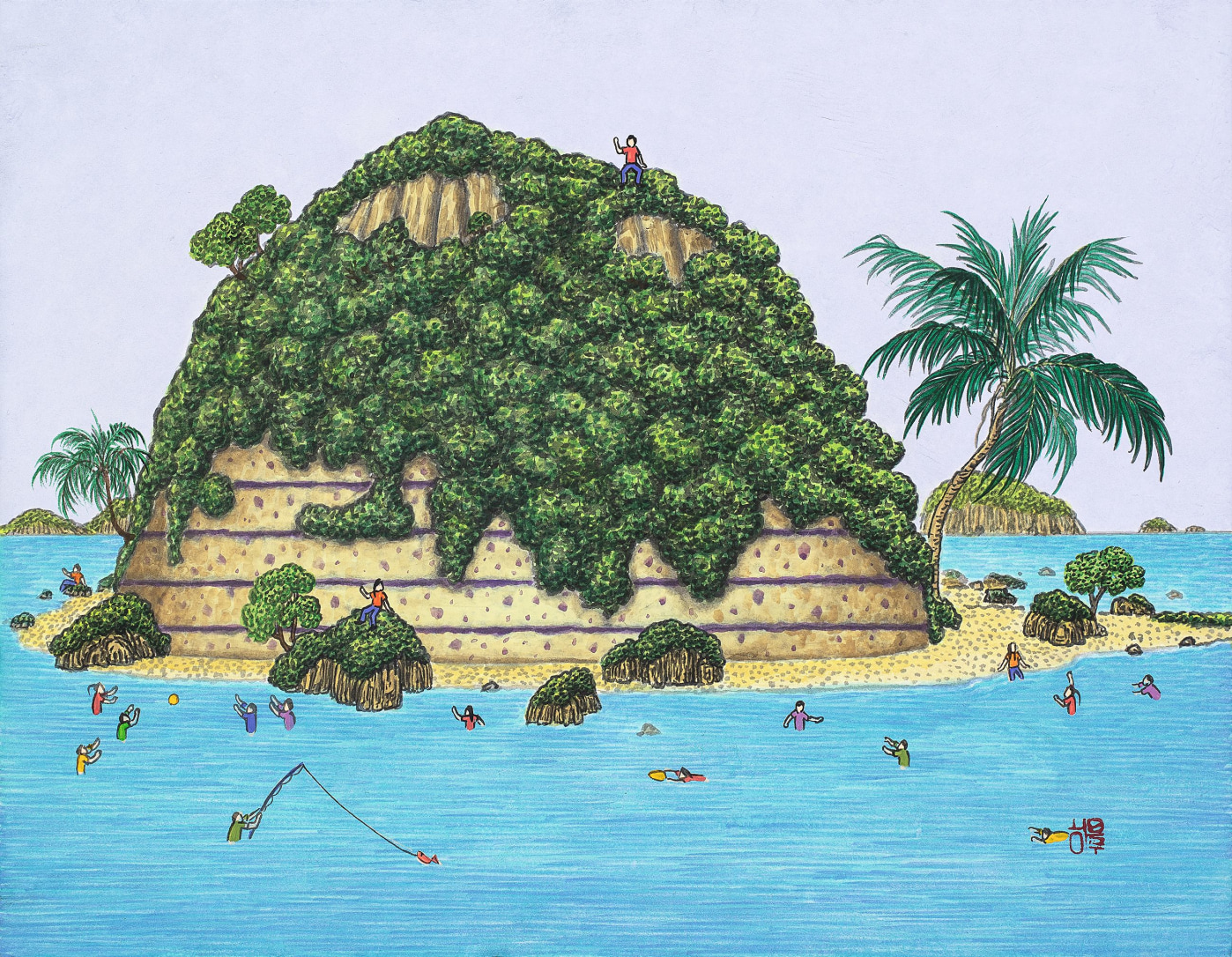
Haru K, Resting in a cake, 2026, Namuso Gallery
Through the bird's-eye perspective, your works can almost feel cartographic, as if you are mapping a landscape. Why did you choose this point of view?
This perspective is something I have naturally inherited from my training in traditional East Asian painting. In East Asian painting, this is called bukanbeop (俯瞰法), a method of depicting a scene from an elevated, bird's-eye view— as if looking down from the sky. This approach allows the artist to observe a subject from multiple perspectives at once. In linear perspective, where the viewer is positioned on the ground, one is usually limited to seeing only the front side of an object, while the sides and back remain largely hidden. In contrast, a bird's-eye view makes it possible to construct a scene by considering multiple aspects of a subject simultaneously. Maps or satellite images such as Google Maps can sometimes serve as references, but for most artists trained in East Asian painting, compositions are built primarily from long-term observation of nature combined with imagination developed over time.
As a result, my works often include scenes that would not be possible in a strictly photographic or scientific sense. However, it is precisely this layer of imagination that expands the visual language of the painting and creates a more engaging and dynamic composition.
The figures in your work often seem to be resting, wandering or simply lingering. They do not appear to be engaged in purposeful activity. Is that a right observation?
Some of the figures are engaged in activities such as climbing mountains, fishing, swimming, or playing with a ball. However, in most cases, they exist in a state of simply enjoying everyday life rather than pursuing any specific purpose or goal. The way these figures behave reflects the kind of life I personally aspire to, and at the same time, it is a message I wish to share with others.
When I named my first daughter, I chose the name "Soyo" (逍遙). In Chinese characters, it means "to wander" or "to stroll freely," suggesting someone who walks slowly and without haste. For me, walking does not simply mean moving forward quickly; it implies moving through life with awareness—observing one's surroundings, taking in nature, and remaining present in each moment.
If life itself can be understood as a journey, then I wonder what it would mean to live it by looking around more attentively, appreciating nature, and enjoying simple pleasures such as food. This idea is what I try to express through the figures in my paintings.
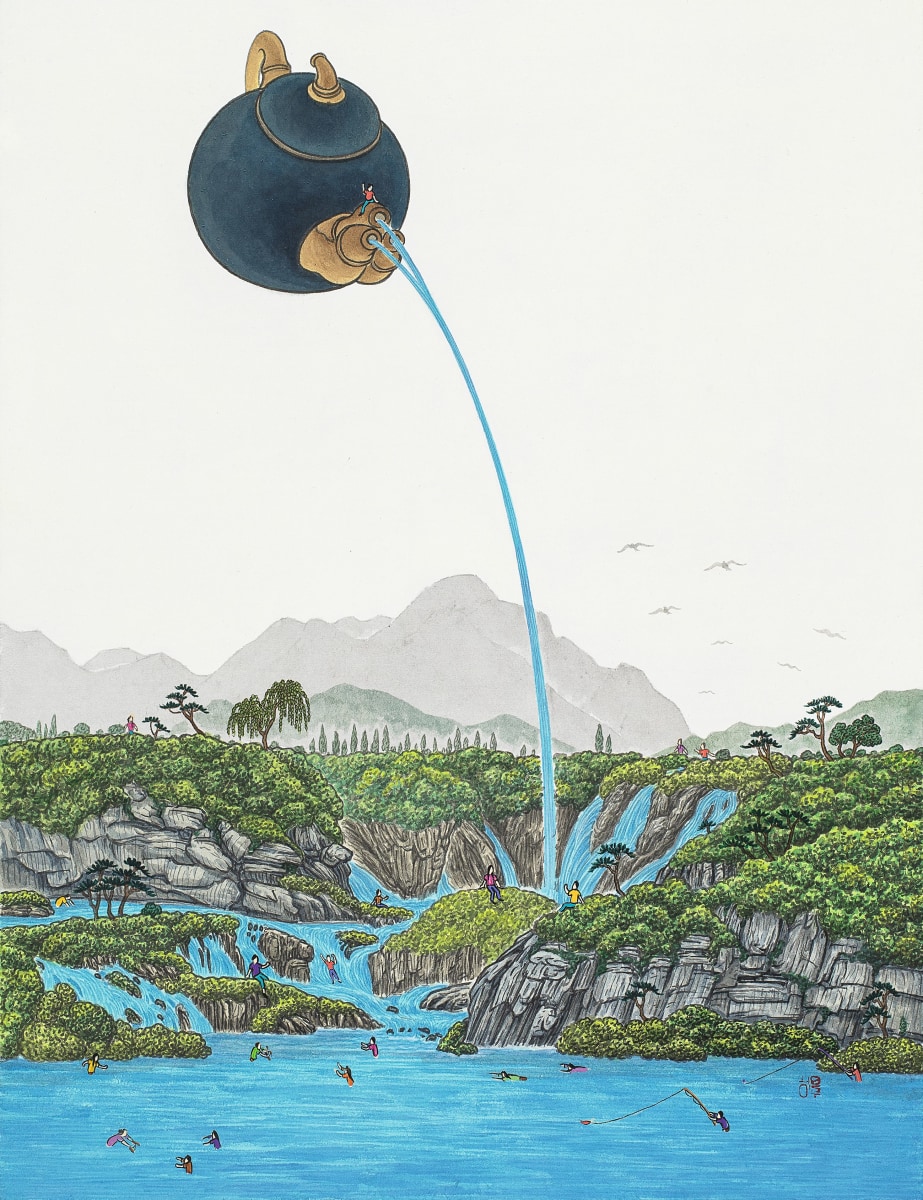
Haru K, Brewing the tea, 2026, Namuso Gallery
In your paintings, mountains, architecture and food often seem to merge into one another. Do you see these elements as equally significant?
The scenes in my paintings represent an ideal world that I imagine. In this sense, mountains, food, and other elements are not hierarchical; rather, they are interconnected parts of a single visual ecosystem. For me, achieving visual harmony and balance within the composition is essential. At the final stage of painting, I sometimes introduce unexpected or even irrational elements - such as unusual foods or objects that may initially seem out of place. However, these choices are not random. They are carefully considered decisions made to complete the overall color balance, form, and visual rhythm of the work.
What I find most challenging, yet also most interesting, is creating a sense of harmony among diverse elements within a single image. Recently, instead of focusing on specific types of food, I have been more interested in how different foods from various cultural contexts can coexist and form new visual relationships within one composition.
What are you currently working on?
I am currently preparing for an exhibition this September at Hello Museum in Seoul. The exhibition focuses on cultural diversity, and recently I have been researching foods from various countries as a starting point for my work. Through this process, I am developing works that reflect the cultures and natural environments of different regions. As I continue to draw and study food, I've come to realize how much information it carries. For instance, the type of meat used can reveal religious contexts, while the choice of vegetables often reflects geographical conditions. Cooking methods, spices, and levels of heat can also suggest differences in climate. Although it is a single subject, food contains layers of information about a country's geography, culture, and environment. For this reason, I try not to limit myself and make an effort to experience as many different foods as possible. Most of these experiences become a source of inspiration for my work. My current practice focuses on visualizing these diverse aspects of food, exploring its meanings and cultural significance.
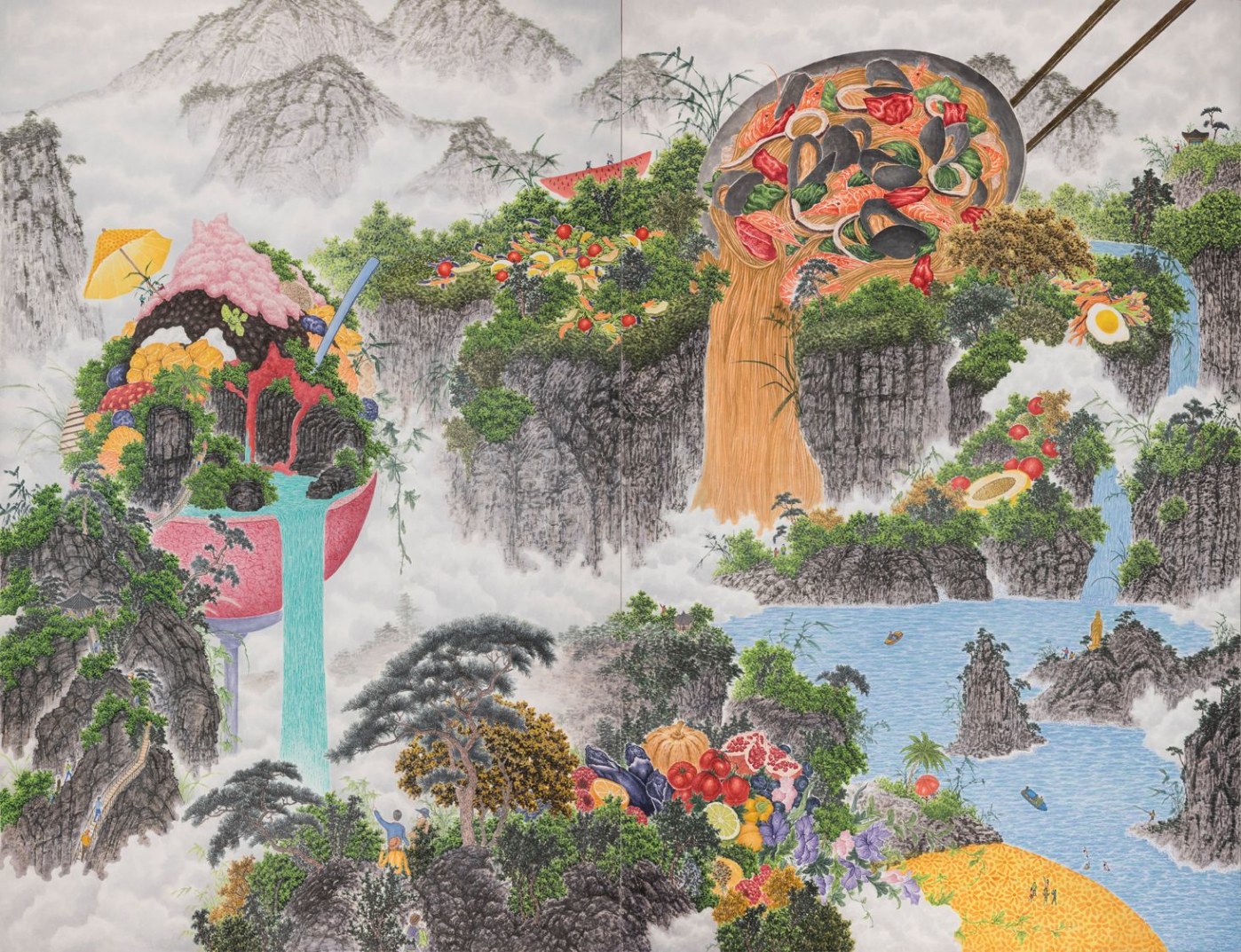
Haru K, Delicious Landscapes, 2017, Namuso Gallery
