07 may 2026, Flor Linckens
In Memoriam: René Groebli

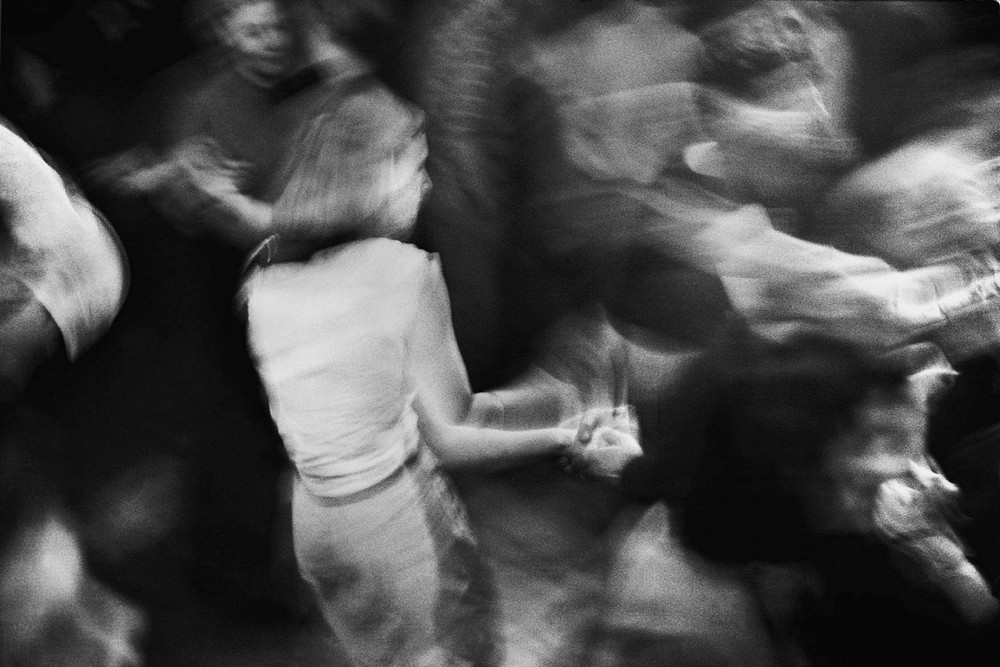
On 5 May, the Swiss photographer René Groebli passed away in Zurich, the city where he was also born in 1927. With his passing, the art world loses a photographer who continuously brought movement into the medium and opened it up in an intuitive way. While many post-war photographers pursued sharpness, control and objectivity, Groebli gravitated towards smoke, movement, grain, speed and emotion. For more than seventy years, he continued to experiment with what photography could be: not only a documentary medium, but also a way of making the intuitive and the elusive tangible, rendering visible that which is felt, remembered and desired. Groebli’s work is represented by Bildhalle.
René Groebli was born on 9 October 1927. In 1944, he started a degree in photography at the Zurich Kunstgewerbeschule, where he trained under Hans Finsler. The art world of post-war Switzerland was, however, shaped by the cool objectivity and strict visual order of the Neue Sachlichkeit (New Objectivity), a sober response to the expressionism that had preceded it. For Groebli, that approach left too little room for his own, more intuitive and movement-oriented way of seeing the world. He abandoned his studies and instead earned a diploma as a documentary cameraman at Central Film and Gloria Film in Zurich, where he would develop the eye of a filmmaker. Yet there, too, he found little room for personal expression and realised that his true interest lay in capturing the elusive: speed, coincidence and a subjective experience of the world around him.

With the money he earned from his first freelance assignment, Groebli travelled to Paris for the first time in 1948, a journey that inspired his first photobook, Magie der Schiene (Rail Magic) in 1949. In it, he captured industrial power through grainy, cinematic images marked by smoke, rhythm and motion blur. At the same time, he remained attentive to small human details: a sleeping passenger or a head leaning out of a train window. The series reflected a new, personal and more expressive approach to the medium that would only be fully appreciated years later. Groebli was just 22 years old at the time.
In the early 1950s, he worked as a photojournalist for international magazines and agencies, a period during which he travelled extensively. During those same years, one of his most personal series emerged: "Das Auge der Liebe" ("The Eye of Love"), a tender, soft and carefully orchestrated visual essay created during his honeymoon with his wife Rita. Much of the series unfolds within their Paris hotel room, effectively transforming it into an intimate shared space. We see a nude silhouette, the line of a shoulder or collar, a transition from light into shadow, without Rita ever being reduced to a mere sexual object. At the time, the book caused quite a bit of controversy because of its explicit imagery, but it is now regarded as a milestone in the history of the photobook.

In 1954, Groebli was admitted to the Council of Swiss Photographers and a year later, his work was shown at the Museum of Modern Art in New York for the first time. Groebli opened his own studio for advertising and industrial photography and specialised in complex colour photography processes, on which he also published several texts. For him, colour was never merely documentary, but also an autonomous visual material. When colour processes became increasingly faster, simpler and cheaper during the 1970s, he rediscovered his fascination with black-and-white photography. By the late 1970s, Groebli decided to focus exclusively on his autonomous work. In 2015, he received a Lifetime Award from the Swiss photography academy.
What makes Groebli’s practice so remarkable is the versatility of his work and the new ways he continuously found to express himself. Driven by intuition, curiosity and experimentation, he responded to the energy of the subjects he photographed. As a result, his work cannot be contained within a single genre, period or technique.
René Groebli’s work was shown at institutions including the Museum of Modern Art, Fotomuseum Winterthur, Tate Britain, the Kunsthaus Zürich and during Rencontres d'Arles. His work has been included in the collections of the MoMA, Maison Européenne de la Photographie, The Museum of Fine Arts Houston, the Folkwang Museum and the FMAC Collection d'Art Contemporain Ville de Genève.
