24 april 2026, Wouter van den Eijkel
Contemporary ceramics collective II at Galerie Fontana
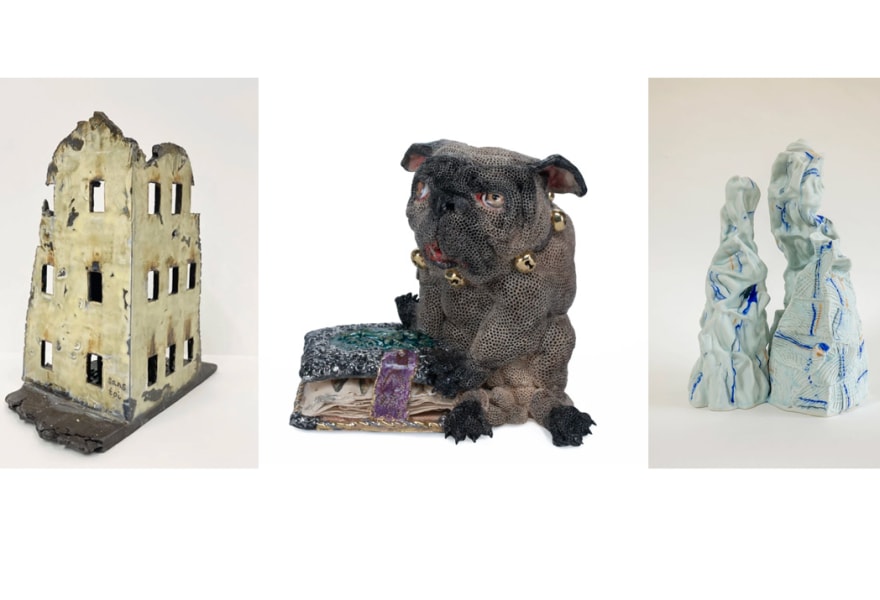
Gallery exhibitions often have a title that refers to a central concept or to the title of a specific work. Contemporary Ceramics Collective II does not follow that approach. Its title is a factual description of what can be seen at the Amsterdam branch of Galerie Fontana: the second overview of contemporary ceramic art.
The choice for a group exhibition featuring ceramicists is understandable if one looks at Fontana's programme. Ceramics has been in the spotlight for several years now. Most galleries have included one or two artists working in the medium, but at Fontana it represents a substantial segment. The first edition, held two years ago, was well received, which is why a second edition followed, explains gallery owner Stefan Heinis.
Contemporary Ceramics Collective II includes work by established names such as Carolein Smit and the Franco-Luxembourgish duo Feipel and Bechamel, as well as lidded vases by Boris van Berkem and sculptures by Asya Marakulina.
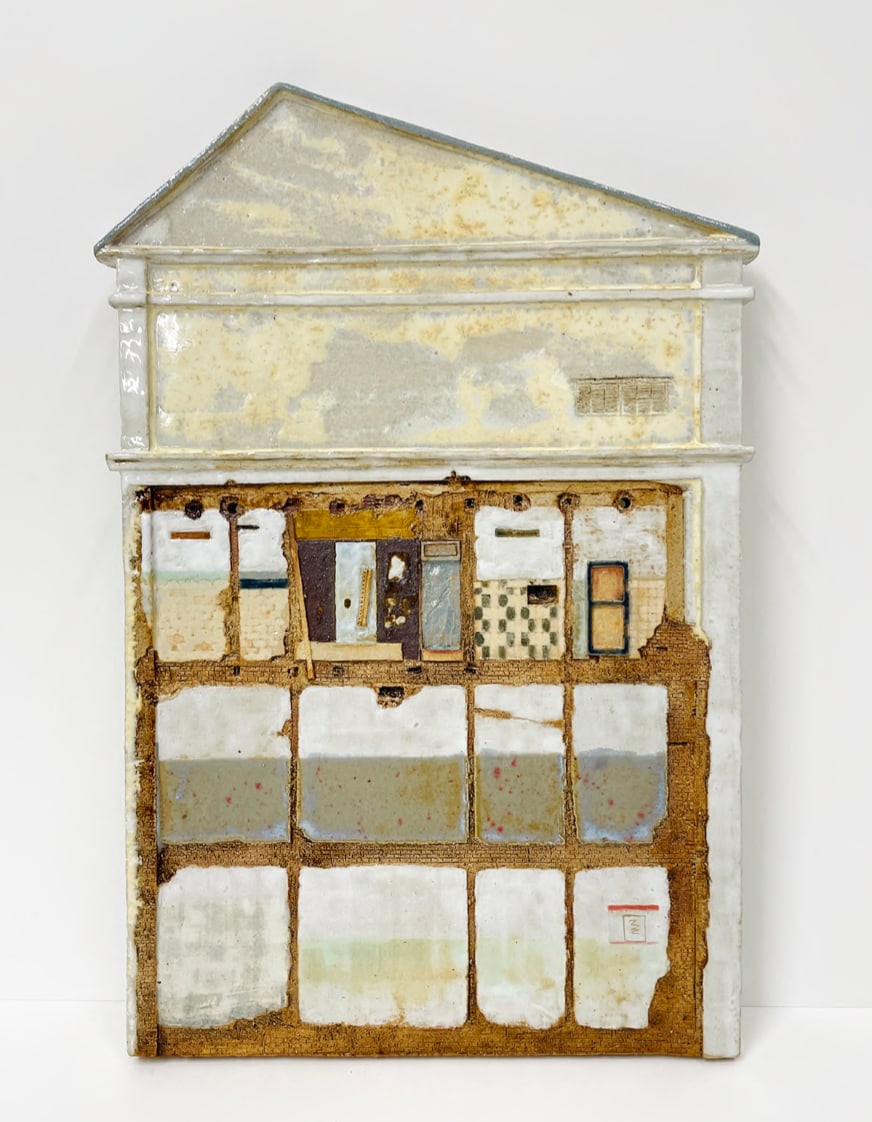
Asya Marakulina, House with a notice board, 2025, Galerie Fontana
This Russian artist, who works in Vienna, creates sculptures depicting what might be called phantom buildings. These are often vacant plots where construction once stood; the former structures can only be inferred from the traces left on the side wall of the adjacent building.
In 19th-century Vienna, buildings were constructed without cavity walls, which means that the traces on a side wall can often reveal how a demolished house was laid out. Green tiles point to a bathroom, stately wallpaper to a dining room, and brighter colours to a child's bedroom, as seen in the wall sculpture House with a Notice Board.
Mountains you are allowed to touch
New is the collaboration with Babs Haenen. Haenen is a major figure in the world of ceramic art. Her career now spans nearly five decades, and she has held solo exhibitions at the Stedelijk Museum Amsterdam and at various galleries in the Netherlands, the United States and China.

Babs Haenen, Diamond Mountain, 2025, Galerie Fontana
At Fontana, three works from her Mountain series are on display. These porcelain mountains, which visitors are allowed to touch, are matte and smooth. The latter quality is due to the moment at which Haenen burnishes the works: just before they are fired. The pieces refer both to the mythical Chinese mountains themselves and to the gongshi, stones that have been valued by scholars in China since the Song Dynasty (960–1270) for their form and appearance, often representing mountains.
These so-called scholar's rocks are generally small, making them easy to bring indoors for meditation or contemplation while writing or painting. Haenen's mountains, however, are not shaped by nature but by the artist herself. At times she also refers to them as Mountain Buildings. This raises the question: are we looking at architecture or nature, or does a work such as Diamond Mountain represent harmony between humans and nature?
An awful lot of snakes
Among the works by Carolein Smit are a sculpture of a pug (Librarian Pug, 2029) and a pigeon (2025). As always in Smit's work, the finish of both pieces is impressive, such as the countless tiny holes in the dog's skin. 'My sculptures appear very precise, but at the same time they are not,' she said in an interview with Gallery Viewer. 'If you look closely, you can see they were made with a certain speed. I am searching for a balance between refined finishing and a more spontaneous execution.'

Carolein Smit, Medusa with an awful lot of snakes, 2026, Galerie Fontana
The highlight is the recent sculpture Medusa with an Awful Lot of Snakes (2026). The title is no exaggeration, as Medusa is almost entirely obscured by snakes. The piece is nearly 130 cm high and consists of two parts—an upper and a lower section—so that it would fit into Smit's kiln.
The work fits seamlessly within Smit's oeuvre. She has long had a preference for religious and anatomical collections, cabinets of curiosities, and old art. This is reflected in her work, which is populated by archaic figures such as the devil, the Man of Sorrows, shamans, skeletons and the rat king, as well as mythological figures like Medusa.
