24 april 2026, Yves Joris
Renato Nicolodi: “I am an employee of my work”
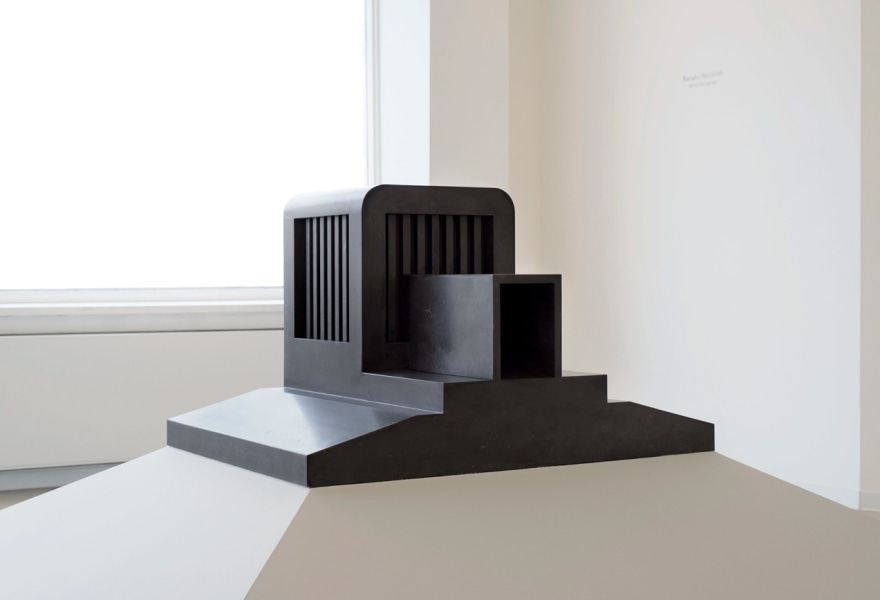
I first met Renato Nicolodi at Axel Vervoordt Gallery on the occasion of Architectura Discordiae, an exhibition I later described as work that does not speak to the viewer, but calls the viewer to account. There was something in the way he spoke about his work that made me decide that a second conversation was needed—one without spectators and in which the studio itself would form the context.
A few weeks later, I drove to Denderleeuw. Nicolodi's studio is not a white cube or a staged workspace, but a place where things happen. His family is there. Stones lie on a cabinet. There is something standing somewhere that does not yet have a name. We sit down and he starts talking in his usual fashion: with the calm of someone who knows he does not have the answers, but definitely has the questions.
You once said that even being a spectator of your own work is difficult.
That's true. Sometimes I still try, but that is also precisely the point. When I create work, it is above all an invitation—an invitation to bring the viewer to a standstill, to reflection. That's also part of why I create: to be able to stop and reflect, to look back for a moment. Who have I become and why? Don't get me wrong; I don't live in the past, but day to day—but with the occasional glance backward. In our fast-paced lives, that's something I value deeply. I do it with the children as well. When we're walking and see something out of the ordinary, we stop. Just to look at it. Because yes, I'm someone who looks at the world. When people pause at my work, I'm immensely grateful. That is my driving force. My ultimate goal.
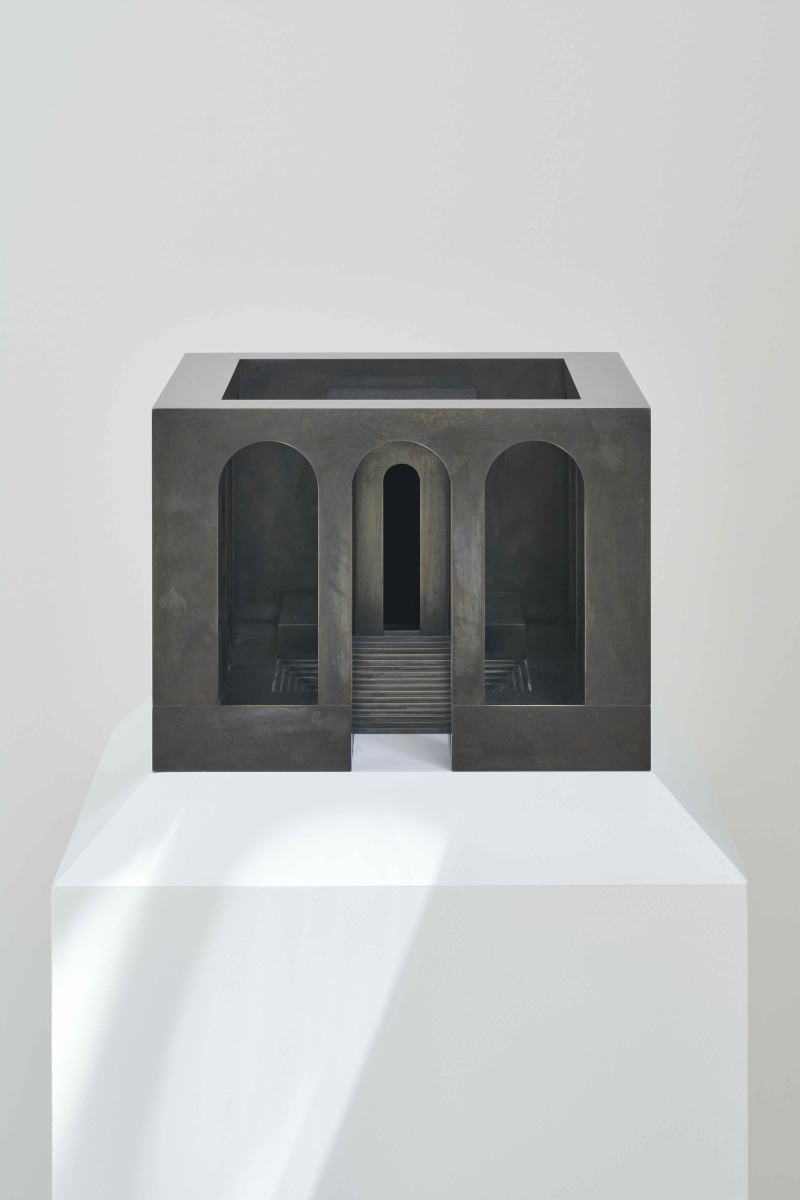
Renato Nicolodi, Statio II, 2020, Galerie Ron Mandos
Your work is immediately recognisable despite the diversity of materials and forms. Is that intentional or did this develop over time?
It's hard to say. I hear that comment quite often and I find it a bit strange myself. After all, I use an archetypal visual language that belongs to all times and cultures. Appropriating something like that is already an odd situation. But I think that recognisability also has to do with the fact that each work is preceded by an intense design phase. That design process is actually the majority of my work, as opposed to 20 years ago, when it was pulling and drawing to create something usable. Today, the process is a much smoother one because over the years, I've created a language that is truly personal. That's also where my resistance to AI comes from: if I were to upload all my work and ask for something similar, I might get an image, but never my image. It often boils down to the details: how a staircase runs into a wall, a certain angle, elements you discover through drawing. That's where the appropriation lies.
You studied painting at Sint-Lucas. How did you end up doing sculptures?
Through the bunkers of the Atlantic Wall. My wife and I—we've been together for 27 years—went on a trip to France. I saw those bunkers and I knew them from my grandparents' stories. You look differently at things when you have a relationship with them. I started painting them, but kept (figuratively) hitting a wall. Painting them didn't make them good work. At some point, I took an acrylic painting I wasn't satisfied with, covered it with lacquer and before it hardened, applied a layer of white oil paint. The next day, I removed that oil layer again, which created a crackle effect.
It was pure coincidence. But that image told me something about materiality, about abstraction. I began making sculptures, mould after mould, cast after cast. From the age of 14, I started working with construction materials with my brother—that was my foundation. I then put painting aside completely for years. Only recently have I returned to it.
When did you have to admit to yourself that you were an artist?
That's a very difficult question and honestly, I still find it difficult. I always say that I'm more an employee of my work. Or a storyteller. That perspective places me somewhat outside the role of artist. And the word itself is heavily loaded. In Belgium, if you say you're an artist, you're not taken seriously. Someone with their head in the clouds. In the Netherlands, it's different—not that I'd like to be called an artist there either, but the public perception differs. It's a double-edged sword: it can be something very beautiful, but also something else entirely.

Renato Nicolodi, Trias III, 2020, Galerie Ron Mandos
A recurring theme in your work and in conversations about it is the sacred without doctrine. What remains when a shrine loses its function, a bunker its context?
That's precisely the essence. As humans, we build and create, convinced that this is the best possible outcome. But the question is whether we are really as good as we think. My work refers to temples, to religion, to politics—but without being political or religious. Sacrality is important to me, but once you assign a function to architecture—a chapel, a doctrine—you can no longer distance yourself from it. That distance is precisely the intention. I try to look at those things as a layperson, to objectify them. I often use the example of the Egyptian pyramids: that cult has disappeared, we don't know exactly why certain things were done, so we have to interpret. I try to make my work in such a way that it must be interpreted. If I refer to a relic, but it is not a relic, you also have to ask yourself: what is it then? And what exactly is a relic?
How does a viewer deal with that freedom? Can the interpretation be completely detached from your own vision?
As an artist, I have control over the work itself—the development, the questions I ask myself. But once I exhibit my work, I do not know who will come to see it. I provide a direction, but at a certain point, I have to let go. There are people who look at it from perspectives I would never have considered. I have no control over that, nor do I aspire to. The work must stand on its own, invite the viewer to walk along for a moment—but then tell its own story. I know why I create. My motivations are very clear to me. But the effect is beyond our control as artists.
Some might say that sacrality without content is an aesthetic trick, a sense of depth without the obligation of meaning. What is your response to that claim?
I don't know if I need to defend myself against it. What I do know is that I act from a place of authenticity, from a sincere conviction. Anything can be made ridiculous—and a viewer who approaches it that way will simply pass it by. That's something you also have to let go of. What matters to me is the context: where the work stands, how it is placed, the space surrounding it. A dark space behind a sculpture where you cannot see the end—that is something visual that you can guide. But the rest belongs to the viewer.
At Axel Vervoordt Gallery, we encountered Hybris—massive yet doomed to fall. Was its disintegration a loss for you?
There is a very relativising aspect to it and that's also part of who I am as a person. I don't want to be placed on a pedestal—nor my work. They are building blocks, ideas. Just as in life, you grow older and people disappoint or surprise you: everything feeds into relativity. Hybris stems from the absurdity of our human condition. We build, we are convinced of our own rightness, yet at the same time, we ruin our world. Great cultures, Romans, Egyptians, are doomed to disappear. Our capitalist system as well. We live in a finite era. You entered the exhibition and saw a symmetrical wall rising upward with light shining from behind through the dome. Imposing. But once you chose a side and walked around it, you saw that the wall was crumbling. Doomed to fall. The installation consisted of 210 elements. They are now dispersing like traces of a larger whole.
A trace—that was also the theme of your thesis.
Yes, I spent a year writing to place my work within philosophy and every time I opened a new book, I hit a new wall. Two weeks before the deadline, I deleted everything and simply wrote my story—about my grandparents, my uncles, images and traces. Because when I go for a walk and see a stone or a stick, that stick is part of a tree, but the way it lies there, eroded, that is a trace of a larger whole. I take it with me. My grandfather was also a collector. He kept everything—Ikea catalogues, you name it. When he passed away, I stopped collecting overnight. What's the point, I thought. Until our children came home with bags full of stones. And I start collecting again.

Renato Nicolodi, AEDIFICIUM INANE I, 2024, Galerie Ron Mandos
That sense of wonder—is it the driving force?
Yes, a teacher once said in class: you should always imagine you are a Martian, seeing everything for the first time. That has never left me. My work is heavy—physically and conceptually—yet it also has something light about it. That sense of wonder is the contradiction. I used to tell my students: there is a stone in front of your door that you kick aside every day. Find that same stone on holiday and you think it's beautiful. That act of looking—I try to force myself to do it every day. But finding something beautiful also means knowing why. And opposite to that is the ugly. Our lives consist entirely of contrasts.
And then there are your art books. An exhibition ends, Hybris becomes an echo, but scripta manent. How do the books relate to the work?
A book is also a work of art in itself. I can include things in it that I rarely or never show in an exhibition. The homages in the first book, the black book, those are my motivations. I give the viewer a bit more insight than I would in a gallery space. Like those Super 8 films of my grandfather at a construction site: his archive projected onto stones like flowing water. It appears and disappears—fleeting like life. And in the new book, the story of my uncle Guido. Someone told me he surreptitiously slipped his way into it. And that's true. He still managed to force his way into a new book. For me, it was also about setting something right, a kind of debt repayment. I'm very glad it's in there now.
The book is not structured chronologically. Why is that?
I sat down together with Onno Hesselink, the designer, and we searched for a composition—rhizomatic, just like designing a work itself. The sequence, the rhythm, the placement of texts in relation to images: there is a movement in it. It's not really a narrative, but still a path.
The name Paul Virilio appears in your early work and in the new book. Why?
Virilio is the very beginning. Everything started rolling after I read Bunker Archéologie. He was an urbanist and a philosopher and what stayed with me most is how he describes the context of the bunkers extensively, but at the end says that you must also be able to look at that bunker completely detached from its context. That gave me permission to do something with it. Because I was always afraid of being misunderstood. An artist once called me a 'fascist'. That sticks with you. There is a museum in France that refused my work—too risky, too sensitive. That element exists in my work and I know it. But Virilio gave me the freedom to carry that risk. His book is the only one I've read two or three times—in French, even though I wouldn't call French my strongest language. But it was unavoidable.
What's on your nightstand?
Too little, honestly. I buy lots of books, open them and read a few pages—and never get around to finishing them. Recently, I had a few books by Jung on my nightstand, books I plan to read someday. All my books are currently packed away in boxes—a transitional phase. I used to know which books I had. Now I think I've bought some twice. But yes, that, too, is a trace in its own way.
As I leave, he signs my copy. Thank you for the good questions, he writes. I close the book and think: the good questions were his.
