07 april 2026, Flor Linckens
Last chance: from object to sculpture at Galerie Ramakers
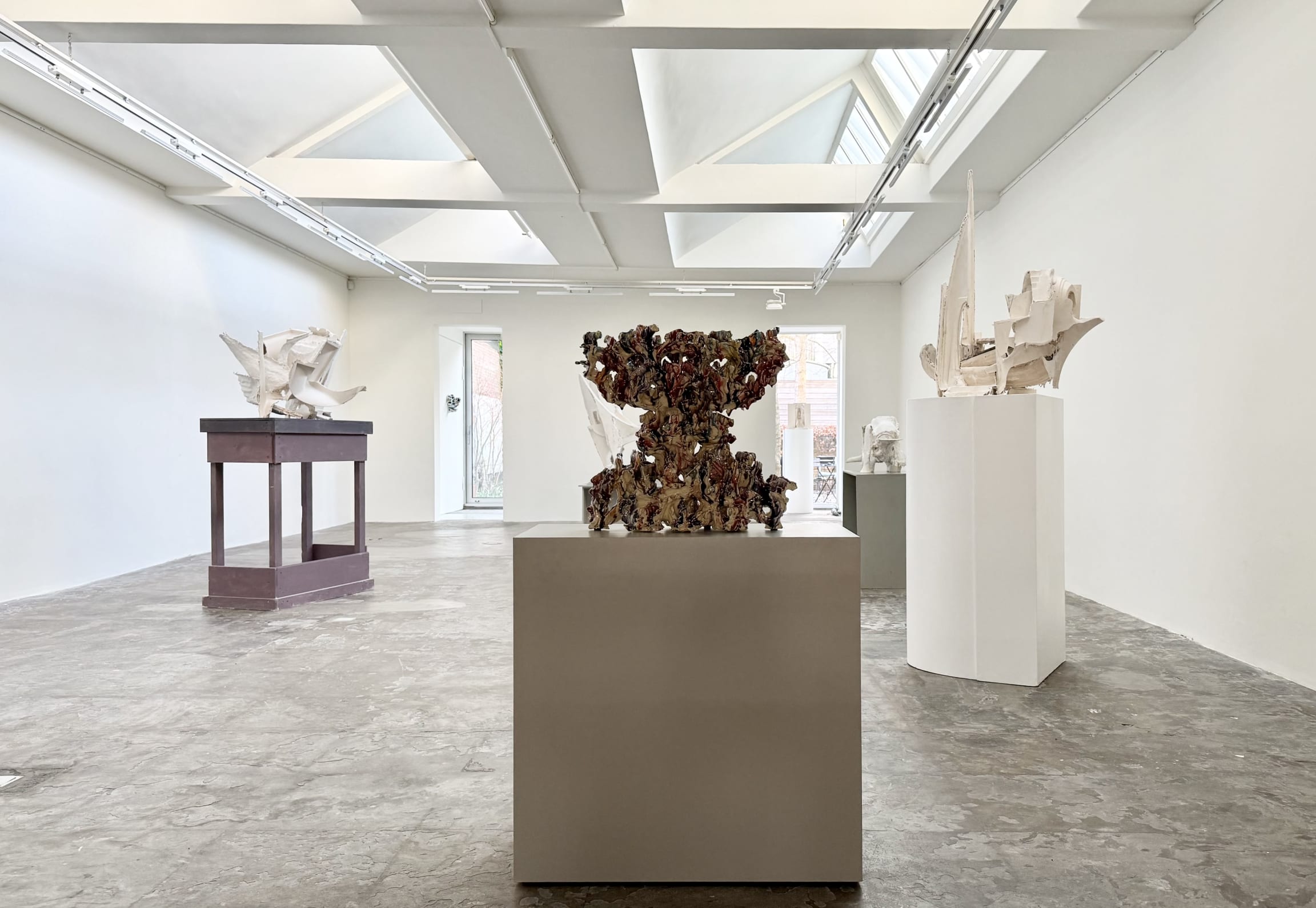
This week marks your last chance to visit a group exhibition in Galerie Ramakers in The Hague, featuring new work by Guido Geelen, Babs Haenen and André Kruysen. In ‘Shape Shift’, the artists show how a form can shift from functional object to sculpture. They engage with form, scale and material, but also with the relationship between their work and the space it occupies. The result is a compelling tension that opens up a different way of looking.
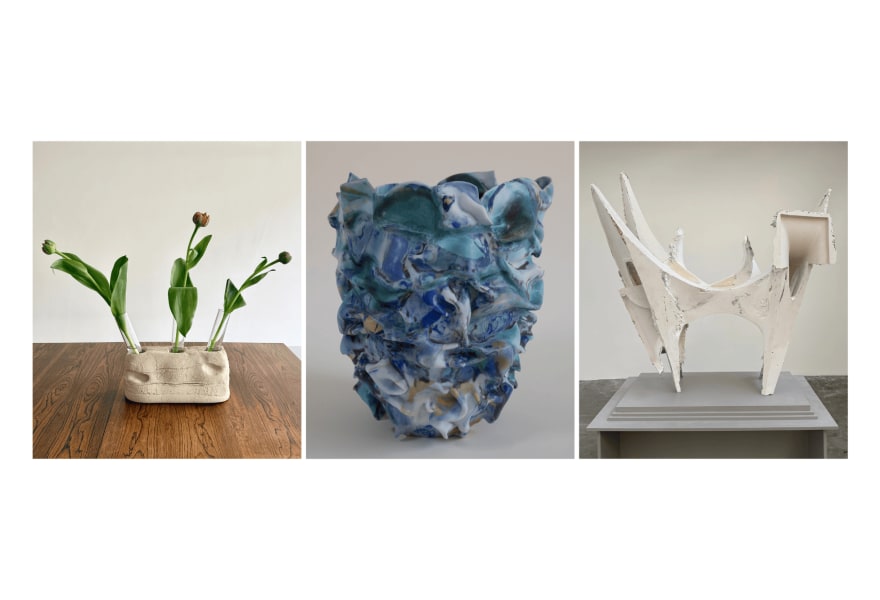
Each artist works with their own chosen material. For her "Turbulent Vessels", Babs Haenen uses porcelain, pigments, enamel and glaze, while Guido Geelen primarily works with unglazed clay for his modular tulip vases, often in combination with glass. André Kruysen constructs his architectural works in 'acrylic one', a composite material made from liquid resin and mineral powder that can be cast and, once hardened, takes on a solid, stone-like quality.
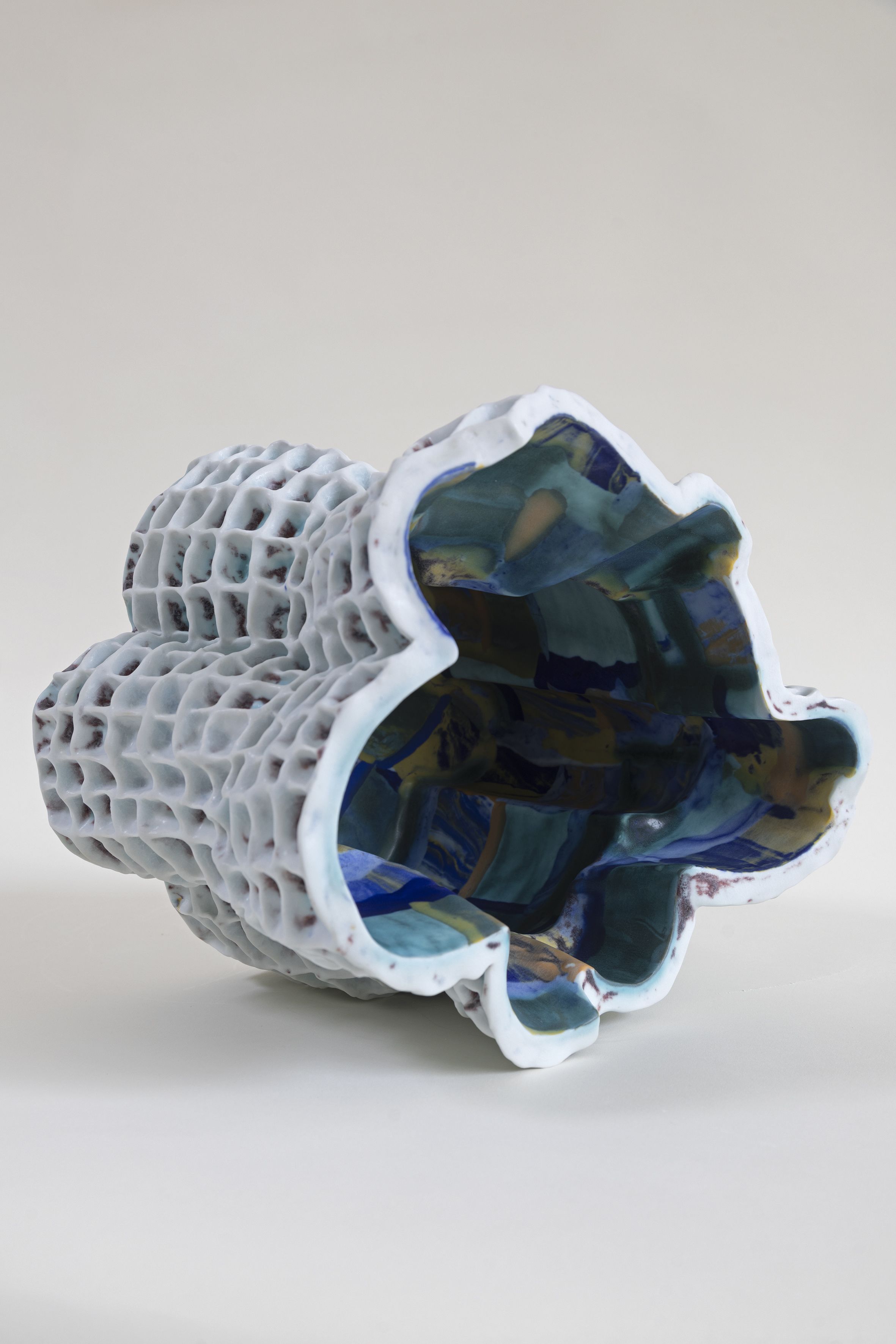
Babs Haenen was born in Amsterdam in 1948 and studied ceramics at the Gerrit Rietveld Academie, where she later also taught. Her expressive practice developed in part from a background in dance, and a certain sense of movement and rhythm still plays a significant role in her practice. Haenen works with coloured porcelain, cutting, folding and building it up layer by layer into freely formed objects. With her series "Turbulent Vessels", the idea of what a vase can be is stretched and opened up. Its primary function recedes, allowing form itself to take centre stage. Visually, Haenen draws inspiration from fashion, 16th- and 17th-century painting and international ceramic traditions. Her work is held in the collections of the Stedelijk Museum Amsterdam, Museum Boijmans Van Beuningen, the Victoria and Albert Museum and the Metropolitan Museum of Art, and was previously shown at Kunstmuseum Den Haag, the Stedelijk Museum Amsterdam, the Frans Hals Museum and De Hallen.

Guido Geelen (Thorn, 1961) studied at the Academie voor Beeldende Vorming in Tilburg and is known for his inventive approach to materials. In ‘Shape Shift’, he presents a series of modular tulip vases in which he deconstructs a recognisable form from the Dutch tradition and rebuilds it in clay. At the same time, the flowers that so unmistakably belong to these vases evoke associations with transience. A defining aspect of his practice is the visibility of the making process: impressions of moulds, casting channels and traces of handling are not concealed, but remain integral to the work. Additionally, Geelen combines industrial and traditional techniques in this approach. His work has been included in the collections of the Kröller-Müller Museum, Museum Boijmans Van Beuningen, Museum De Pont, Stedelijk Museum Amsterdam and the Dutch Ministry of Foreign Affairs. He received the Charlotte Köhler Prize for sculpture as well as the Dr A.H. Heineken Prize for Art.

André Kruysen was born in The Hague in 1967. He studied at the Royal Academy of Art in The Hague and at the Rijksakademie van beeldende kunsten in Amsterdam, and completed a residency at the EKWC. His sculptures emerge from an investigation into architecture, light and space, in which he engages with the ways daylight enters and moves through a space. Within an increasingly fast and complex visual culture, he appears to be searching for a deliberate moment, a moment of slowing down and finding balance. This results in carefully composed structures in which both this disruption and this stillness appear to coexist. His works are inherently relational, responding to the space in which they are presented as well as to the context in which they are made. His work is held in the collections of Kunstmuseum Den Haag, the Bonnefantenmuseum, Museum Beelden aan Zee and Museum De Fundatie, and was previously shown at Museum De Fundatie, M HKA in Antwerp and Voorhout Monumentaal. In 2011, he received the Ouborg Prize.