31 march 2026, Flor Linckens
Dirk Salz: layers of light
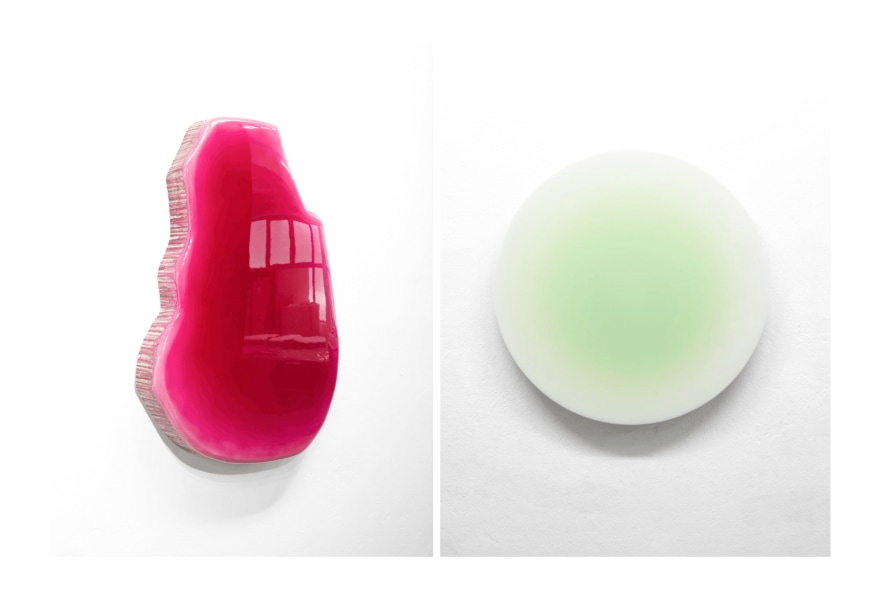
Until 11 April, Galerie Roger Katwijk in Amsterdam is presenting a solo exhibition of Dirk Salz. His career did not start out in the studio but at the drawing board. The artist was born in 1962 in Bochum, near Dortmund. From 1979 to 1981 he took private lessons in which he immersed himself in drawing, painting and art history. After secondary school he studied engineering at the Technical University of Aachen. Only in 2002, after a career in IT, he decided to devote himself fully to his artistic practice. Yet that technical detour is still visible in his work, which is precise, methodical and carefully constructed.
Salz’s practice is based on an extremely slow process. The artist mainly works with industrial materials. His primary material is epoxy resin, which he mixes with pigments and then applies in dozens of semi-monochrome layers on a support made of plywood, MDF, cork or aluminium, often prepared with a black ground layer. The colour in the subsequent layers does not lie on the surface but is embedded within, suspended in many transparent layers. Each layer of resin must harden before the next can be applied. The artist finishes the work with a layer of polyurethane lacquer. The entire process can take weeks and requires great technical precision and material knowledge, as the material can react to temperature, humidity and its surroundings.
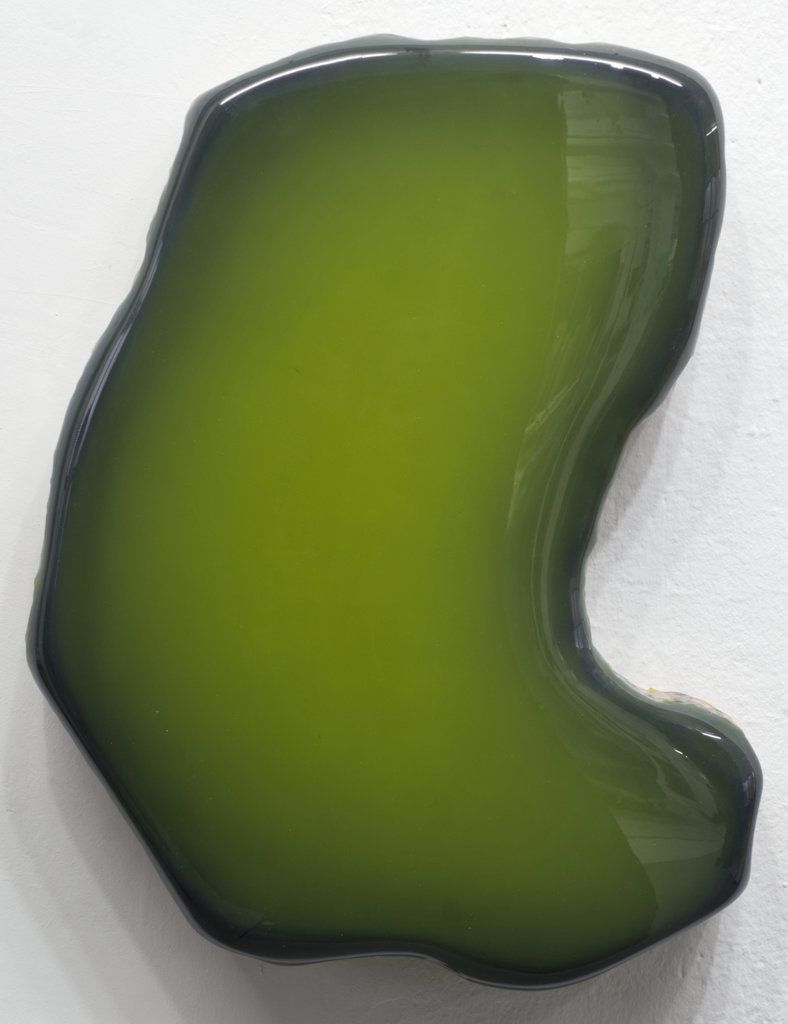
The works that emerge in this way are not paintings in the usual sense. The resin builds up to a considerable thickness, almost like a sculpture on the wall. Yet Salz defines himself first and foremost as a painter, and in essence he is: someone who applies pigment in layers onto a support. Along the sides the individual layers remain visible like a cross-section. But when viewed from the front, the works reveal an almost endless depth. The viewing experience is also influenced by light, the time of day and the space in which the work is presented. Your own presence also becomes part of the work as a faint contour. At the same time, some works appear to be illuminated from within, like an optical illusion. Salz’s work is therefore not only about colour and form but above all about perception. The result is difficult to capture in a photograph because the material resists translation into a static, time-bound and two-dimensional image.

The reflection in the glossy works is not an accidental side effect but a structural part of the composition and the viewing experience: Salz designs his colour fields with these anticipated reflections in mind. As a viewer you see yourself, the space you are in and the colour depth within the work, all at once and always differently. The artist also experiments with matte works in which the reflection disappears and the colour appears softer and more diffuse. He also varies in form. In the exhibition at Galerie Roger Katwijk you see rectangular panels and perfect circles, but also various irregular, organic contours in which the material seems to determine its own edges.
The artist draws inspiration from American post-war abstract painting, including the work of artists such as Barnett Newman, Mark Rothko and Ad Reinhardt, as well as from European Concrete Art, the Light and Space movement and Minimal Art, for example in the work of Imi Knoebel, Dan Flavin, James Turrell, Donald Judd and Blinky Palermo. The colour theory of Josef Albers also plays a significant role in his practice, as do ideas from philosophy.

The work of Dirk Salz has been included in the collections of AkzoNobel and DELA, among others.
