20 march 2026, Flor Linckens
Ingo Arndt: the gravity of equal attention
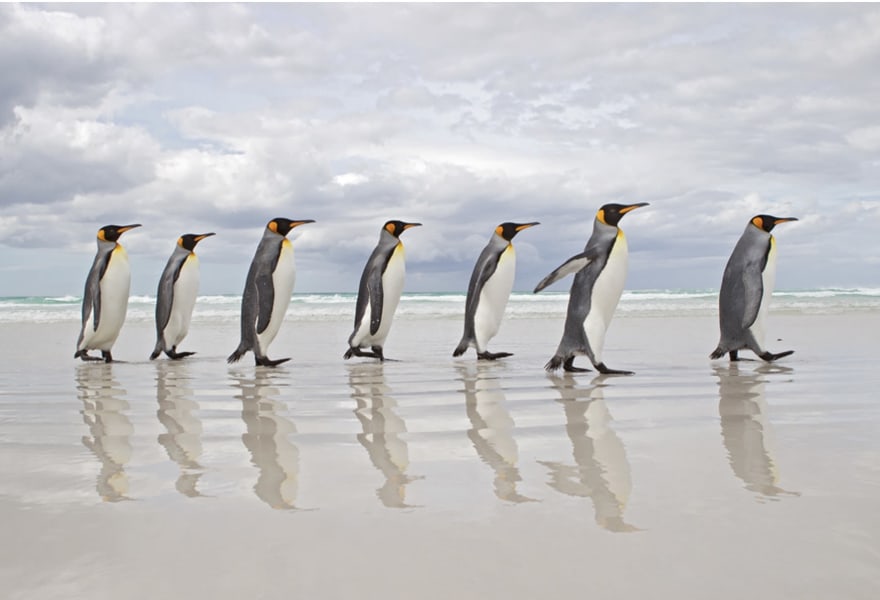
Until 5 April, SmithDavidson Gallery presents an online exhibition on GalleryViewer featuring the work of German photographer Ingo Arndt. With 'Encounters in the Wild', the gallery brings together images Arndt made across the globe, from Kenya and Norway to Patagonia in South America. Central to his approach is the time he takes, whether he is photographing the smallest insects or the largest predators.
For many projects, he spends weeks or months in a single location to understand animal behaviour before he starts photographing. He seeks to grasp situations: where animals move, how they respond to changes in their environment, and how they relate to one another. The resulting images are not staged, but the payoff of the time the photographer invests. For some series, he took tens of thousands of photographs before everything converged in a single image.

Arndt was born in 1968 in Frankfurt am Main. As a child, he spent all his free time outdoors, and that early fascination with nature and animals continues to underpin his practice. Since the early 1990s, he has travelled the world as a wildlife photographer, capturing animals and their habitats in their natural environment. Photography soon became more than a way of recording remarkable encounters: it also became a means of drawing attention to ecosystems that are increasingly under pressure. Notably, his way of looking is non-hierarchical: a majestic predator and a colony of birds receive the same level of attention and seriousness.
Arndt has photographed ant colonies in German forests, migrating locusts in Madagascar, cranes gathering in vast roosts, king penguins on the Falkland Islands, and musk oxen moving closely together through a snowstorm. In 2024, he received the Wildlife Photographer of the Year award in the Invertebrates category for an image of red wood ants, systematically dismantling a beetle in order to carry it into their nest. In a video released by the competition, the photographer calmly explains that he had only a few minutes to capture the scene, as hundreds of ants were simultaneously spraying him with formic acid. His wife, Silke Arndt, a graphic designer and videographer, often travels with him and plays a significant role in the presentation of his work.
The works in the online exhibition on GalleryViewer span the period from 2007 to 2022. Among them are king penguins on the Falkland Islands, flamingos in Kenya, a puma in Patagonia, and a brown coastal bear in Alaska.

In "Starlings II" (2009), Arndt captures a flock of starlings that appears almost abstract against a white sky. In "King Penguin" (2011), he shows a row of penguins on a wet shoreline. At first, the image seems doubled twice, as the animals resemble one another so closely, but if you watch a bit longer, subtle individual personalities begin to emerge. Perhaps this also touches on something anthropomorphic: the human tendency to project emotions and traits onto animals.
For "GRIZZLY III" (2011), Arndt photographed a brown bear standing upright in the water, frontal and almost monumental. As a viewer, you primarily see the image, and not the distance and concentration required to capture such a moment without disturbing the animal. Arndt observed these grizzlies, which can weigh up to 700 kilograms, over multiple seasons, watching them for hours on end. In "PUMA IV" (2017), we look directly into the eyes of a puma, a predator within its own territory. This is no chance encounter: Arndt spent months in their environment, across several trips, learning their rhythms. He worked with telephoto lenses to maintain distance and endured extreme weather conditions. For his work, he often collaborates with trackers and scientists.

In works such as "Cranes" (2010) and "Muskox I" (2022), the focus shifts from the individual to the group. These images are not only about animals themselves, but about movement and collective rhythm. Arndt’s photography is not only concerned with beauty or rare encounters, but also with understanding how animals live and survive, whether in solitude or within complex group dynamics. He seeks to make behaviour visible and to reveal the relationship between animal and habitat. At the same time, his work invites reflection on our own position within an increasingly anthropocentric era.
Arndt studied Graphic Design and Photography at the Hochschule Darmstadt. His work has been shown at institutions including the Natural History Museum in London, and he has received multiple Wildlife Photographer of the Year awards and World Press Photo awards. He has published more than twenty books, and his photographs have appeared in international publications such as GEO, National Geographic and BBC Wildlife.

