17 march 2026, Yves Joris
This exhibition says nothing – which is exactly why you should go: The Quiet Between Things at the Eva Steynen Gallery
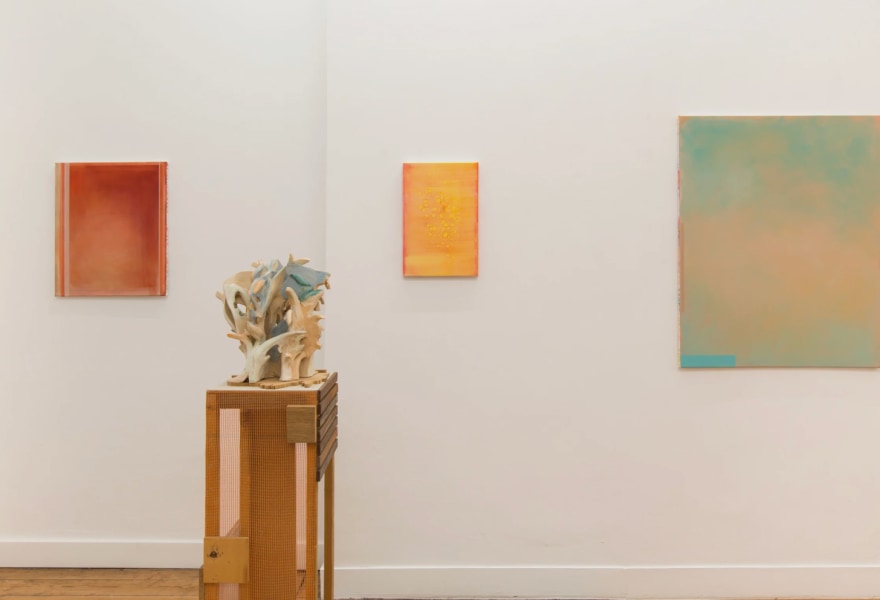
A visit to The Quiet Between Things at the Eva Steynen Gallery
The city is too loud. Not just today, not just here. All cities are structurally, chronically, constitutionally too loud. We move through it like fish in water that’s too warm: we no longer notice it, yet it exhausts us. But then there is a gallery on Zurenborgstraat that is holding an exhibition about silence. Not about the concept of silence nor about silence as a statement, but about the small, fragile, indispensable space between things. I walked inside with the city still ringing in my ears. I walked out again with something I can only describe as inner calm.
The door closes and the air changes
The Eva Steynen Gallery is presenting three artists: ceramicist Veroniek Van Samang (b. 1988) and painters Chris Meulemans (b. 1967) and Ann Grillet (b. 1961). The title of the exhibition, The Quiet Between Things, reveals nothing. It describes an attitude, a way of being in the world that we have unlearned because it produces nothing, yields nothing, shares nothing. To me, the silence between things is not the silence of absence, but the silence of a presence that does not impose itself. It is precisely the kind of silence that a gallery like this allows to exist in a city that does its best to push it aside.
The three artists work in different media across a generational gap of nearly 30 years. And yet something connects them, something Steynen has seen clearly and arranged with care: a shared trust in the power of the understated. None of the three is trying to prove anything. None is trying to persuade. They offer. The viewer decides.
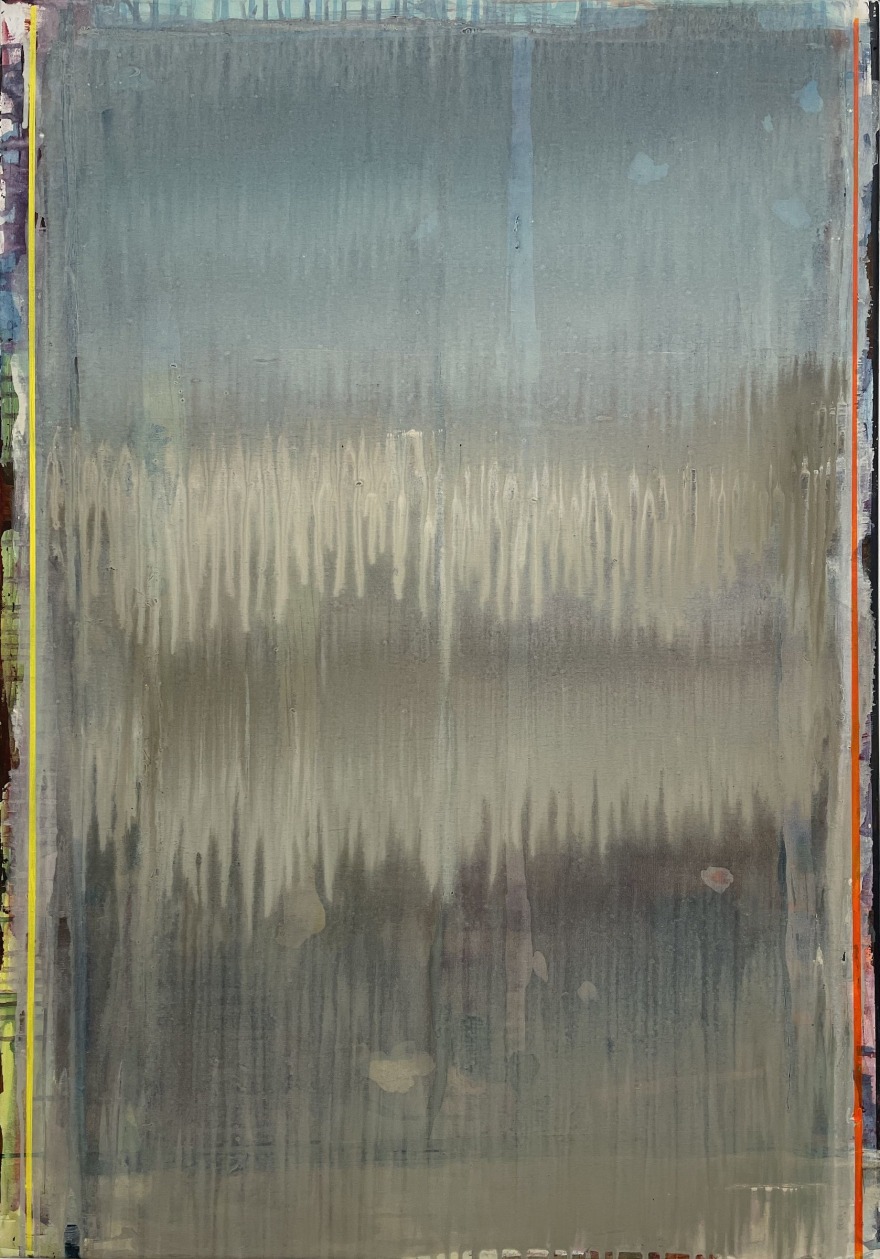
Ann Grillet, Rising Blue, 2019, EVA STEYNEN GALLERY
Three voices, one breath
Ann Grillet works in layers. Not as a technique, but as a form of thinking. Her abstract canvases are sediments of time. Dozens of thin brushstrokes, each a day or a moment or a hesitation, accumulate until the surface resembles a relief map of silence. You are not looking at an image, but a process that decided to suddenly stop. There is always a moment when Grillet decides it is enough. Not because it is finished in the conventional sense, but because adding more would destroy something that is still breathing.
That moment of stopping — the decision not to go any further — may be the most underestimated gesture in contemporary art. In a culture that rewards more, faster and louder, the artist who withdraws her hand at exactly the right moment is rare. Grillet is one such artist. Her canvases demand patience and repay it with interest to anyone willing to wait.
Nearby hang the floral paintings of Chris Meulemans and the pairing is no coincidence. Whereas Grillet begins with abstraction and gradually allows something tangible to emerge, Meulemans starts with the recognisable — the flower — and slowly lets it dissolve into rhythm and colour. Her paintings hover in a zone between recognition and abstraction, a zone that could feel uneasy but does not. Her work feels familiar, like a word in a language you once spoke and have all but forgotten.
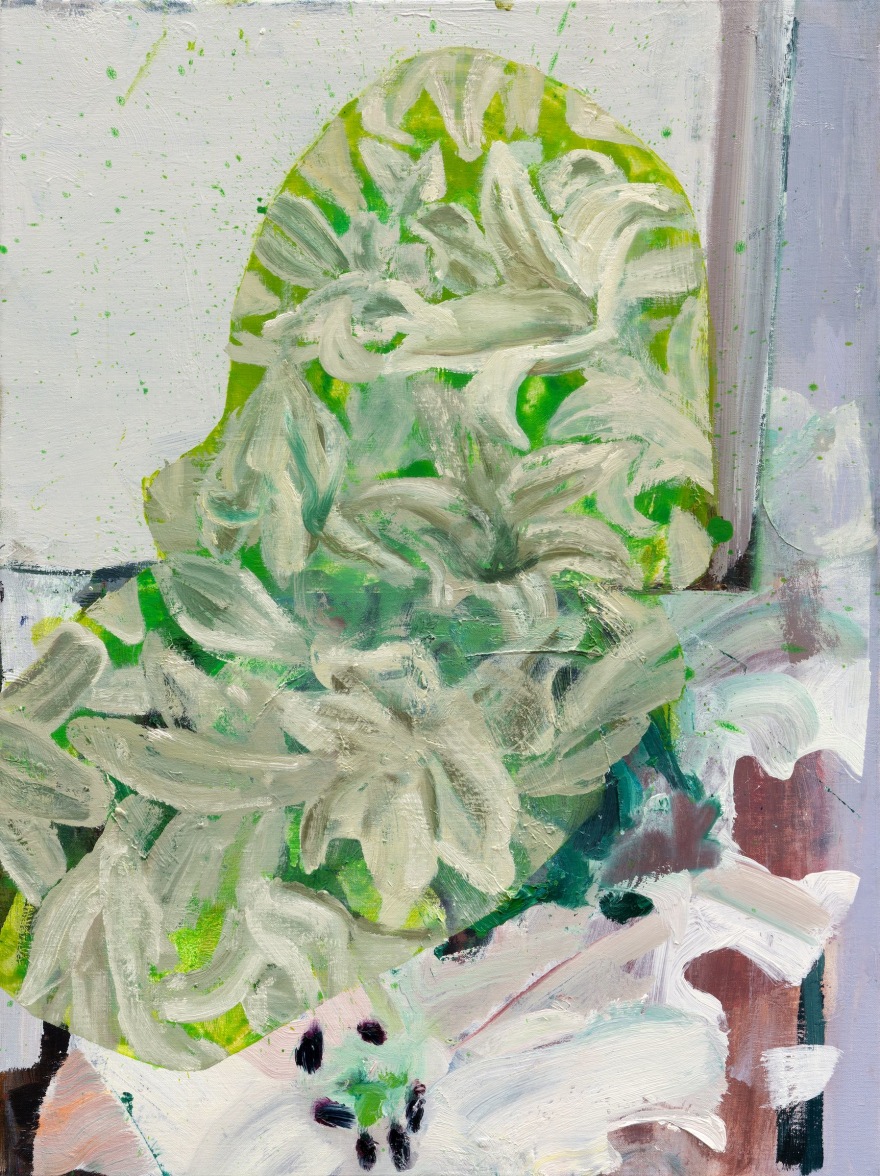
Chris Meulemans, Vanishing Vista, 2023, EVA STEYNEN GALLERY
Meulemans paints flowers that are no longer flowers. Or rather, flowers that are more than flowers. Botanical reality is her point of departure, not her destination. What remains after her transformation is a chromatic cadence — a rhythm of warm and cool tones, a repetition that becomes meditative without ever turning monotonous. You look and something in your body begins to settle. Not because the work is calm, but because it takes over your rhythm and slows it down.
And then there are the sculptures by Veroniek Van Samang. While Grillet and Meulemans work on the surface, Van Samang brings the body into the room. Her ceramic objects are three-dimensional paintings, tactile beings that merge colour and vulnerability within the fired material itself. She trained as a painter, but clay has given her something canvas could not: gravity, fragility, the physical memory of hands. You see the pressure of fingers. You see the decisions. You see how an object proudly carries its own vulnerability.
What struck me most was the interaction between the three. Not the sum of three individual practices, but a shared breath, a conversation already under way before I walked in. Grillet commences something. Meulemans sets it in motion. Van Samang gives it weight and volume. Or the other way round, depending on how you move through the space. The exhibition has no beginning and no end, only entrances.
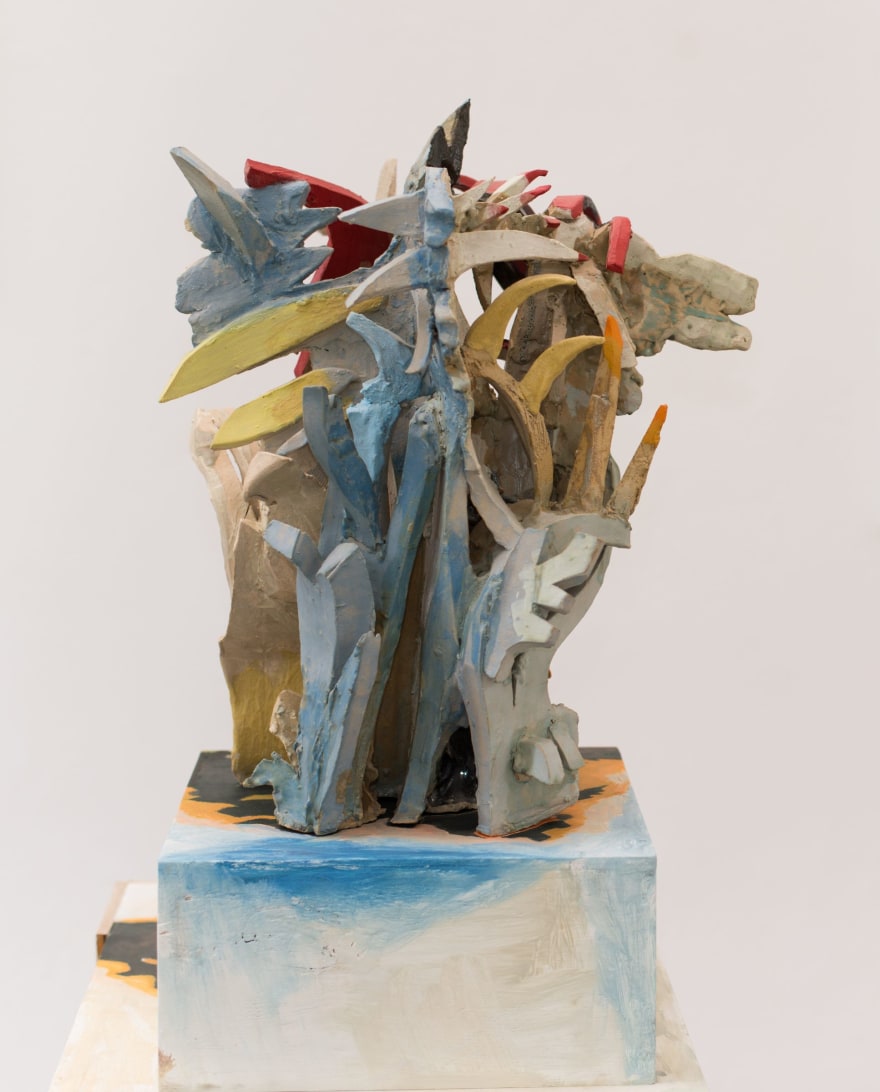
Veroniek Van Samang, Behind the fence II, 2024, EVA STEYNEN GALLERY
What the Japanese knew and we forgot
There is a word in Japanese that has no satisfying translation, which is precisely why it is so useful: ma. It means something like a meaningful interval. You might describe it as the pause between two notes that makes music possible, the silence between two sentences that allows a conversation breathe or the emptiness in a room that makes the presence of objects visible in the first place. Ma is not the absence of something, but the presence of space.
In traditional Japanese architecture, ma is deliberately created and protected. A room is not full when every surface has been used. A room is only full when the space within it no longer has air. Western interiors, Western museums, Western exhibitions tend towards the opposite: fill the wall, occupy the floor, comment on every work with an extensive label. More is more, because more proves that you are taking things seriously.
The Quiet Between Things is based on a different premise. The works of art hang and stand with space around them. They breathe. And that breathing space is not a luxury or a waste, but a necessary condition under which the work can speak. Without ma there is no dialogue, without silence no conversation.
Restraint as a radical gesture
There is something uncanny about work that refuses to persuade. That does not shout, does not claim, does not demand to be seen, but waits until you are ready to look. In an era of maximum visibility — algorithms, the attention economy, the aesthetic violence of the constant stream of images — restraint becomes an act. Not of weakness, but of trust — the trust that the viewer has enough in front of them already, provided they are willing to slow down and truly see.
Grillet, Meulemans and Van Samang each practise that restraint in their own way. They do not explain, but simply exist, with a patience that can feel almost embarrassing to anyone who enters with an overfilled schedule. And perhaps that is the most subtle thing this exhibition does: it makes you aware of your own inner noise.
Not here. Here you have to do the work yourself.
I stood for a long time in front of a painting by Grillet whose title I could not recall afterwards. That seemed the best proof that the exhibition had succeeded: the label does not matter. What matters is the silence it created in me — the ma I carried back outside, into the city, where the trams were still running and no one knew. But I knew. I carried that quiet interval with me for a while, like something precious wrapped in a coat that was far too loud.
Go. Not because you should, but because afterwards, you will realise you needed it.
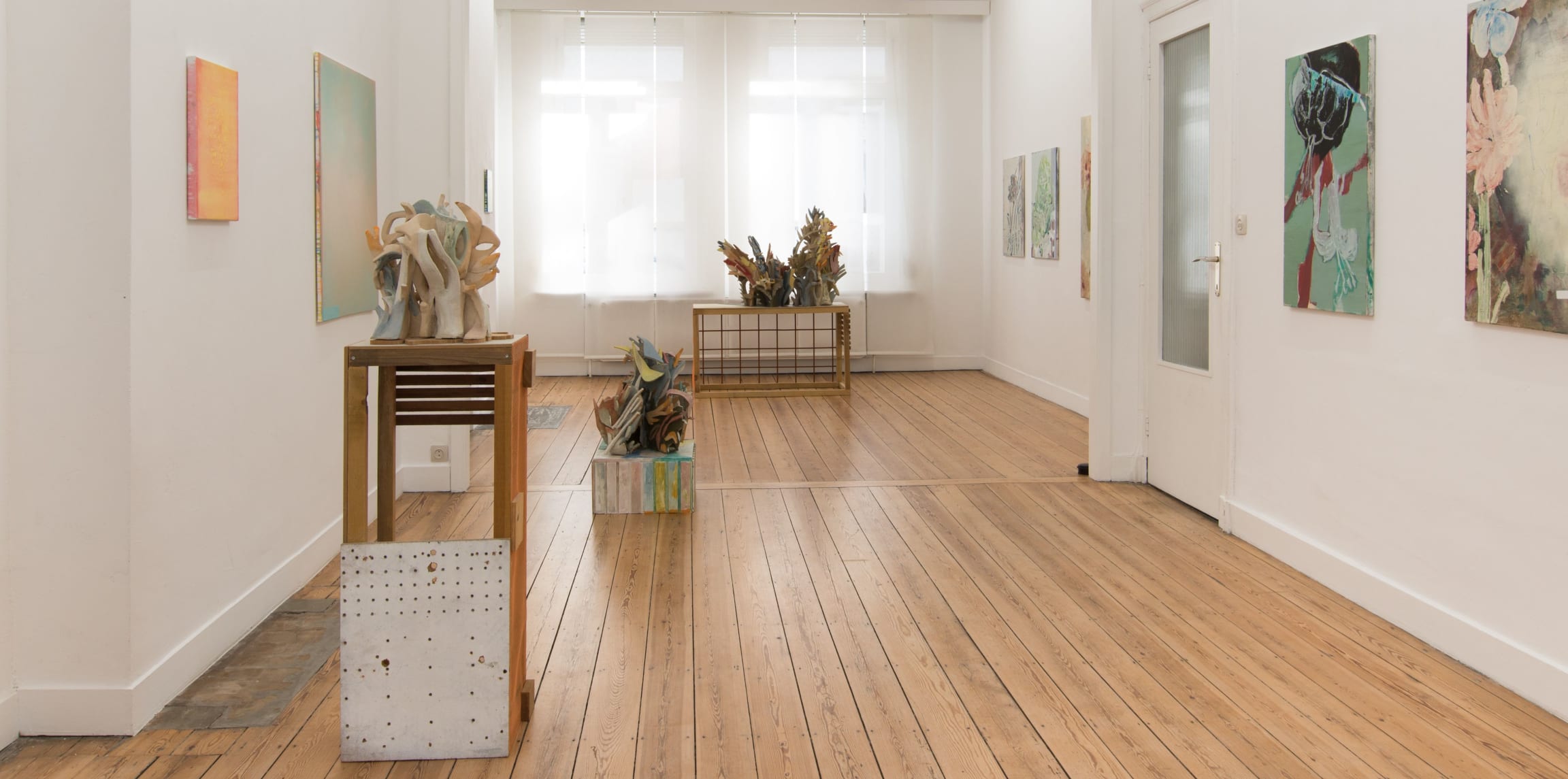
The Quiet Between Things, EVA STEYNEN GALLERY
