13 march 2026, Martine Bontjes
The studio of... Joost Vandebrug
This evening, 13 March at 18:00, the very first solo exhibition of the Belgian photographer Joost Vandebrug opens at Bildhalle. With a microscopic gaze directed at plants and seeds Vandebrug returns to the plant studies of Karl Blossfeldt (1865–1932). During his time at the academy he became fascinated by the work of this German photographer. Where Blossfeldt isolated his plants in order to record them in a clear and systematic way, Vandebrug investigates how an image can never be completely fixed. His work revolves around capturing moments that never truly stand still: "Just like water or air, there is never really such a thing as a repeatable image as everything is constantly changing."
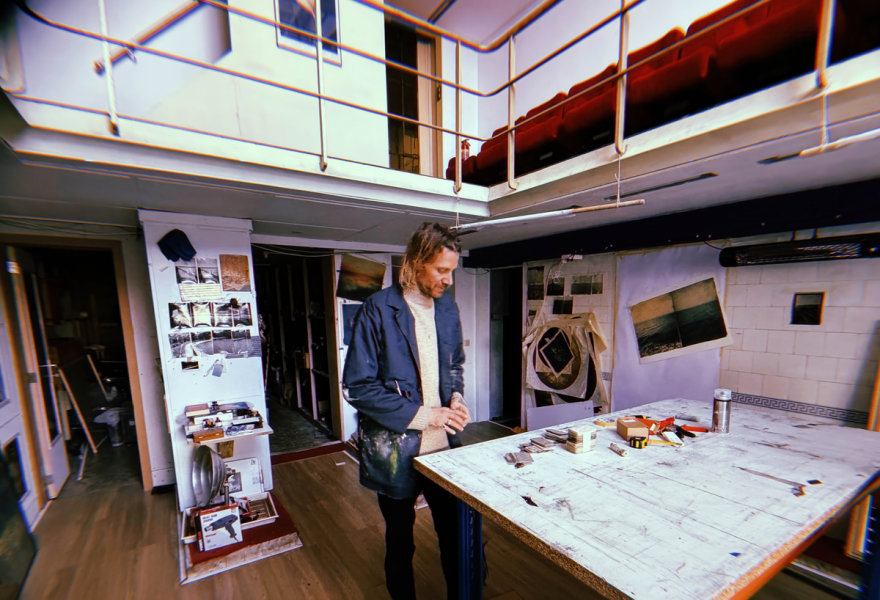
The studio of Vandebrug is also a place where materials and objects are constantly shifting. He works in Antwerp in an old theatre among antique etching plates, copperwork and stacks of old material. Nothing is considered waste material as everything can reappear in new work. The work in his studio slowly develops through collecting, rearranging and allowing new connections to emerge. The exhibition Not Yet the Image is on show at Bildhalle in Amsterdam until 2 May.
Where is your studio and how would you describe this place?
My studio is in Antwerp in an old theatre or rather something like an auditorium. I work in the old orchestra pit surrounded by two tiers of theatre seats so at times it feels as though I am constantly being watched by an audience that never applauds.

Joost Vandebrug, 26-30 Triptych, 2026, Bildhalle
Are there objects, books or particular music that are always present in your studio?
Yes absolutely. There is always all kinds of material here that has already lived a previous life. A lot of old work and thousands of handmade cards that I keep carrying from one project to another and that often resurface in something new. I do not like throwing them away, because for me they are not leftover material but something that simply continues to work.
I also collect old craft objects: antique etching plates, copper plates, inlaid woodwork, small technical devices. I love that almost casual craftsmanship — the precision of it but also the slowness. The most precious object here however is actually a bootleg booklet by Guy Debord called La Derive printed on half an A4 sheet, copied and stapled together, which I once bought online years ago. The booklet deals with psychogeography, a term used by Debord that roughly tries to capture the idea that a place is never entirely neutral. The theory takes itself quite seriously, though not entirely without a wink, and behind all that theoretical smoke there is something very simple and useful: that places affect you and that wandering can sometimes be a better method than planning. For me that feels relevant, also in the way images come into being in my work.
For this exhibition you were inspired by plant studies and photographic experiments by Karl Blossfeldt. When did you first encounter his work?
That was during my time at the art academy. What struck me immediately about Blossfeldt was that he did not use photography to make "art" but rather as a way of looking and investigating. The images are so precise, so clear, so functional that they carry something deeply convincing. I am drawn to work that does not try to be beautiful or important but that sometimes becomes exactly that because of it.
Another thing I appreciate is the absence of unnecessary expression. It is very precise, almost dry, yet never lifeless. Rather attentive. As if through those plants he was trying to understand something about structure, rhythm, growth, form — and photography simply happened to be the best tool for that. That approach resonates much more strongly with the way I look at images than when photography is only about style or composition.
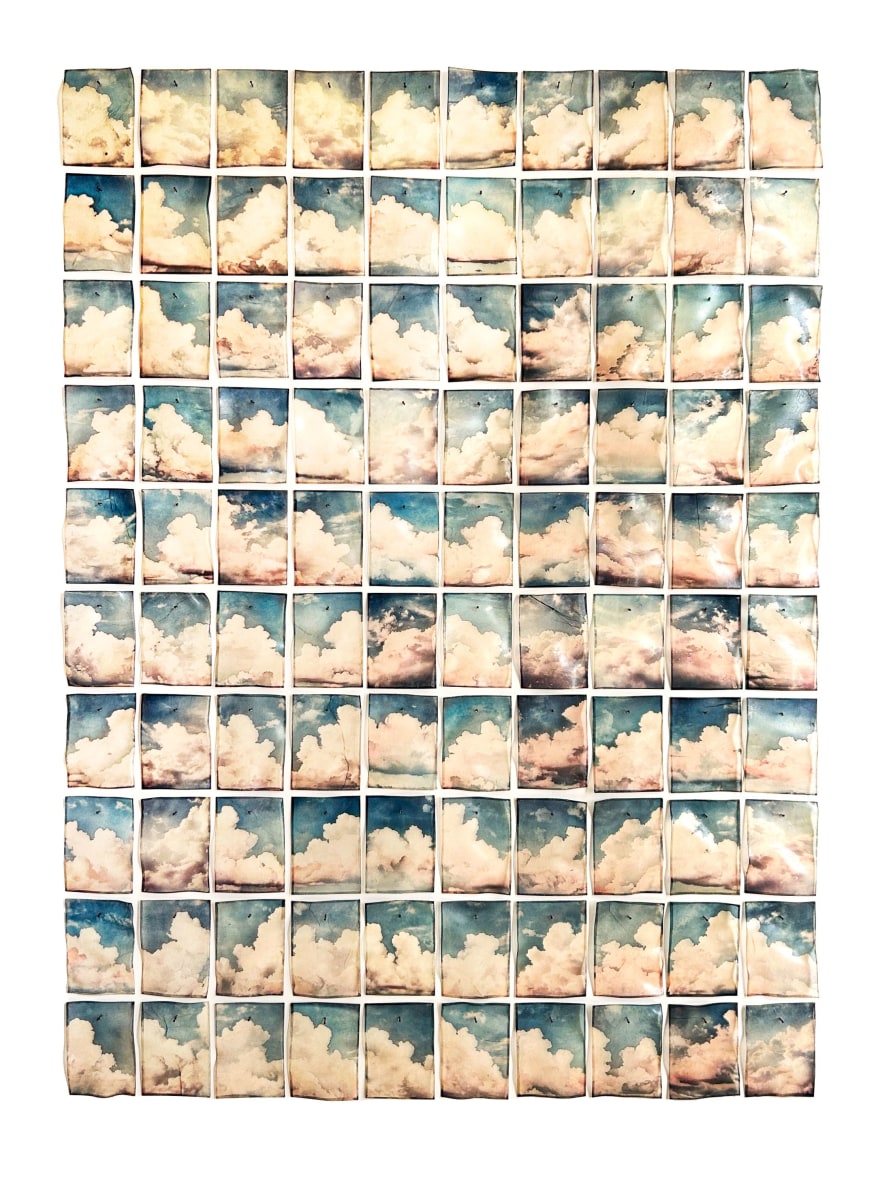
Joost Vandebrug, Clouds I, from Moment In Time, 2025, Bildhalle
Blossfeldt isolated his plants in order to document them scientifically. In what way does your way of working differ from his systematic approach?
With Blossfeldt there was a strong impulse to isolate, to organise and to make visible — the plant becomes a specimen. I find that very beautiful. For me the connection lies in that same concentration, but where he uses isolation to achieve clarity and definition I use it to make an image less fixed. In my case it does not necessarily lead to greater certainty; quite the opposite, as the closer you get the less definitive the image becomes.
My work is not about the object itself, but about perception, time, distance, fragmentation and memory. Because I work with multiple exposures of the same subject the image remains far more fluid. It does not become a single isolated object that you can study but something that gradually takes shape.
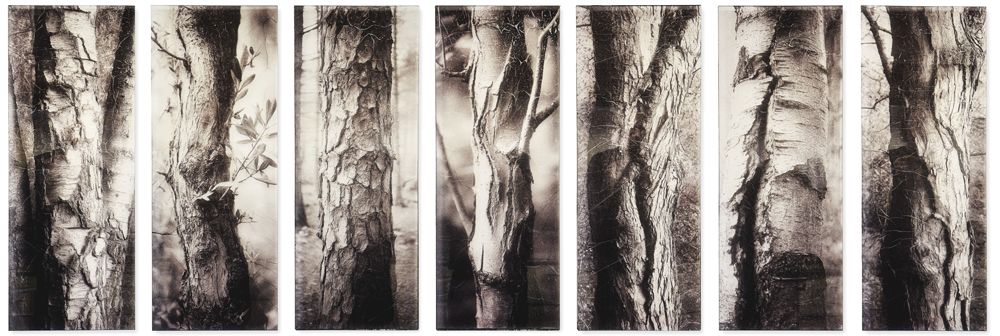
Joost Vandebrug, Vertical Forms, Group of 7 works, from (26-t1234567), 2026, Bildhalle
When did you start to collect these plants and where did you find them?
I began collecting during the pandemic in 2020. Because travelling suddenly disappeared my world became very small and I began to take that quite literally. I started looking much more closely at small plants, seeds, fragments of debris — things that normally disappear into the background. I began photographing them with a microscope. This eventually became a series that I have also exhibited, though at the time it was mainly a way of dealing with that strange stillness.
I could not even name all the plants precisely because it was less about creating a botanical catalogue than about developing a way of looking. They were often very ordinary things I found close to home — fragments from the roadside or the garden, material you would otherwise barely notice. Through the microscope they acquired something monumental. Not many of those first images ended up literally in this new series, though the foundation of the work did begin there. Above all the way of looking: slowed down, extremely close, with attention to structure and fragment. However I do not photograph as a single isolated image but through multiple images created by small shifts in distance and viewpoint, which only later begin to form a work in fragments.
You say you move through a subject "as through a puzzle". Do you already see the larger picture before you begin or does everything emerge along the way?
Everything really emerges along the way. The contours are usually already there in the sense that I know in which direction I am looking, but the real work develops very reactively. I respond to what happens during the making, to what an image begins or fails to do, and sometimes simply to the work I made just before it. One work often pushes the next in a different direction.

Joost Vandebrug, Not Yet The Image - Group of 9 works, 2026, Bildhalle
You present your work on different kinds of supports. Which material did you choose for this new series?
For this series I work among other things with emulsion transfers on handmade paper and ultrathin 5 gsm washi. The transparency of that paper makes the image very dependent on its background, on the light, and on the wall in front of which it hangs. The work therefore never fully stands on its own as the surroundings always slide into it a little. This also reflects how few images remain neutral as they are always read through their context, their environment, their moment. This work does not hide that dependency but makes it visible.
All the work begins from moments that have already passed by the time you try to hold on to them. Just like water or air, there is never really such a thing as a repeatable image as everything is constantly changing. In that sense the work is not only about capturing but also about the awareness that such a moment is already disappearing.
Are you currently working on a new project or are there plans for the future that already excite you?
When I began working on this exhibition for Bildhalle I thought it would be a good moment to bring together the past years and perhaps close something off. Yet that very process ended up opening many things instead. Seeing the work together made me realise how many new directions and layers are still present in it. What I find most beautiful now is that the attempt at finishing something ultimately became the beginning of something new. That is why the exhibition shows only new work — almost nothing that had previously been presented at an art fair or elsewhere.

Joost Vandebrug, The Sea, from Pillow Book, 2026, Bildhalle
