05 march 2026, Flor Linckens
Four artists in dialogue at Namuso Gallery
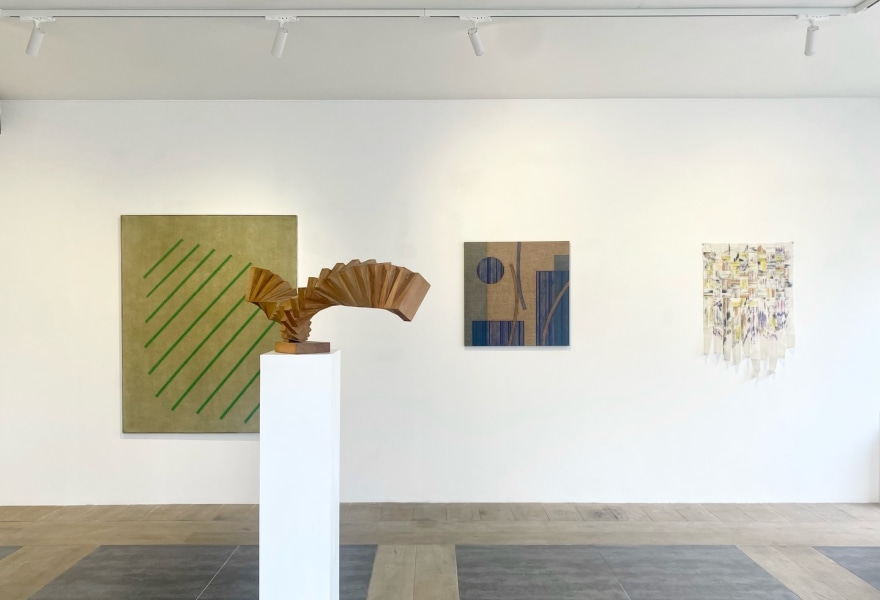
In ‘A gust of wind gives voice to the trees', Namuso Gallery in The Hague brings together four artists who at first glance seem to have little in common: a young Korean painter, a Dutch textile artist, a painter who studies grass and a Dutch abstractionist who once represented his country at the Venice Biennale. The exhibition is a collaboration between Namuso Gallery and Dürst Britt & Mayhew and was curated by Jaring Dürst Britt and Alexander Mayhew.
Wind does not appear as an explicit motif in any of the works and yet the exhibition is shaped by movement, as an invisible force that gives shape to the works. This paradox reveals something about the ability of abstract art to show more than it depicts, to evoke an experience without fixing it in place, to make the intangible and the unseen perceptible. From this perspective, a bridge emerges between East Asian minimalist traditions and European abstraction. In both contexts reduction plays an important role as a way of directing attention towards materiality, duration and presence. By placing these practices side by side, the exhibition reveals how closely related these sensibilities can be.
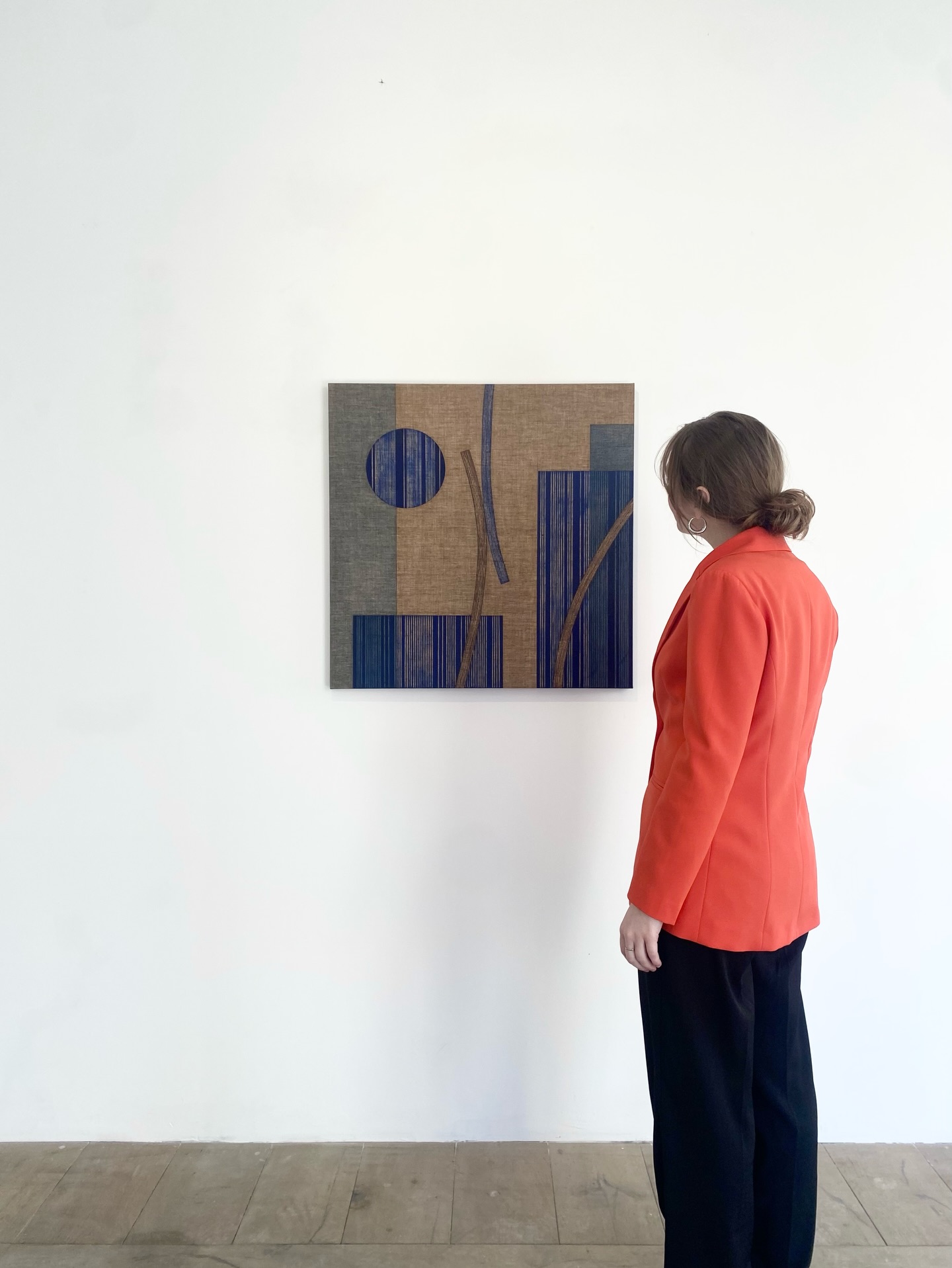
In his paintings, Lee Chae (1989, South Korea) works with oil on canvas through a process of building up and subsequently wiping away. The final image does not arise through addition but rather through what remains over time. Traces of pressure, repetition and duration settle into the surface. Lee recently presented his work in a duo exhibition with Lee Ufan at Whitestone Gallery in Hong Kong and his work has been included in the collection of the National Museum of Modern and Contemporary Art in Seoul.

The practice of Maja Klaassens (1989, New Zealand) follows a related logic. Her grass paintings do not depict a specific landscape but are constructed through careful observation and disciplined repetition. Their apparent simplicity is deceptive: the lushness and uniformity of the grass makes the works appear both realistic and slightly unreal. Klaassens studied at the Royal Academy of Art in The Hague and obtained a master’s degree in Art History from the Vrije Universiteit Amsterdam. Her work is included in the collections of Museum Voorlinden and De Nederlandsche Bank and one of her grass paintings was recently acquired by the AkzoNobel Art Foundation.
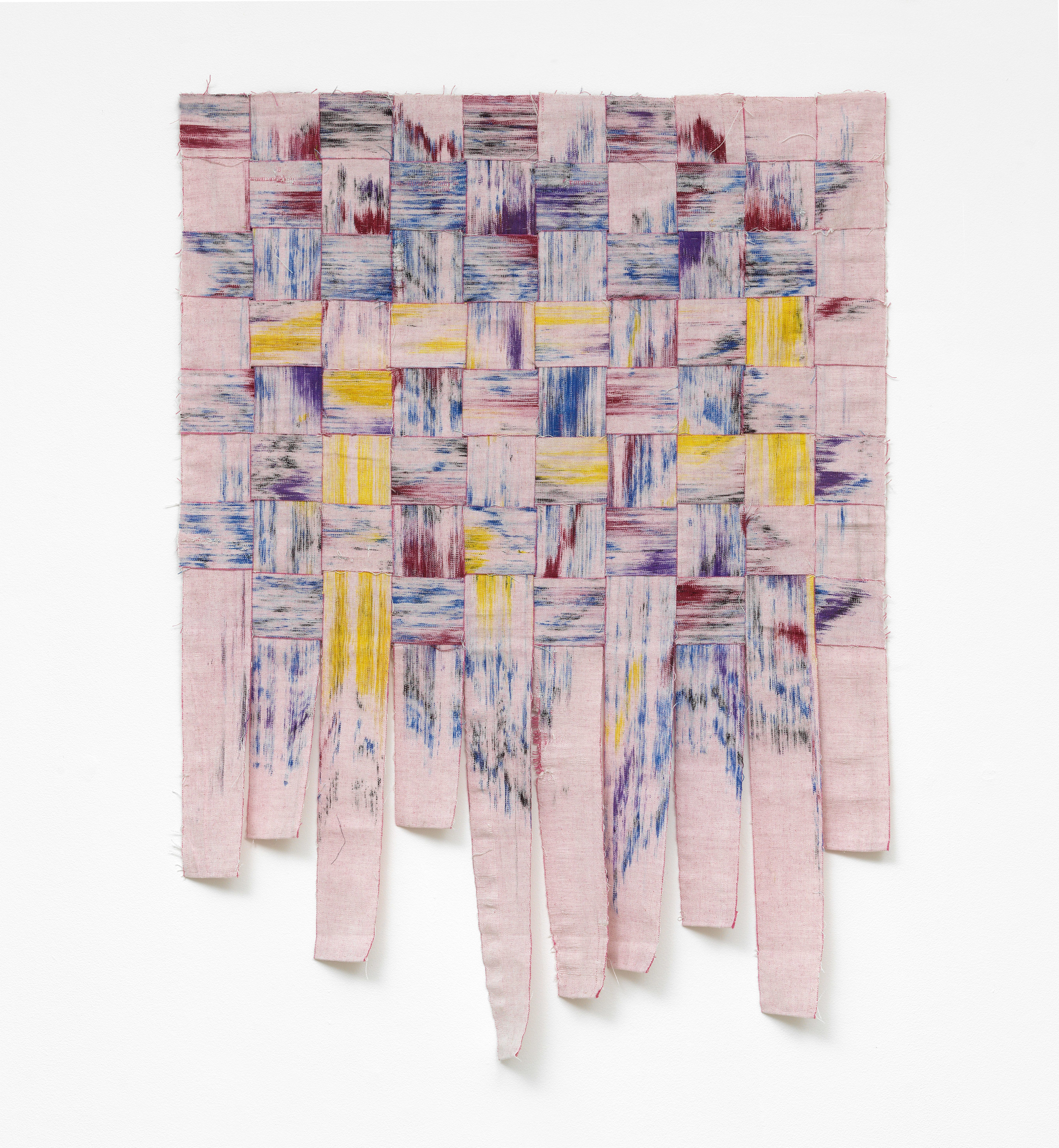
Paul Beumer (1982, The Netherlands) approaches painting from a very different material perspective. Instead of paint and canvas he works with textiles and fibres, often produced in collaboration with workshops in India and Southeast Asia. By dyeing, folding, layering and assembling fabrics, he develops a visual language in which movement becomes embedded in the material itself, with attention to the cultural, material and symbolic aspects of textile. His practice is rooted in years of living and working in various countries, including China, Nigeria, Japan, Malaysia, Sri Lanka and India, and in the knowledge of local textile traditions he encountered there. After studying at the Royal Academy of Art in The Hague, he completed a residency at the Rijksakademie van beeldende kunsten in Amsterdam. His work has previously been shown at Kunstmuseum Den Haag, the Fries Museum and Museum Kranenburgh.

Willem Hussem (1900–1974, The Netherlands) forms the historical axis around which the other three practices revolve. Within his multidisciplinary practice, he developed a form of abstraction centred on balance, tension and spatial awareness. With minimal means, the artist was able to evoke movement and atmosphere while creating a palpable sense of silence. Zen Buddhism played an important role in his thinking. Hussem represented The Netherlands at the Venice Biennale in 1960 and exhibited his work at institutions including Kunstmuseum Den Haag, Stedelijk Museum Amsterdam and Museum Boijmans Van Beuningen, which also hold his work in their collections.
