06 february 2026, Emily Van Driessen
Vertical Connections Between Earth and Sky: Besmir Latifi at Shoobil in Antwerp

“An artist is a cripple who seeks to find his missing, lost or damaged limb in the most sincere and original way possible by engraving in his character and soul the most prominent moments of pain, happiness and rage.” – Besmir Latifi
Besmir Latifi (born in Albania, lives in Antwerp, Belgium) exhibits his latest work at Shoobil in Antwerp. The exhibition is a textured telling, with paintings and sculptures showing his elegant craftsmanship, meandering painterly linework and mythical, cyclical storytelling. Steady while floating, both his paintings and sculptures are in flux while rooted in a grounded colour palette. There is an opulent symbolism and mythicism, which could lead to many interpretations. To give the viewer breathing space to roam and interpret the works freely, Latifi made the deliberate decision not to title the exhibition.
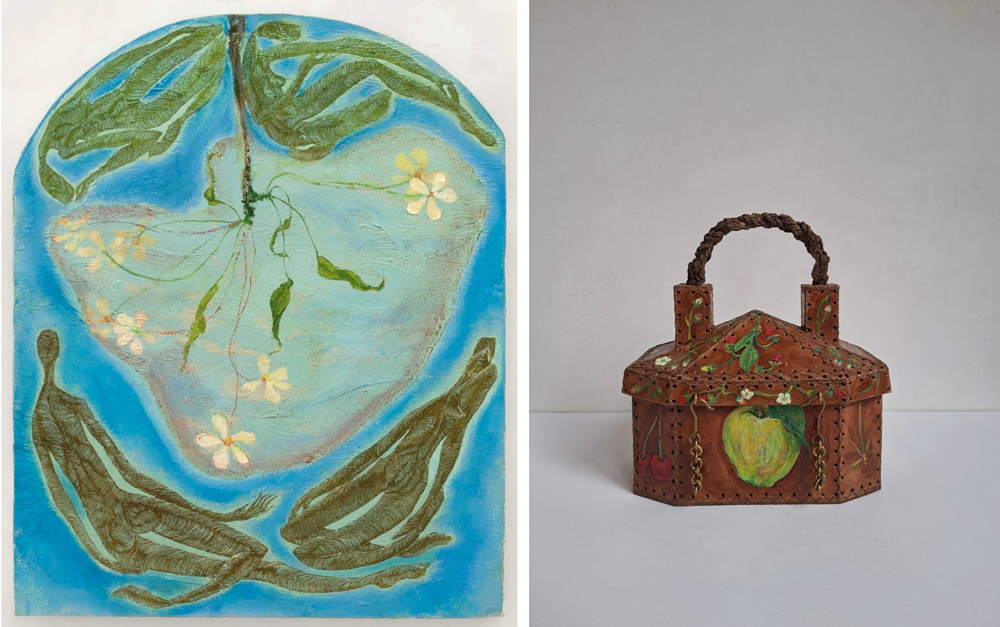
Besmir Latifi, The will, 2025 & House of life, 2026, Shoobil
His skilled, hands-on approach to material, particularly visible in his use of leather, also extends into his parallel practice as a fashion designer. Next to his artistic practice in the visual arts, Latifi also runs his own fashion label, creating unique handcrafted leather shoes and accessories.
In an interview with Gallery Viewer, the artist shares insights into his creative practice and process.
What sits at the core of your practice?
The essence of my work arises simply and fluidly from my everyday life, being interpreted through the dynamics and gestures of the images. In most cases, the frame of the painting loses its geometric shape and serves the dynamics of the painting and its expression, as I felt that my painting required a natural departure from the traditional geometric way of its form.

Besmir Latifi, Shoobil
Which experience, context or influence has shaped the way you work?
My artistic journey was born far away in my childhood, somewhere among the mountains in the north of Albania, with a very basic life between nature and people who lived by the code of honour and the hardships of a shattered state just emerging from the clutches of communism. This was the end of the decade of the 1990s, during the Balkan war, which culminated in the bombing of Serbia by NATO to stop the war in Kosovo.
My village was not far from the border with Kosovo, and one of the main roads connecting Kosovo with Albania passed through it. The weight of historical importance and great developments was strongly felt, but not understood by a child who was fascinated by seeing dozens of bomber planes passing over the mountains and tanks on the road. It was magical.
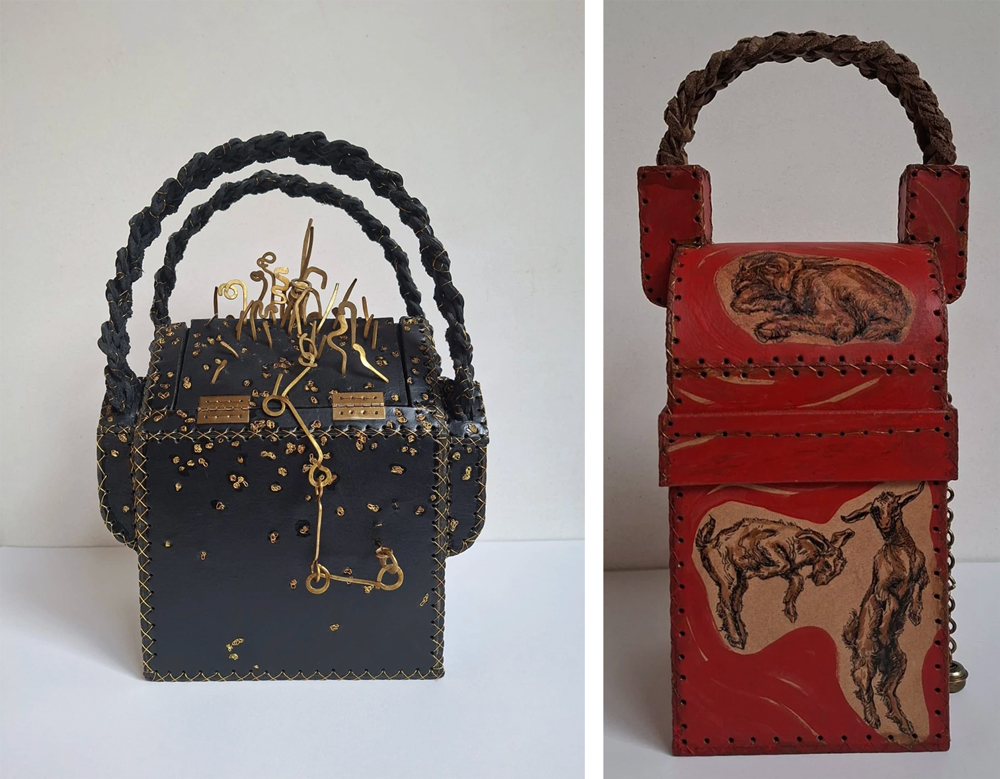
Besmir Latifi, Night prayers, 2024 & Red Goats, 2024, Shoobil
The sculptural handbags in particular are very intriguing elements in the exhibition. Can you tell us more about the roots of this concept?
They refer to the architecture of the traditional kulla houses from my childhood. Kulla literally means ‘tower’ or ‘fortress’. These stone houses, built with thick walls, were designed to protect families from invaders and to shelter them during periods of blood feuds, an honour code deeply rooted in the culture of the region. This historical weight sits at the symbolic core of my sculptural works, which carry the memory of generations who lived in these towers.
Beyond their accessorial nature, they are also emotional symbols of the human journey. They function as vertical connections between earth and sky, between protection and vulnerability. In this way, the sculptures become tangible heirlooms that celebrate the spirit of the Albanian people and their enduring connection to their architectural heritage.
Besmir Latifi’s latest work is on view at Shoobil in Antwerp until 22 February 2026.
Besmir Latifi is an Albanian-born artist based in Antwerp, working across painting, sculpture and handcrafted leather objects. His practice is rooted in a strong sense of materiality and making, shaped by both fine arts training and an ongoing engagement with fashion and leather craftsmanship. Latifi studied painting and fashion design at the University of Arts in Tirana, where he graduated top of his class, and later continued his education in fashion design at the Royal Academy of Fine Arts Antwerp. Latifi has received several awards for both his artistic and design practice, including the Shoes Award at the International Lab of Mittelmoda in 2023.
