16 january 2026, Emily Van Driessen
Fire and Eyes by Tramaine de Senna at Fred & Ferry in Antwerp
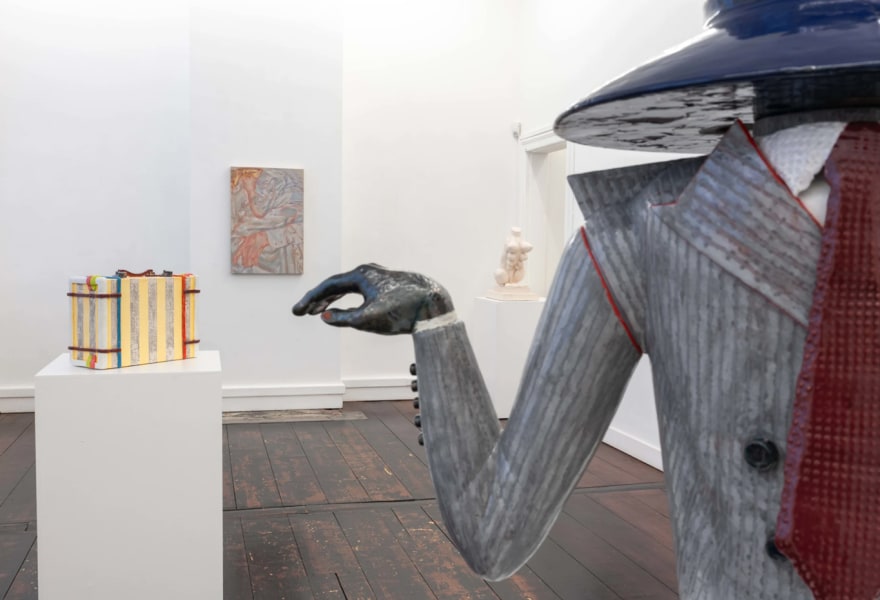
At Fred & Ferry in Antwerp, a new exhibition opens with a title that rolls off the tongue and sticks to the mind. Fire and Eyes marks the new solo presentation by Tramaine de Senna, born and raised in California and now based in Antwerp for almost a decade. de Senna is best known for her sculptural practice, shaped by material diversity and a constant negotiation with gravity and what she calls “a contest between subject and its plastic forms”. In Fire and Eyes, she brings together a group of works that have developed over extended periods of making, alongside more recent experiments.
In a conversation with the artist, she explains that the title is very intentional. “Growing up in California, before social media, information came through printed media, television or radio,” she recalls. “There was this Revlon perfume advertisement called Fire and Ice, an affordable perfume you could buy at the drugstore. Its name got stuck in my head, just like other commercial imagery and jingles from that time.”
The homophonic overlap in ice and eyes introduces an intriguing structural subcurrent for the exhibition title. “The eyes are not just receptors, but an extension of the brain itself,” de Senna explains. “Although sometimes people argue that the audience is passive, I believe people are actively viewing and making a judgement or choosing not to.”In that way, Fire and Eyes becomes a way of naming a tension she recognises as fundamental to her practice. “It relates to my creative process of being open to ideas and exploration, without restraint, but also having that moment where I have to be conscientious and follow my idea through to when it is finished.”

Tramaine de Senna, Fire and Eyes, FRED&FERRY. Photography: Lynn Van Oijstaeijen
That push and pull is inextricably present in the exhibition, bringing together older and newer works that have yet to be shown. The older works are considered older simply because they took a long time to finish. Her earlier sculptures are more fully coated and layered with glaze, whereas her newer works allow the clay to remain more exposed. Although the finish has shifted, her approach remains largely consistent. “Ceramics can also be made by pouring into moulds, or on a wheel,” she explains. “But I build every sculpture by hand.”
In doing so, she deliberately chooses to engage with gravity. One of the central sculptures in the exhibition proved a particularly demanding challenge in this respect. Fallingwater aka Cantilevered (after Frank Lloyd Wright) aka Nature Study (after Louise Bourgeois) is a work that in the first place was inspired by Louise Bourgeois’ Nature Study (1984-1998), a sculpture of a female dog without arms but with mammary glands. “Normally, when a dog is standing on its haunches, its arms project and help hold the body steady,” de Senna says. “But in this case there are no arms, so the whole torso has to cantilever out, and the centre of gravity is off balance.”

Tramaine de Senna, Full title: Fallingwater aka Cantilevered (after Frank Lloyd Wright) aka Nature Study (after Louise Bourgeois), FRED&FERRY. Photography: Lynn Van Oijstaeijen
Building such a form in clay requires not only skill, but above all time. “With handmade ceramics, you can build standing forms, but you have to build with time,” she notes. “As you build up, the clay slowly dries and it can support its own weight, which is remarkable and quite difficult to achieve.” In other materials, such results are easier to realise. “When you look at monuments in bronze, for example, it is possible to have tall statues of people sitting on horses, because everything is cast. The material is poured into a mould.”
de Senna first wanted to make Fallingwater while she was still studying, but she was told it was not physically possible. The idea remained dormant for years before fiercely resurfacing again. When the piece was finally realised, it also brought another association to mind: the house designed by Frank Lloyd Wright in the 1930s, built around a waterfall, after which the work was ultimately named. “Structurally, that project was very difficult to conceive. The house is cantilevered and appears to float, yet it is held together by a complex internal construction. It was only possible because of access to new modern technologies.”

Tramaine de Senna, Fire and Eyes, FRED&FERRY. Photography: Lynn Van Oijstaeijen
What intrigues her here is the broader drive of modernism. “There was a moment when humans made things that looked as if they could only be made by machines,” she reflects. “Whereas today, with contemporary construction, especially with modular housing, I feel that many buildings are machines built by machines.” Alongside the slow, eruptive creative process of building ceramics by hand, de Senna also presents a new body of work: drawings on primed linen. She speaks about drawing with lightness and relief. It offers an immediacy that sculpture cannot provide. Yet including these works in the exhibition did not come without hesitation.
“Seeing them exhibited for the first time, I felt very vulnerable,” she says. “Flanders has such a rich history in painting. Now that my drawings are on canvas, I’m entering into hundreds of years of artists painting and composing on canvas.” That awareness is not paralysing, but it is anxiously present. “Whenever someone is making something, each one of us is standing on the shoulders of giants.”
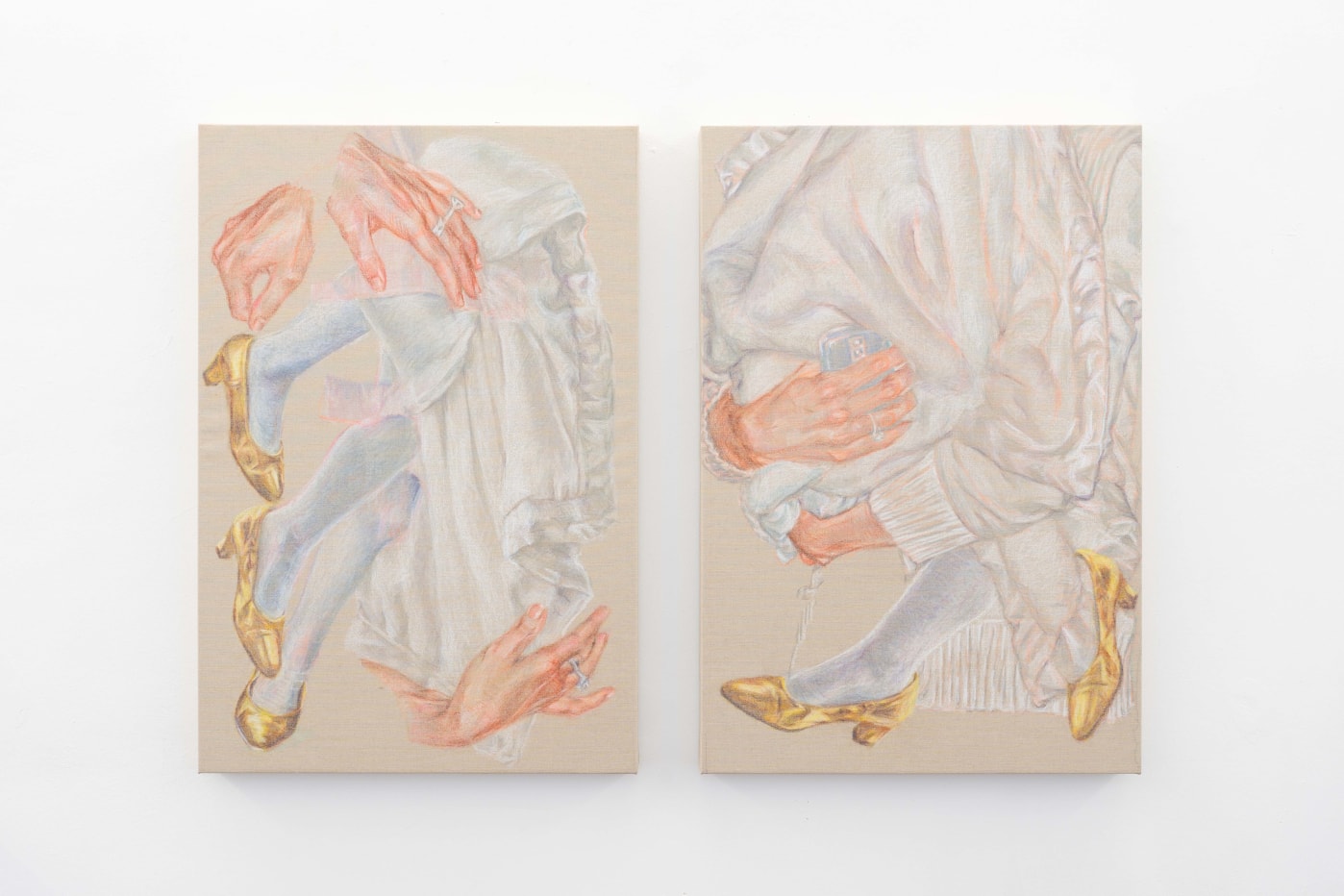
Tramaine de Senna, Gravity and Composition Rehearsal I (Three Gold Shoes), Gravity and Composition Rehearsal II (Three Gold Shoes), 2026, FRED & FERRY. Photography: Lynn Van Oijstaeijen
That duality between creation and exposure returns the text to its title, and to de Senna’s structural way of working. Fire speaks to the pleasure and urgency of making, to the deliberate process that comes with it, and to the willingness, even restlessness, to act without a fixed endpoint. Eyes mark the anticipated moment of finishing, but also of being seen, of being judged. An artist who can inhabit both states as part of the creative process, without collapsing one into the other, operates on a different level altogether, one that reaches beyond the work itself and into the realm of the sublime.
Fire and Eyes can be visited until 7 February at Fred & Ferry in Antwerp.
