02 january 2026, Emily Van Driessen
What the Body Whispers at Gallery Ysebaert
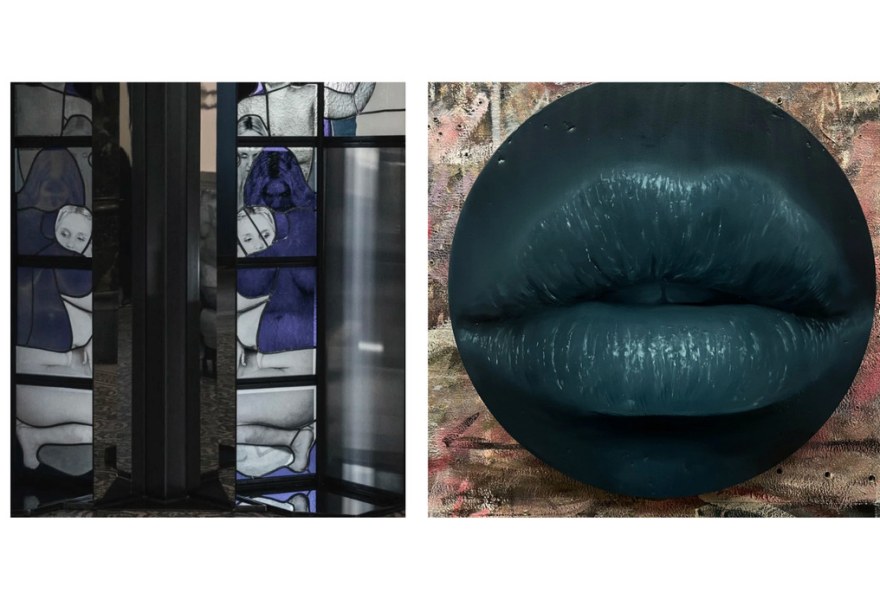
In What the Body Whispers at Gallery Ysebaert in Ghent, the body is not staged as something that announces itself loudly. It appears in fragments, in traces of presence. The exhibition brings together the work of Steven Peters Caraballo and Wolfe De Roeck, two visual artists who start from markedly different disciplines, yet meet in a shared form of bodily awareness.
Steven Peters Caraballo presents only new paintings in this exhibition, all realised in 2025. They revolve around a single recurring element: the mouth. “The works in this exhibition consist of paintings of the mouth of Charon,” he says. In Greek mythology, Charon is the old ferryman who guides souls between life and death, a figure without judgement or emotion. “For me, Charon is a senseless, silent, seductive guide,” Peters Caraballo continues. “The mouth thus becomes a site of tension between speaking and silence, between physicality and stillness.” In his paintings, the mouth is a place where speech is possible, yet restrained.
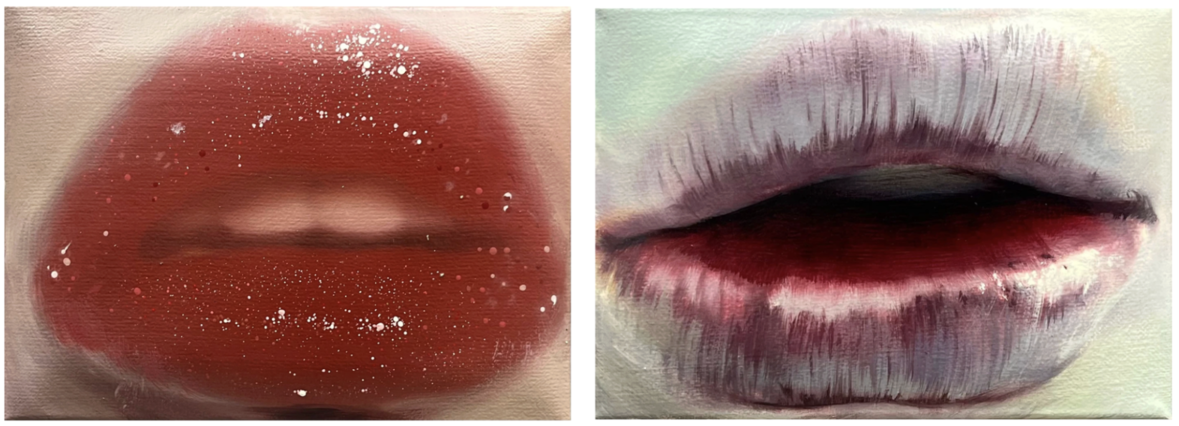
Steven Peters Caraballo, Untitled, 2025, Ysebaert Gallery
This focus on the mouth emerged during the COVID period, a time when physical contact and direct communication were abruptly restricted. “During that period, proximity and desire became something you experienced at a distance,” he says. That experience is not depicted literally in the paintings, but remains present beneath the surface. “For me, an image is never merely illustrative,” he emphasises. “It has to provoke, raise questions and not necessarily provide answers. I attach great importance to the autonomy of the viewer. The perception of an image is always subjective.”
Gradually, Peters Caraballo sees his practice shifting further towards portraiture. “I feel that in the coming years my work will develop a more pronounced and unique voice. For a long time, I deliberately kept my practice open, both technically and visually, to allow my oeuvre to grow broadly. That phase was necessary. But portraiture, for me, is one of the most difficult yet most intriguing genres. It is inexhaustible, complex and constantly changing.”
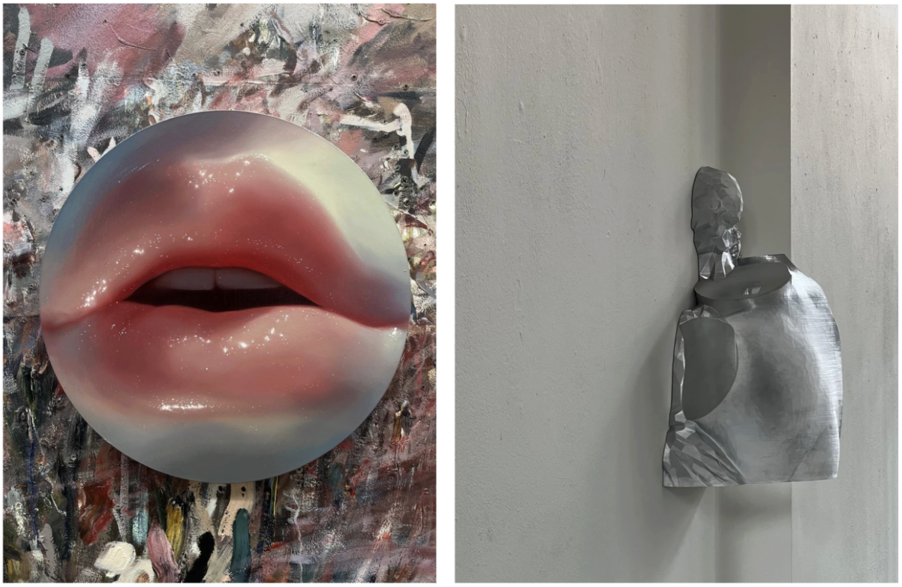
Steven Peters Caraballo, Untitled, 2025 & Wolfe De Roeck, Incomplete Venus IV (Wall piece), 2025, Ysebaert Gallery
Where Peters Caraballo approaches the body through proximity and psychological charge, Wolfe De Roeck starts from tension. Her practice operates at the boundaries of sculpture, installation and performance, and explicitly investigates the relationship between body and object. In My, I Present You, she reworks ancient Venus figures, icons of a standardised beauty ideal. “I study them at a time when the authenticity of an image can no longer be traced,” she says.
De Roeck uses materials that are also present in art history, but consciously deploys them today as mutable and unstable. “For me, making art means stripping images, situations and landscapes of their ideals so they can come closer to the viewer,” she explains. Her focus lies on the five poses of the most iconic female figures. “I merge them into an abstraction,” she says. “In doing so, I want to break through standardisation and present myself not only as a body or an object, but as a performer, with the aim of fostering a universal sense of equality.” In central works in the exhibition, moulds, measuring structures and stained-glass installations act as carriers of this investigation.

What the body Whispers,Ysebaert Gallery
For Peters Caraballo, De Roeck’s installations are not a contrast but rather an extension of his own work. “Her cool, almost detached work connects strongly, in terms of content, with my theme of the senseless, silent Charon,” he says.
In What the Body Whispers, Peters Caraballo and De Roeck present impressions of presence in which the viewer’s bodily awareness is subtly drawn in. The exhibition can be visited until Sunday 18 January at Gallery Ysebaert in Ghent.
