19 december 2025, Emily Van Driessen
Slow Movement at HILDE VANDAELE Gallery
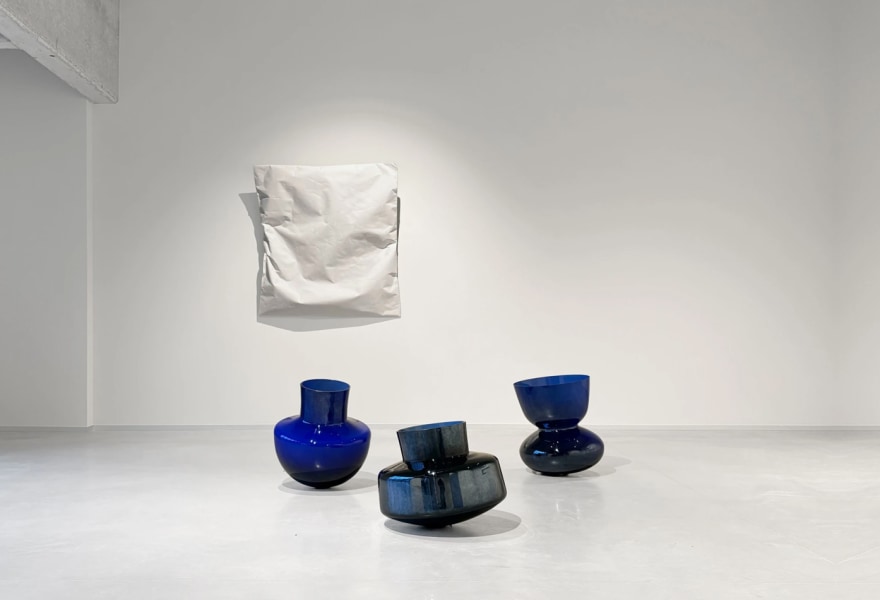
“For me, Slow Movement is about slowing time down. That deceleration creates space for focus and silence, and perhaps for truly looking, or truly feeling.” These are the words of visual artist Ilse Van Roy, who presents a duo exhibition together with Johan De Wit at HILDE VANDAELE Gallery in Kortrijk.
The exhibition has been composed with great sensitivity by gallerist Hilde Vandaele, to whom both artists have entrusted their work. Ilse shows a series of hand-blown glass objects in varying scales. “The large blue objects were made during the corona period,” she explains. “These are works I would normally realise with a team of eight people in the Czech Republic, master glassblowers from the Bohemian region with whom I have collaborated for over fifteen years to make pieces of this size.” During the pandemic, travelling was impossible, and the works were produced remotely, while contact was maintained through video calls.
Scale plays a decisive role in her way of working. “Those large blue glass objects are really a maximum size,” Ilse says. “If you ask master glassblowers to attempt that and they do not know you, they simply will not begin. For smaller glass objects, I can work with a single blower in Germany or Belgium. I do not need that large team for those.” Within her practice, differences in scale and complexity emerge, while the point of departure remains the same. Working with glass continues to rely on craftsmanship grounded in years of experience, collaboration and trust, and on knowledge that cannot easily be transferred.
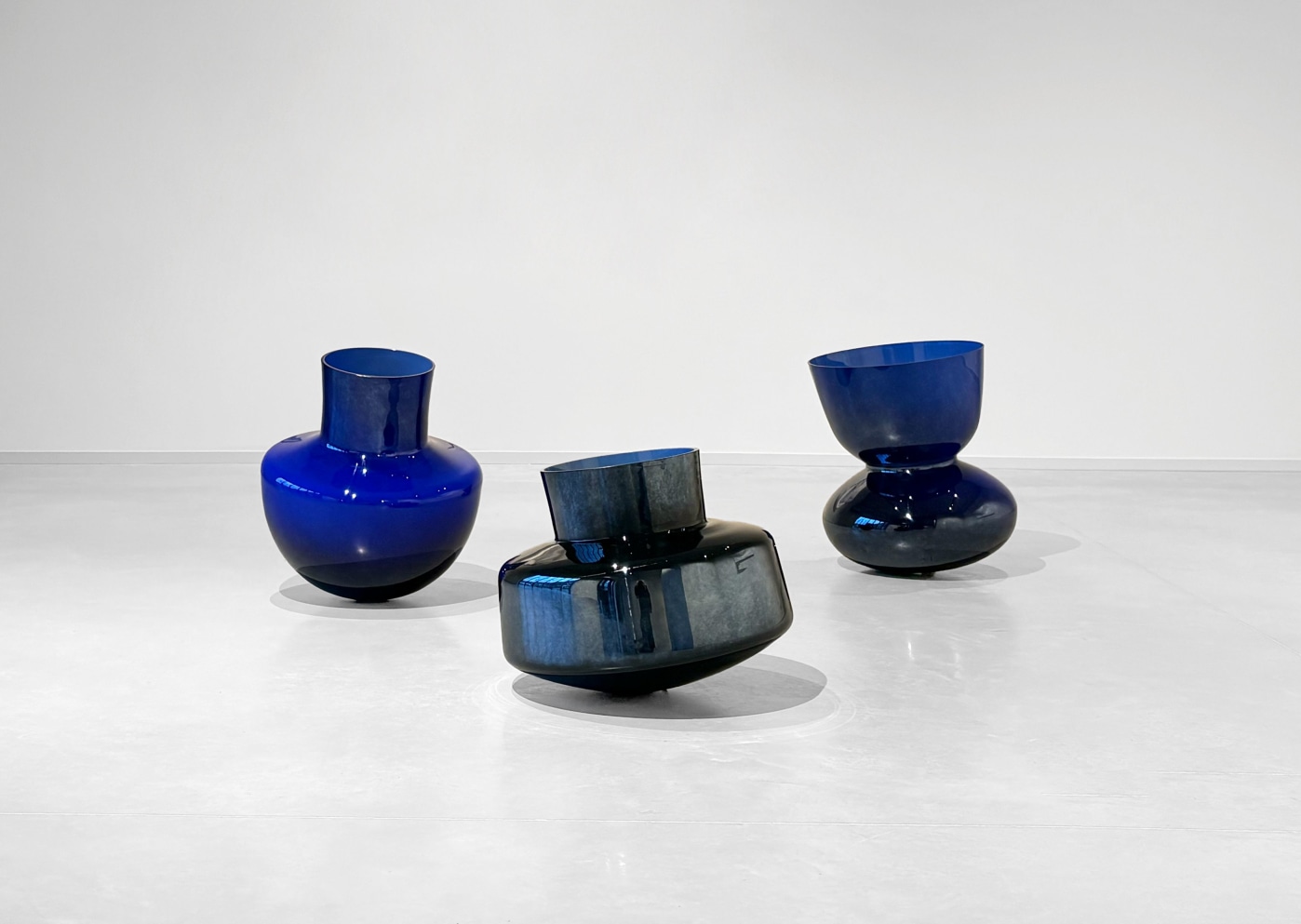
Ilse Van Roy, The three Sisters, Vida, Dana and Alina, 2022, HILDE VANDAELE Gallery
In her work, Ilse speaks of what she calls a silent encounter. “For me, it is about fragility and vulnerability,” she says, “not in the typical way we speak about glass, but much more in terms of a human condition.” She also connects this thinking to textile, a second key material in her practice. “My grandparents were master tailors, and my grandmother had a particular talent for knitting.”
Although her textile works are not shown in this exhibition, that way of thinking remains palpable in her glass objects. “Knitting means working with a single thread. If you cut it, everything unravels. Fragility is therefore fundamental.” Ilse herself works with a Brother knitting machine that has been passed down through generations.
In Johan’s work, Ilse recognises a similar sense of stillness and deceleration. “His creases resemble the pause of a movement,” she says. “He captures something that has just passed, it becomes almost photographic. Like a cushion you have just climbed out of, or the trace of an embrace you can still feel, but that cannot be held.”
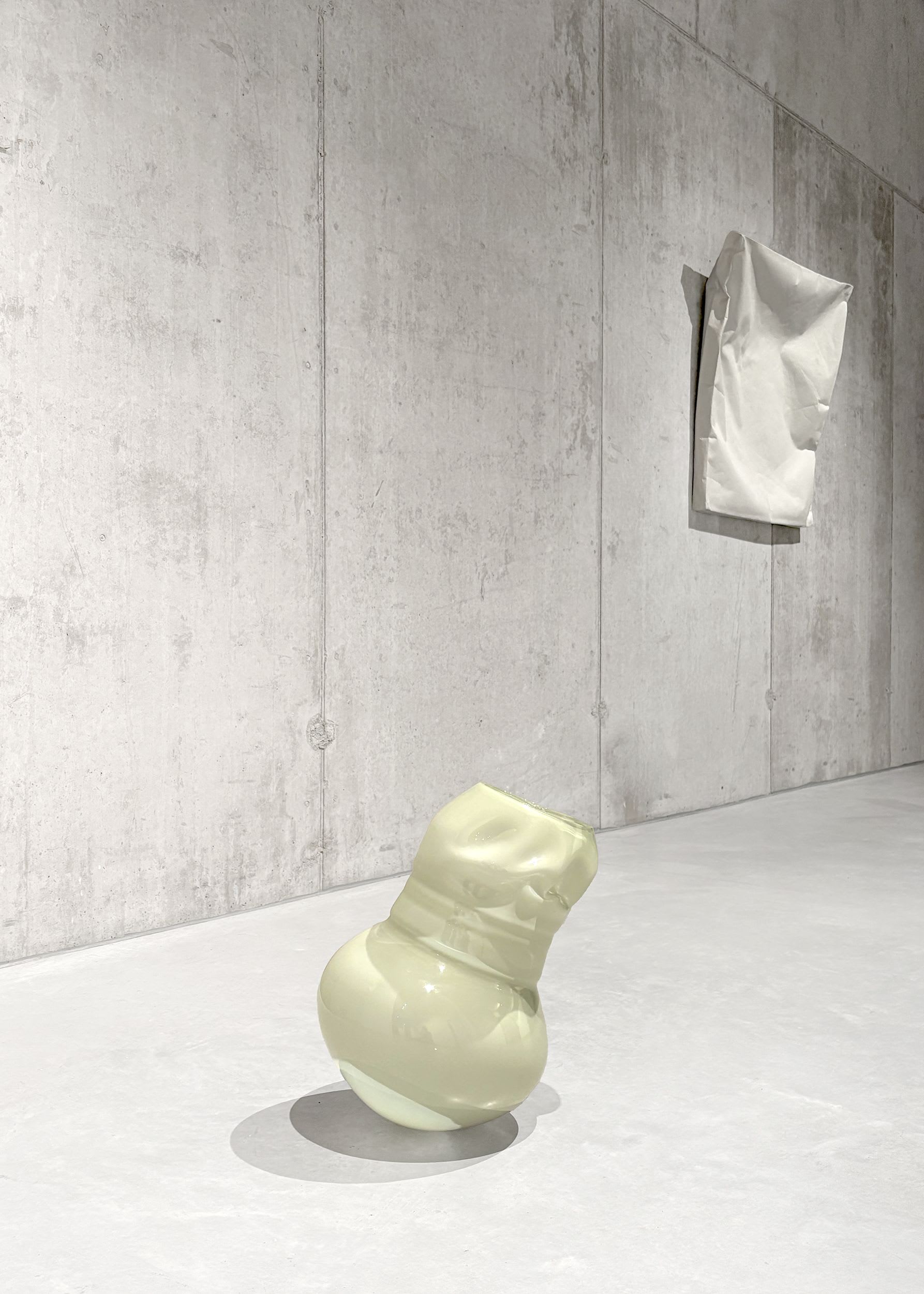
Slow Movement, Johan De Wit & Ilse Van Roy, HILDE VANDAELE Gallery
In Slow Movement, Johan’s works depart from paper. “I reinforce them with resins and pigments. As long as I am working with resin, I can create dents. Once it hardens, they remain. In that sense, it is similar to glass. At the moment it solidifies, you can no longer introduce movement.”
He also sees a resonance here with Ilse’s glass objects. “It is always about dents, bulges and creases, and also and about vanitas and ephemerality. I think Ilse and I share that attitude, finding beauty in imperfection.”
Johan’s objects are painted and sanded repeatedly, allowing traces to disappear and later re-emerge. Light falling onto these surfaces accentuates the layered quality of the material. In Slow Movement, he presents exclusively white abstract works, a deliberate choice that foregrounds stillness in his oeuvre while at the same time establishing a subtle link to the still lifes of Giorgio Morandi. “I also have a deep affection for still life, for example,” Johan says, referring to the seventeenth-century old masters. “I am indebted to art and do not allow my practice to be confined to a single form.” His oeuvre also includes sculptural objects such as bottles and jars, sober three-dimensional forms through which he continues to explore form and stillness.
This openness also shapes how he thinks about space. “I sometimes grow tired of the white box of the gallery world,” he says. In Slow Movement, the space plays an explicit role. “The gallery painted the walls grey, and one side is left as bare concrete. The elements come together beautifully, as the materiality of the space resonates with both our practices.”
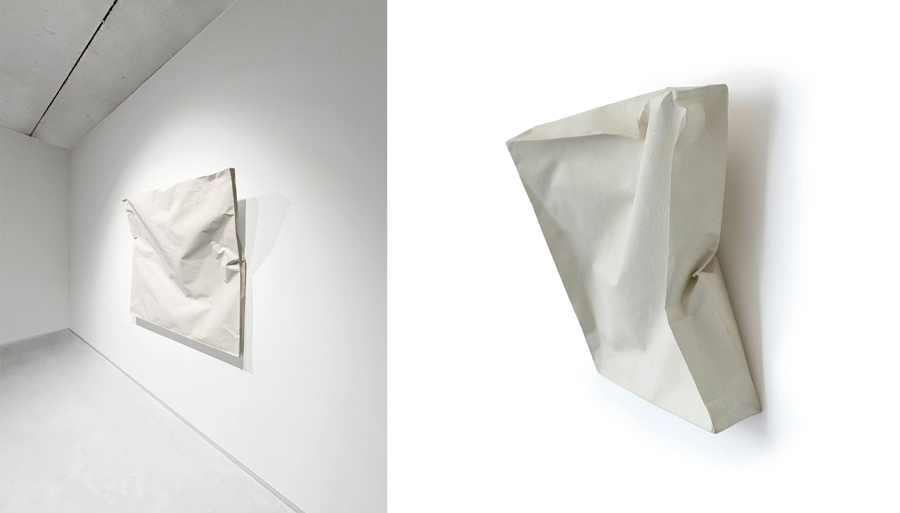
Johan De Wit, Untitled, 2024, HILDE VANDAELE Gallery
A recurring motif in Ilse’s work, one in which movement is contained, is that of the vessel, the carrier. In Johan’s work, this appears more clearly in the form of pots and bottles. “Historically, this relates to urns and vases,” Ilse says, “to holding and pouring, including water.” She refers to the figure of the water carrier. “These were people who wore beautiful garments and carried vessels of water around their necks, visiting homes to pour water.” For her, that gesture brings many things together. “The act of pouring water as a primal movement of life and care.”
The movements embedded in their works also extend beyond the objects themselves. “I experience glassblowing almost as a stage,” Ilse says. “It feels like theatre, or even dance theatre.” The work never comes into being alone; collaboration becomes almost performative. “You always need a team to realise the work: a blower, a second blower, a master blower, assistants, each with their own specific task.” The making process unfolds as a choreography in which the traditional division between subject and object, between maker and the object, dissolves.
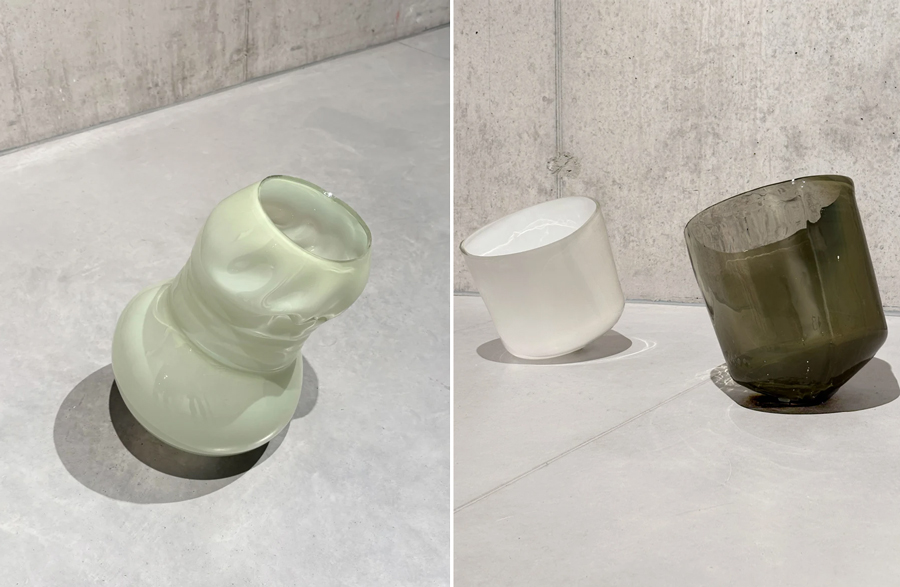
Ilse Van Roy, Pablito, 2021 & YOU and ME, 2025, HILDE VANDAELE Gallery
Slow movement also plays a central role for both artists beyond the studio. Ilse increasingly works with video and with performers who carry her objects. “The memory of the body and the memory of time are central here. I am also deeply fascinated by the slow movements of seaweed and algae under water,” she says. For Johan, a playful attitude forms an intrinsic part of his practice. “Musicians and actors do not say: I have to go to work. They say: I am going to play tomorrow. I decided never to work again. Only to play. Playing is more enjoyable.”
The exhibition Slow Movement can be visited until Sunday 18 January at HILDE VANDAELE Gallery. Please note: The gallery is closed from 20 December until 4 January, but visits during this period are possible by appointment. Afterwards, the gallery resumes its regular opening hours.
